


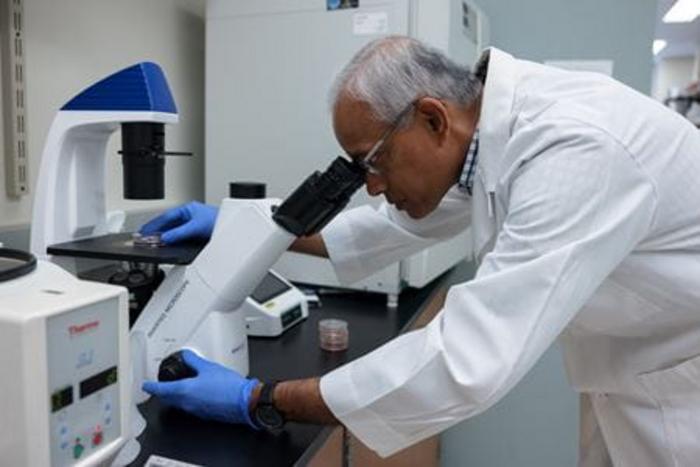
INDIANAPOLIS — Researchers at the Indiana University Melvin and Bren Simon Comprehensive Cancer Center have completed the most extensive mapping of healthy breast cells to date. These findings offer an important tool for researchers at IU and beyond to understand how breast cancer develops and the differences in breast tissue among genetic ancestries.

Credit: Photo courtesy of the IU Simon Comprehensive Cancer Center
INDIANAPOLIS — Researchers at the Indiana University Melvin and Bren Simon Comprehensive Cancer Center have completed the most extensive mapping of healthy breast cells to date. These findings offer an important tool for researchers at IU and beyond to understand how breast cancer develops and the differences in breast tissue among genetic ancestries.
Published this month in Nature Medicine, researchers developed a comprehensive atlas of breast tissue cells – including details on how genome is organized in each cell type and the effects of this genome organization on how RNA is made in each cell type to drive their function in various parts of the breast – using healthy breast tissue from women of diverse ancestry.
“Breast cancer shows variability in the outcome based on your genetic ancestry,” said Harikrishna Nakshatri, PhD, senior author of the study. “While socio-economics are certainly a contributing factor, we believe biology and ancestry also play a role. This study will help us to address that biological, ancestral aspect.”
Nakshatri is the Marian J. Morrison Professor of Breast Cancer Research at IU School of Medicine and a researcher of the Vera Bradley Foundation Center for Breast Cancer Research at the IU Simon Comprehensive Cancer Center.
Nakshatri’s lab sequenced 88,000 cell nuclei from 92 women who donated healthy breast tissue to the Komen Tissue Bank at the IU Simon Comprehensive Cancer Center. The donors included people of African, European, Indigenous American, Hispanic, East Asian, Southeast Asian and Ashkenazi-Jewish-European ancestry.
The cell mapping includes data not only on the genes expressed in various cell types, but also on how the genes are organized and what specific gene expressions are limited to each cell type. Researchers know breast cancer most often originates in specific cell types and where it originates leads to different cancer type and treatment responses. This study could improve understanding of breast cancer development and lead to identifying new treatment targets.
“This research aimed to understand the building blocks of the normal breast – meaning how many different cell types exist in the normal breast and do the building blocks of the cells show genetic ancestry-dependent variability,” Nakshatri said. “Unless we know from which cell types of the breast the cancer originates, we can’t really figure out what exactly is going wrong in breast cancer compared to the normal breast.”
Previously available research resources have used normal tissue from breast cancer surgeries and reduction mammoplasty samples. The Komen Tissue Bank, the world’s only healthy breast tissue bank, offers IU researchers a unique opportunity for this study.
“We are using tissue from women who are clinically free of breast cancer; for that reason, we do believe the data that we created are close to perfect—truly the closest you can get,” Nakshatri said. “The data we generated from this is going to stay in perpetuity because it’s going to be used by many, many groups for future research.”
The cell atlas information from the study will be broadly available to breast cancer researchers through databases offered by the National Institutes of Health, Human Cell Atlas and Chan Zuckerberg CELL by GENE Discover.
This research is the culmination of nearly five years of intense work from the Nakshatri lab and with bioinformatic analysis. Additional IU School of Medicine and IU Simon Comprehensive Cancer Center authors include Poornima Bhat-Nakshatri, Hongyu Gao, Aditi S. Khatpe, Adedeji K. Adebayo, Patrick C. McGuire, Cihat Erdogan, Duojiao Chen, Guanglong Jiang, Rana German, Lydia Emmert, George Sandusky, Anna Maria Storniolo and Yunlong Liu.
Writer: Candace Gwaltney, cmgwaltn@iu.edu
Source: Hari Nakshatri, hnakshat@iu.edu
For more news, visit the IU School of Medicine Newsroom: medicine.iu.edu/news
Follow us on X: @IUMedSchool
About the IU Simon Comprehensive Cancer Center
The Indiana University Melvin and Bren Simon Comprehensive Cancer Center is the state’s only National Cancer Institute-designated Comprehensive Cancer Center and one of only 57 in the nation. The prestigious comprehensive designation recognizes the center’s excellence in basic, clinical, and population research, outstanding educational activities, and effective community outreach program across the state. It is also one of only 33 members of the National Comprehensive Cancer Network. As a member, the center’s physicians have a role in determining the recognized standard of clinical care for cancer patients. The center is the central hub for cancer research and education across Indiana University.
About the IU School of Medicine
The IU School of Medicine is the largest medical school in the U.S. and is annually ranked among the top medical schools in the nation by U.S. News & World Report. The school offers high-quality medical education, access to leading medical research and rich campus life in nine Indiana cities, including rural and urban locations consistently recognized for livability. According to the Blue Ridge Institute for Medical Research, the IU School of Medicine ranks No. 13 in 2023 National Institutes of Health funding among all public medical schools in the country.
Journal
Nature Medicine
Article Title
Single-nucleus chromatin accessibility and transcriptomic map of breast tissues of women of diverse genetic ancestry
Article Publication Date
9-Aug-2024
Cite Scienmag News
Nathaniel Bowman. (August 12, 2024). Comprehensive atlas of normal breast cells offers new tool for understanding breast cancer origin. Scienmag. https://scienmag.com/comprehensive-atlas-of-normal-breast-cells-offers-new-tool-for-understanding-breast-cancer-origin/
Nathaniel Bowman. "Comprehensive atlas of normal breast cells offers new tool for understanding breast cancer origin." Scienmag, 12 August 2024, https://scienmag.com/comprehensive-atlas-of-normal-breast-cells-offers-new-tool-for-understanding-breast-cancer-origin/. Accessed 4 September 2026.
Nathaniel Bowman. "Comprehensive atlas of normal breast cells offers new tool for understanding breast cancer origin." Scienmag. August 12, 2024. https://scienmag.com/comprehensive-atlas-of-normal-breast-cells-offers-new-tool-for-understanding-breast-cancer-origin/

