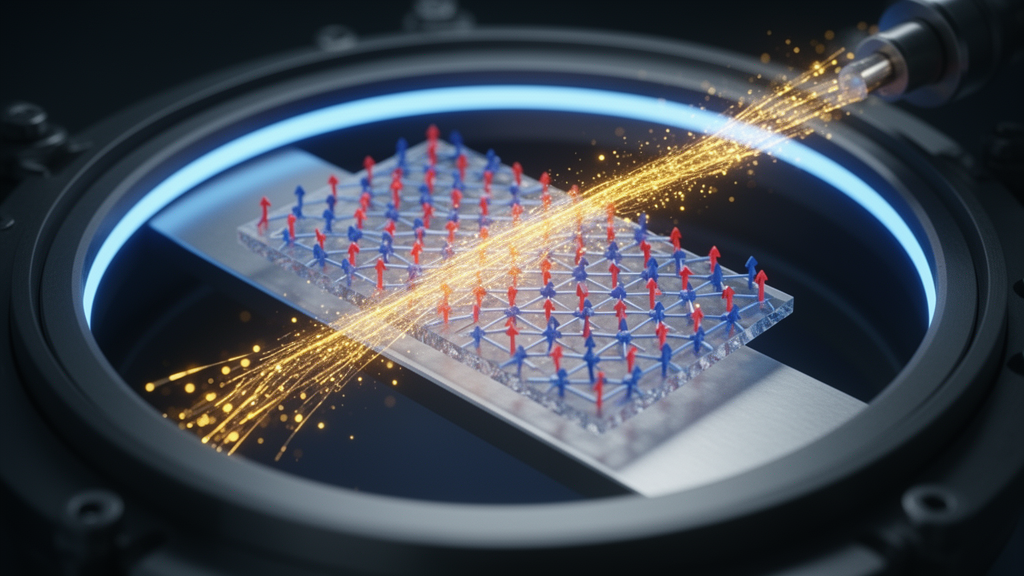
Physicists have demonstrated that a magnet with no net magnetization can electrically inject spin currents into a non-magnetic channel, a result that challenges the long-standing assumption that ferromagnets are needed for this task. The team, led by researchers including Jone Mencos, Helena Reichlova and Fèlix Casanova, used Mn5Si3, a compensated magnet, in lateral spin-valve devices and detected the injected spins at a spatially separated ferromagnetic electrode. The work, published in Nature on 28 October 2026, provides experimental evidence that spintronic functionality can be achieved without net magnetization.
Spintronics, the field in which information is carried and manipulated using the electron spin rather than solely the electrical charge, relies on the generation and transport of spin currents. Conventionally, electrical spin injection has depended either on ferromagnets, in which the spin polarization originates from a net magnetization, or on relativistic effects such as the spin Hall effect. The new experiment shows that Mn5Si3, a compensated magnet whose net magnetization vanishes, can serve as a spin injector, with the magnetic order of the material itself controlling the spin current.
A key finding is the time-reversal-symmetry-breaking nature of the injection. When the researchers switched Mn5Si3 between its two time-reversed magnetic states, the detected spin signal reversed. This demonstrates that the spin injection breaks time-reversal symmetry, a behaviour that distinguishes it from conventional ferromagnetic and spin-Hall injection. The effect was observed for two distinct electrical-biasing geometries, providing a characteristic signature that the authors say differs from those established mechanisms.
The interpretation draws on the altermagnetic order of Mn5Si3. Altermagnets are materials in which spin-polarized currents can arise despite the absence of net magnetization. Symmetry analysis, first-principles calculations and spin-transport modelling carried out by the team, including theorists such as Libor Šmejkal, Olena Gomonay and Jairo Sinova, indicate that the observations are consistent with this altermagnetic phase. The first-principles calculations yield spin polarizations of 6.5 to 10 percent, values the authors note are comparable to those of conventional ferromagnets, while the spin-transport modelling of the experiments indicates spin diffusion lengths of 50 to 130 nanometres.
The experimental platform was a lateral spin-valve geometry, in which spins are electrically injected from Mn5Si3 into a non-magnetic channel and detected at a ferromagnetic electrode placed some distance away. The measurements were performed at 100 K, and the reported figures for spin polarization and diffusion length come from calculations and modelling rather than direct measurement, so they represent the theoretical framework consistent with the observed signals rather than independently measured device parameters.
Because the injected spin signal reverses when the magnetic state of Mn5Si3 is switched between time-reversed configurations, the magnetic order of the injector acts as a control over the spin current. This is the defining feature highlighted in the study: a compensated magnet can generate spin currents controlled by its magnetic order, and the altermagnetic properties of Mn5Si3 enable this functionality without net magnetization. The demonstration covers two distinct electrical-biasing geometries, both of which showed the same symmetry-breaking signature.
The authors state that their results provide experimental evidence for this compensated-magnet spin injection and demonstrate the spintronic functionality enabled by the altermagnetic properties of the material. As with any newly reported device physics, the findings are based on the specific lateral spin-valve devices and conditions described in the paper, and the quantitative spin polarizations and diffusion lengths are those obtained from the accompanying calculations and transport modelling.
Subject of Research: Spin injection from the compensated altermagnet Mn5Si3 in lateral spin-valve devices
Article Title: Time-reversal-symmetry-breaking spin injection from a compensated magnet
Article References: Mencos, J., Badura, A., Dolan, E., Beckert, S., González-Hernández, R., Sigales, N., Kokkeler, T., Kounta, I., Petit, M., Guillemard, C., Hellenes, A. B., Campos, W., Rial, J., Kriegner, D., Baltz, V., Hueso, L. E., Sinova, J., Bergeret, F. S., Gomonay, O., … Casanova, F. (2026). Time-reversal-symmetry-breaking spin injection from a compensated magnet. Nature. https://doi.org/10.1038/s41586-026-11227-7
Image Credits: AI Generated
DOI: 10.1038/s41586-026-11227-7
Keywords: spintronics, spin currents, altermagnets, Mn5Si3, compensated magnet, time-reversal symmetry, spin injection, lateral spin valve, spin diffusion length, Nature, Time-reversal-symmetry-breaking, spin
Cite Scienmag News
Katie Riggs. (October 29, 2026). Compensated magnet delivers spin currents without net magnetization. Scienmag. https://scienmag.com/compensated-magnet-delivers-spin-currents-without-net-magnetization/
Katie Riggs. "Compensated magnet delivers spin currents without net magnetization." Scienmag, 29 October 2026, https://scienmag.com/compensated-magnet-delivers-spin-currents-without-net-magnetization/. Accessed 30 October 2026.
Katie Riggs. "Compensated magnet delivers spin currents without net magnetization." Scienmag. October 29, 2026. https://scienmag.com/compensated-magnet-delivers-spin-currents-without-net-magnetization/