

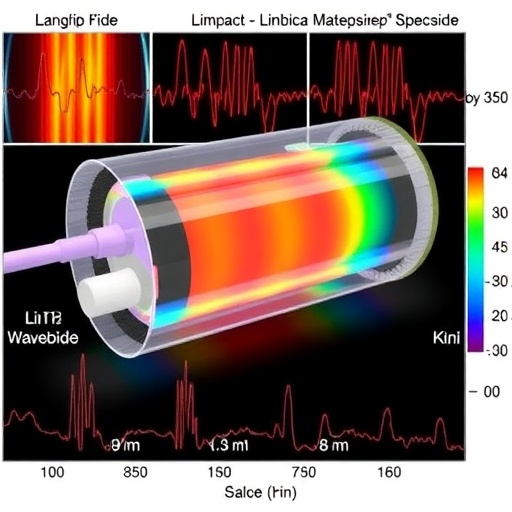
In a groundbreaking development that promises to revolutionize terahertz (THz) spectroscopy, researchers have unveiled a compact and highly efficient THz absorption spectrometer based on a lithium niobate (LiNbO3) slot waveguide. This innovative approach opens new horizons for miniaturized sensing technologies across a wide array of scientific and industrial applications, offering unprecedented control over THz radiation in a chip-scale device. The breakthrough, published in Light: Science & Applications, is poised to advance the frontiers of terahertz science, a rapidly evolving field that bridges electronics and photonics.
Terahertz waves, occupying the electromagnetic spectrum between microwaves and infrared light, have long fascinated scientists because of their unique interactions with matter. These frequencies are particularly sensitive to molecular vibrations and rotational transitions, making them ideal for chemical identification and nondestructive material inspection. However, conventional THz spectroscopy apparatuses are often bulky, sensitive to environmental noise, and lack integration capabilities, limiting their widespread adoption. The novel LiNbO3 slot waveguide device addresses these challenges head-on by offering a compact, robust, and integratable platform for THz absorption spectroscopy.
At the heart of this technology lies the clever use of a lithium niobate slot waveguide, a nanophotonic structure that directs and confines THz waves within a narrow gap—termed a “slot”—embedded in high-quality LiNbO3 crystal. This crystalline material is renowned for its strong electro-optic properties, low loss in the THz range, and compatibility with established fabrication techniques. By engineering the waveguide dimensions carefully, the researchers were able to maximize the overlap between the guided THz mode and the sample to be analyzed, substantially enhancing the interaction length and thus the absorption sensitivity.
One of the key technical hurdles overcome by this design was achieving an optimal balance between confinement and propagation loss. In conventional waveguides, tighter confinement usually leads to higher loss due to scattering and absorption at the waveguide boundaries. The slot waveguide approach, by contrast, uses the high refractive index contrast between the LiNbO3 and the air-filled slot to confine the electric field predominantly within the slot itself, minimizing losses while preserving strong field-sample interaction. This novel mode profile design is a critical enabler for the device’s impressive sensitivity.
Experimental validation revealed that the LiNbO3 slot waveguide spectrometer could reliably detect the characteristic THz absorption signatures of various molecular gases and liquids with remarkable precision. The team demonstrated capacity for precise absorption measurements of low-concentration analytes, even at room temperature, underscoring its practicality for real-world sensing applications. This achievement is vital for sectors ranging from environmental monitoring and homeland security to pharmaceutical quality control and biomedical diagnostics.
Moreover, the device’s design permits integration with existing photonic circuitry and electronic systems, opening the door for on-chip THz spectroscopy solutions. The compact footprint, combined with potential for mass production, suggests future portable and handheld spectrometers that can deliver laboratory-grade sensitivity and accuracy outside specialized facilities. This could dramatically democratize access to terahertz sensing capabilities, fueling innovation in consumer electronics, industrial process monitoring, and beyond.
The researchers also explored the tunability of the LiNbO3 slot waveguide system by modifying the slot width and waveguide geometry. These adjustments permit fine control of the spectral response, allowing the device to be tailored for specific spectral regions within the THz band. Such adaptability is critical as applications diverge in their wavelength requirements—for example, discriminating complex biomolecules versus detecting hazardous compounds in the field.
Underpinning the device’s functionality is lithium niobate’s intrinsic electro-optic nonlinearity, which can be exploited to generate and modulate THz waves efficiently. In this platform, the team successfully leveraged these properties for active tuning and signal enhancement. Active control mechanisms embedded in the waveguide circuitry could facilitate dynamic spectral scanning and real-time adaptation to changing measurement conditions—a significant leap forward compared to passive, fixed-frequency THz devices.
The integration of lithium niobate with slot waveguide technology marks a convergence of material science and photonic engineering. The superior crystal quality of LiNbO3 ensures minimal signal degradation, while precise nanofabrication techniques enable reproducible waveguide geometries at the submicron scale. This synergy ensures device performance stability and robustness, essential for practical deployment in various environmental conditions.
Future developments are expected to focus on combining this waveguide design with on-chip THz sources and detectors, propelling fully integrated spectroscopic systems toward reality. Such advancements could enable rapid chemical fingerprinting in situ, with applications spanning forensic analysis, food safety evaluation, and even real-time monitoring of industrial chemical reactors. The marriage of high sensitivity and compactness in this device represents a pivotal innovation in THz technology.
Additionally, researchers are investigating the use of this platform for nonlinear THz optics, exploiting the strong field confinement within the slot to generate higher harmonic signals and facilitate ultrafast spectroscopy studies. The unique electromagnetic environment within the slot waveguide offers a fertile testing ground for fundamental physics as well as new sensing paradigms.
The work also highlights the promise of tailoring the waveguide interface with functionalized coatings or integrating microfluidic channels within the slot region to enable selective molecular capture and enhanced absorption specificity. Such hybridization could lead to a new class of smart sensors capable of identifying complex mixtures or trace contaminants directly.
In conclusion, the compact THz absorption spectrometer realized with a lithium niobate slot waveguide embodies a transformative step toward accessible, sensitive and integrated terahertz spectroscopy. By uniting material advantages with innovative waveguide architecture, it overcomes longstanding barriers of size, sensitivity, and integration. As this technology matures, it is poised to unlock new applications and stimulate further research in the multidisciplinary arena of photonics, materials science, and chemical sensing.
This pioneering effort vividly demonstrates the power of combining cutting-edge nanofabrication with optimal material choices to harness the enigmatic terahertz spectrum for practical, impactful uses. The implications of compact, high-performance THz absorption devices stretch far beyond academic curiosity, hinting at a future where terahertz spectroscopy is a ubiquitous tool for science and technology.
Subject of Research: Terahertz absorption spectroscopy using a lithium niobate slot waveguide for compact and integratable sensing devices.
Article Title: Compact THz absorption spectroscopy using a LiNbO3 slot waveguide.
Article References:
Sung, E.R., Nelson, K.A. Compact THz absorption spectroscopy using a LiNbO3 slot waveguide.
Light Sci Appl 15, 47 (2026). https://doi.org/10.1038/s41377-025-02105-4
Image Credits: AI Generated
DOI: 10.1038/s41377-025-02105-4 (Published 04 January 2026)


