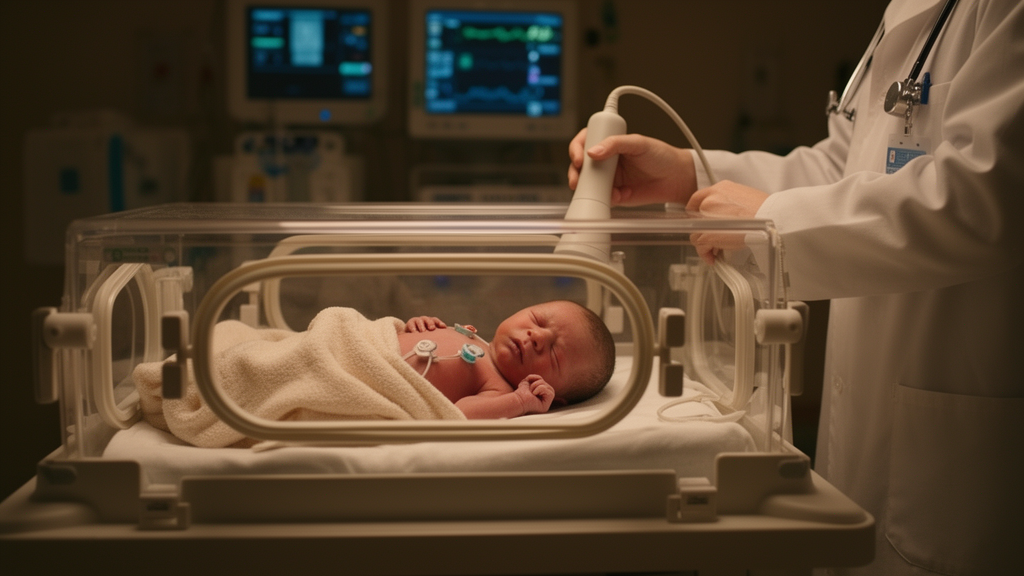
Neonates whose cranial ultrasound shows isolated subependymal echogenicity—a bright area near the ventricles suspicious for a small hemorrhage—were the focus of a retrospective single-center cohort study now published in Frontiers in Human Neuroscience. The study reviewed 317 neonates admitted between January 2015 and December 2018 whose initial ultrasound finding was suspicious for isolated subependymal hemorrhage, and it examined how clinical and imaging findings related to recorded mortality and cerebral palsy.
The researchers reviewed clinical records, available MRI findings, and follow-up information for the cohort. Cerebral palsy was ascertained from rehabilitation or neurology diagnostic records, supplemented by telephone follow-up conducted in January 2026, independently of developmental test scores. This approach was designed to capture persistent clinical diagnoses rather than to grade developmental performance.
Across the cohort, there were 52 deaths, representing 16.4 percent of the 317 neonates. Among survivors, 9 infants had recorded cerebral palsy, or 2.8 percent, while 256 survivors, or 80.8 percent, had no recorded cerebral palsy. MRI findings were compatible with hemorrhage in 61 of the 90 infants examined, a proportion of 67.8 percent.
The primary adjusted analysis compared infants who died with all survivors. The model used an exploratory six-item comorbidity count together with clinical covariates; hospitalization duration was excluded from the model, and laterality was coded simply as unilateral or bilateral. The analysis was restricted to complete cases, giving a sample of 316 infants for the mortality model.
In that complete-case model, each additional comorbidity was associated with greater odds of death, with an adjusted odds ratio of 2.462 and a 95 percent confidence interval of 1.787 to 3.391, at a p value below 0.001. The other covariates included in the model were not statistically significant. The authors emphasize that systemic comorbidity burden was associated with mortality within this ultrasound-defined cohort.
White matter abnormalities were recorded in nine infants in the cohort. Notably, eight of those nine infants were among the nine survivors with recorded cerebral palsy, and the remaining one infant was a survivor without recorded cerebral palsy. The study describes this observation as descriptive, noting that white matter abnormalities accompanied most recorded cerebral palsy cases but that the finding does not establish a causal relationship.
The authors are careful to frame the scope of what the study can and cannot show. Specialist diagnostic records and the later telephone follow-up characterize persistent clinical diagnoses, but they do not establish the independent effect of subependymal echogenicity itself, nor do they establish normal development across all domains in survivors without recorded cerebral palsy. Because the cohort was defined by an initial ultrasound finding suspicious for isolated subependymal hemorrhage, the results speak to outcomes within that ultrasound-defined group rather than to the effect of the echogenicity finding in isolation.
The retrospective, single-center design is a further limitation, as the cohort consisted of neonates admitted to one hospital over a four-year window. The comorbidity count used in the mortality model was explicitly exploratory, and the coding choices—such as excluding hospitalization duration and collapsing laterality into unilateral versus bilateral—shaped the adjusted analysis. Readers should therefore interpret the odds ratio as an association observed within this specific cohort rather than a generalizable causal estimate.
Within those boundaries, the study offers a structured picture of outcomes for neonates with this ultrasound finding: most survivors had no recorded cerebral palsy, MRI confirmed findings compatible with hemorrhage in a majority of those imaged, and accumulating systemic comorbidity stood out as the factor associated with mortality. The descriptive link between white matter abnormalities and recorded cerebral palsy may guide future follow-up of similar cohorts, while the authors’ stated caveats underline that the independent contribution of subependymal echogenicity to long-term outcomes remains an open question.
Subject of Research: Clinical and imaging outcomes in neonates with isolated subependymal echogenicity on cranial ultrasound
Article Title: Imaging findings and clinical outcomes in neonates with isolated subependymal echogenicity on cranial ultrasound: a retrospective cohort study
Article References: Xiang, Y., Chen, J., Huang, S., Shi, H., Li, X., Jiang, J., & Zhang, X. (2026). Imaging findings and clinical outcomes in neonates with isolated subependymal echogenicity on cranial ultrasound: a retrospective cohort study. Frontiers in Human Neuroscience, 20, Article 1945002. https://doi.org/10.3389/fnhum.2026.1945002
Image Credits: AI Generated
DOI: 10.3389/fnhum.2026.1945002
Keywords: neonates, cranial ultrasound, subependymal hemorrhage, subependymal echogenicity, cerebral palsy, mortality, MRI, white matter abnormalities, comorbidity, retrospective cohort, brain imaging, Imaging
Cite Scienmag News
Ophelia Keating. (October 28, 2026). Comorbidity burden tied to mortality in neonates with subependymal ultrasound findings. Scienmag. https://scienmag.com/comorbidity-burden-tied-to-mortality-in-neonates-with-subependymal-ultrasound-findings/
Ophelia Keating. "Comorbidity burden tied to mortality in neonates with subependymal ultrasound findings." Scienmag, 28 October 2026, https://scienmag.com/comorbidity-burden-tied-to-mortality-in-neonates-with-subependymal-ultrasound-findings/. Accessed 28 October 2026.
Ophelia Keating. "Comorbidity burden tied to mortality in neonates with subependymal ultrasound findings." Scienmag. October 28, 2026. https://scienmag.com/comorbidity-burden-tied-to-mortality-in-neonates-with-subependymal-ultrasound-findings/