


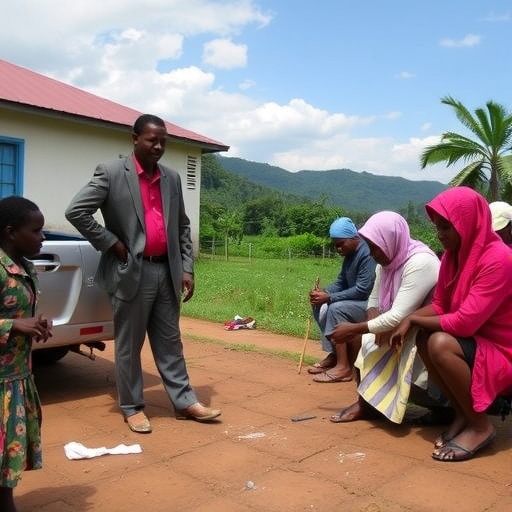
The Democratic Republic of the Congo is battling the seventeenth Ebola outbreak in its recorded history, and the figures arriving from the country’s east are stark by any measure. As of August 4, 2026, health authorities had confirmed 3,973 cases of Ebola virus disease, together with 1,801 deaths and 776 recoveries, spread across 51 health zones in five provinces. In a single 24-hour period, the surveillance system registered 99 new cases and 52 deaths. Yet a new commentary published in the journal New Microbes and New Infections argues that the most consequential number in this epidemic is none of these. It is 75 percent — the proportion of known contacts of confirmed cases who are currently being traced and followed up. That figure sits well below the 95 percent target that outbreak scientists regard as necessary to interrupt transmission chains quickly, and its authors, Abdullahi Abdisalam Mohamed and Mohamed Mustaf Ahmed, contend that the gap will not be closed by vehicles, smartphones and staffing rosters alone. The deficit, they write, is a measure of something far harder to procure: community trust.
The commentary centers on the joint call issued on August 6 by the World Health Organization and the Africa Centres for Disease Control and Prevention for an urgent scale-up of community-led action against the outbreak, which began in Ituri Province in May 2026. The call emphasizes measures that are technically beyond reproach: early recognition of symptoms, meticulous contact follow-up, infection prevention and control in health facilities, and support and protection for frontline health workers. The authors do not quarrel with the science behind any of them. Their claim is colder and more uncomfortable. In a region where confidence in health institutions has been repeatedly damaged — by decades of conflict, chronic marginalization and bruising earlier encounters with external responders — these measures will fail to translate into containment unless they are paired with a deliberate, adequately resourced strategy for rebuilding community trust. Technical packages, the argument runs, do not implement themselves. People carry them out: villagers who report a sick neighbor, families who consent to isolation, survivors who return to work in treatment centers. Cooperation on that scale cannot be requisitioned. It has to be earned.
The reasoning rests on the unforgiving mechanics of Ebola containment. The disease is caused by ebolaviruses that spread through direct contact with the blood and bodily fluids of infected people, and patients become most infectious once symptoms appear — which is exactly when contact tracing becomes the central defensive maneuver. For every confirmed case, investigators must reconstruct everyone the patient may have exposed while ill, then monitor each of those contacts for 21 days, the outer limit of the virus’s incubation period, so that anyone who develops symptoms can be isolated before passing the infection on. The arithmetic is brutal. Every contact who is never found is an unlit fuse: a potential seed of an entirely new transmission chain that will surface only weeks later, when it has already branched beyond easy reach. This is why the 95 percent follow-up target exists. At that level of coverage, the network of transmission remains visible enough to be severed quickly. At 75 percent, roughly a quarter of the network is effectively invisible — moving, breathing and, in some fraction of cases, silently transmitting.
A shortfall of that magnitude, the commentary notes, is rarely attributable to logistical capacity alone. Here the authors reach back to the country’s 2018 to 2020 epidemic in North Kivu and Ituri — the second largest Ebola outbreak ever recorded — in which more than 450 acts of violence or threats against health workers were documented. Treatment centers were attacked, contact-tracing teams were driven out of neighborhoods, and rumors spread that the response itself was a political scheme or even a source of the disease. A review of that epidemic’s humanitarian approach concluded that a heavily biomedical strategy which sidelined community grievances tended to generate precisely this kind of resistance, which then undermined the follow-up work on which containment depended. The response began to gain traction only when strategic plans were revised to place community engagement, logistics and security on an equal footing with clinical measures — not as accessories to the medical operation, but as structural pillars of it.
The contrast with Uganda’s handling of its own 2026 Ebola event is instructive, though the authors are careful to frame it as a comparison rather than a transferable template. Following its outbreak declaration, Uganda recorded only 20 confirmed cases and two deaths before declaring the end of transmission on July 28 — an outcome attributed in part to early detection, coordinated national action and trusted community engagement. The virus there was met by surveillance that caught it early, a public that largely cooperated with contact-finding, and institutions that could mobilize without having to fight suspicion at every turn. The scale of the current DRC epidemic, the armed insecurity that constrains movement across five provinces, and the accumulated institutional distrust in the affected region differ substantially from the Ugandan context, and this difference, the commentary argues, explains much of the divergence in outcomes. Identical protocols do not produce identical epidemics. The social substrate on which a pathogen spreads helps determine how far and how fast it travels.
Research from the earlier Congolese epidemic adds depth to that claim. Community-based surveillance systems developed during the 2018 to 2020 outbreak demonstrated that early and consistent community involvement can strengthen both disease detection and access to care, and that this involvement was a critical factor in local acceptance of response activities. Networks of teachers, traditional healers and village volunteers learned to flag suspicious illness long before a sample ever reached a laboratory, buying the response its most precious commodity: time. At the same time, a review of the broader humanitarian approach delivered a more critical verdict, questioning how far affected communities were genuinely brought into decision-making rather than simply consulted after national and international actors had already set the direction of the response. Other observers have gone further, noting that what looked to outsiders like irrational resistance to Ebola control often reflected a coherent response to decades of conflict, marginalization and prior encounters with external actors — an “epidemic of suspicion,” as one analysis memorably put it, in which refusal was less a misunderstanding of the science than a rational reading of lived history.
The costs of that suspicion are now visible in the geometry of the current response. Treatment center occupancy in North Kivu has reportedly reached 139 percent of capacity — a figure with clinical and social consequences in equal measure. Overcrowded facilities strain infection prevention and control: triage slows, suspected and confirmed cases risk being held in close proximity, and the odds of transmission inside the very institutions meant to stop it rise. Staff working under acute pressure face exhaustion and error, and these dangers compound one another. The perception matters as much as the reality. When families hear that treatment centers are overflowing, and when they associate those places with fear rather than care, patients arrive late or not at all — dying at home, where they continue to expose relatives and neighbors and seed further chains of infection. The authors argue that expanding bed capacity and clinical supplies is necessary but unlikely to be sufficient. The lesson of earlier outbreaks, they write, is that trust is not a byproduct of an effective response but a precondition for one, and that resourcing decisions should be judged in part by whether they visibly address the everyday concerns of affected communities, not only the epidemiological indicators that responders track.
From this diagnosis the commentary draws three operational conclusions. First, the 95 percent contact follow-up target should be treated as a diagnostic of community relations as much as of operational capacity: when the figure stalls, the response in the affected health zones should review its engagement practices, not merely hire additional staff. Second, resources directed toward frontline health workers should be paired with visible, near-term benefits for host communities, following the precedent of the cash-for-work and infrastructure programs that appeared to improve acceptance of the response during the 2018 to 2020 outbreak — an acknowledgment that communities asked to shoulder the burdens and risks of containment are entitled to returns they can see and judge for themselves. Third, evaluations of the current response, including those conducted jointly by the WHO and Africa CDC, should report indicators of community trust and engagement alongside case counts and mortality figures, so that the balance between biomedical and social investment can be assessed transparently as the outbreak evolves.
That final recommendation carries the commentary’s sharpest edge. Calls for community-led action, the authors warn, risk remaining rhetorical — repeated with each new outbreak while the metrics by which responses are judged remain exclusively clinical and epidemiological. What gets measured gets funded and managed; if trust is never quantified, it will always lose the budget line to another shipment of protective equipment. The proposal to place engagement indicators beside case counts is an attempt to make the social dimension of outbreak response auditable — to subject community relations to the same transparency routinely applied to bed occupancy, laboratory turnaround times and mortality ratios.
For now the seventeenth outbreak continues to expand, and every day of 75 percent contact follow-up leaves a quarter of the transmission network unmonitored. The commentary ends not with a technical prescription but with a reframing: epidemics such as this one are social events as much as biological ones, and the pathogen’s arithmetic runs through human decisions — whether to answer the door to a tracing team, disclose a contact, carry a fevered relative to a treatment center, or trust the strangers in protective equipment who arrive at the village edge. The DRC’s health authorities and their international partners have pledged resources. The question the authors pose to them is whether those resources will purchase the one commodity that, in every previous Congolese epidemic, separated containment from catastrophe.
Cite Scienmag News
Kristina Jarvis. (August 30, 2026). Community trust, not funding alone, will decide DRC’s seventeenth Ebola outbreak. Scienmag. https://scienmag.com/community-trust-not-funding-alone-will-decide-drcs-seventeenth-ebola-outbreak/
Kristina Jarvis. "Community trust, not funding alone, will decide DRC’s seventeenth Ebola outbreak." Scienmag, 30 August 2026, https://scienmag.com/community-trust-not-funding-alone-will-decide-drcs-seventeenth-ebola-outbreak/. Accessed 3 September 2026.
Kristina Jarvis. "Community trust, not funding alone, will decide DRC’s seventeenth Ebola outbreak." Scienmag. August 30, 2026. https://scienmag.com/community-trust-not-funding-alone-will-decide-drcs-seventeenth-ebola-outbreak/


