


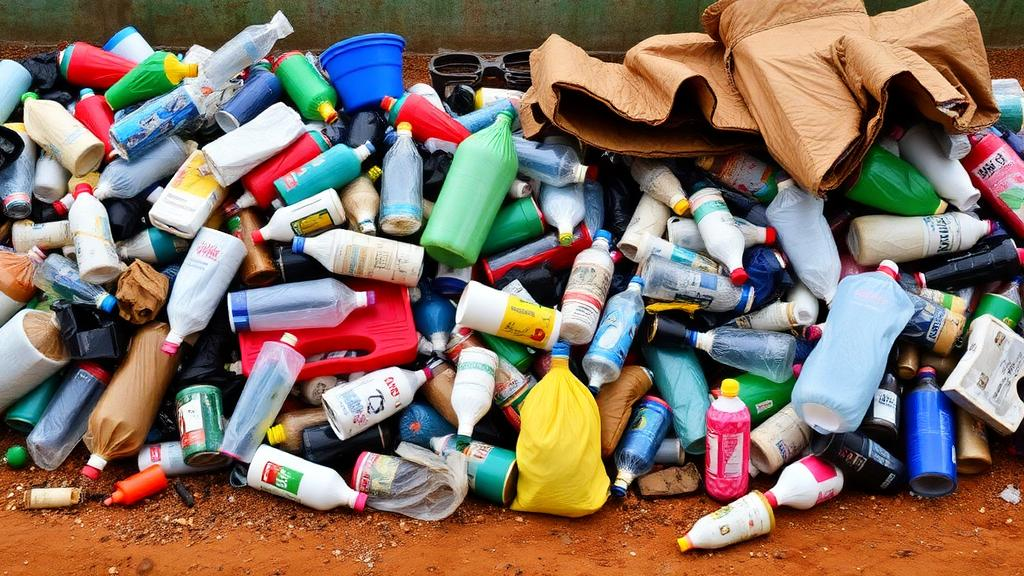
In the hills of Nagaland, a state in northeastern India where tribal traditions once sustained a nearly waste-free way of life, plastic packaging has quietly rewritten the rules of daily living. A new mixed-methods study published in Environmental and Sustainability Indicators suggests that the key to changing how residents handle plastic waste lies not in teaching them to care about the environment, which they already do, but in mobilizing the community institutions that shape what their neighbours expect of them. The finding challenges one of the most common assumptions in environmental psychology and could reshape how waste interventions are designed across the developing world.
The research, led by Prabhakar Sharma and Gyanendra Nath Tiwari, surveyed 226 residents across three Nagaland districts, Kohima, Dimapur, and Chümoukedima, spanning urban, semi-urban, and rural settings. The team anchored their work in the Theory of Planned Behaviour, a widely used psychological framework holding that behaviour flows from three conscious drivers: attitude toward the act, perceived social pressure from others, and perceived behavioural control, the sense that one is able to carry out the behaviour. To this classic trio the researchers added measures of cultural values and perceptions of policy and governance, and they paired the survey with open-ended questions and ten in-depth interviews to capture what residents themselves saw as the real obstacles.
The quantitative results were striking in their asymmetry. Respondents scored highest on items measuring environmental concern and personal responsibility: agreement that plastic waste harms the environment averaged 4.77 on a five-point scale, that reducing plastic use is necessary averaged 4.58, and that one feels personally responsible for proper disposal averaged 4.38. Yet the subscale measuring perceived behavioural control, covering access to disposal points, confidence in segregating waste at home, and the availability of affordable alternatives, was the weakest of all, averaging just 2.97. In other words, people knew the problem was real and felt it was theirs to solve, but they did not feel equipped to act.
When the researchers ran a hierarchical multiple regression to see which constructs actually predicted self-reported waste-management behaviour, the pattern upended expectations. Subjective norms, the perception of what neighbours, friends, and the community expect and practice, emerged as by far the strongest predictor, with a standardized coefficient of 0.485. Cultural values contributed next, at 0.251, followed by attitude at 0.186. Perceived behavioural control, the variable that classical theory often casts as decisive, contributed essentially nothing once the other factors were accounted for, with a coefficient of negative 0.023 and a p-value of 0.661. Although control showed a small bivariate correlation with behaviour, that association was entirely absorbed by its overlap with subjective norms. The final model explained 44.5 percent of the variance in self-reported practice.
Just as telling was what did not matter. Adding residents’ perceptions of policy and governance, whether the plastic ban was enforced, whether government was managing waste efficiently, whether public information was adequate, improved the model by exactly nothing, a change in explained variance of zero with a p-value of 0.908. Residents clearly viewed enforcement as weak: agreement that the plastic ban was strictly enforced averaged only 2.85, and belief in efficient government management averaged 2.88. But those dim views of the state did not independently predict what people actually did with their plastic. The machinery of governance, in this setting, appears to shape behaviour only indirectly, if at all.
The qualitative strand of the study filled in the human texture behind these numbers. Among roughly 131 open-ended survey responses, the most frequently cited barrier to proper disposal was lack of awareness and education, named by 67 percent, followed by inadequate infrastructure and facilities at 58 percent and weak enforcement at 32 percent. In the separate interview sample, infrastructure deficits and the absence of plastic-specific traditional beliefs were rated as very high intensity themes, raised unprompted by eight or more of the ten participants. One interviewee captured a widespread mindset bluntly: people consider all waste equal, so everything belongs in the same bin. Traditional Naga practices, built around biodegradable materials and low-waste living, simply never developed categories for a plastic-dominated waste stream.
When the researchers integrated the two strands of evidence, the most revealing result was a divergence rather than an agreement. Infrastructure was overwhelmingly salient in how residents talked about the problem, yet individually perceived control carried no unique statistical weight in the regression. The authors propose, cautiously, that infrastructure may operate less as a direct constraint on individual action and more as a structural condition that shapes community norms and expectations, so that where collection points are absent, responsible disposal simply never becomes a shared local standard. That mediational hypothesis could not be tested with the study’s cross-sectional design, but it offers a concrete target for future longitudinal research.
The theoretical implications extend beyond Nagaland. The Theory of Planned Behaviour is a deliberative-reasoning model, assuming that people weigh attitudes and consequences before acting. A growing literature argues that everyday waste disposal is often habitual, cued by routine and context rather than conscious reflection, and the survey instrument used here was not designed to detect such automatic processes. The authors also flag social-desirability bias as a risk, since normatively loaded items about responsibility and cleanliness may inflate self-reports, and they acknowledge that the attitude and cultural values subscales showed weak internal consistency, with Cronbach’s alpha values of 0.35 and 0.46 respectively, well below conventional thresholds. The cultural values finding, they stress, should be read as a promising but tentative extension rather than an established determinant, particularly because exploratory factor analysis showed some of its items blending into the subjective norms factor.
For policy, the practical message is unambiguous. Awareness campaigns alone are unlikely to close the gap between what people believe and what they do, because belief is not the binding constraint. Instead, the authors argue, interventions should centre community-based and norm-oriented strategies, enlisting the village councils, religious organisations, and youth groups that already function as trusted arbiters of local expectation. Respondents themselves pointed in the same direction: awareness and education campaigns were the most frequently proposed solution, cited by 72 percent of open-ended respondents and 90 percent of interviewees, followed by better infrastructure at 53 and 70 percent respectively, and stricter enforcement at 38 and 60 percent. Ideas such as plastic buy-back schemes, subsidies for reusable alternatives, and regular community clean-up days surfaced repeatedly.
The study has clear limits. Its sample, recruited through stratified quotas combined with convenience sampling, skewed young and male, with roughly half of respondents under 25, and all behaviour measures were self-reported rather than validated against observed practice or objective infrastructure audits. The cross-sectional design forbids causal claims, and two exploratory moderation tests, whether residential area or cultural values changed the strength of other predictors, failed to reach significance. Still, the core result stands as a genuinely useful contribution: in a collectivist, community-governed society, the strongest lever for changing plastic behaviour is not the individual conscience but the collective gaze. If Nagaland’s village councils and youth groups begin treating segregation as a shared expectation rather than a private virtue, the plastic choking its urban slopes may finally have somewhere to go other than the open fire.
Subject of Research: Psychosocial and cultural determinants of plastic waste management behaviour in Nagaland, India
Article Title: Psychosocial, cultural, and structural determinants of plastic waste management practices in Nagaland, India: A mixed-methods study using the theory of planned behaviour
Article References: Sharma, P., & Tiwari, G. N. (2026). Psychosocial, cultural, and structural determinants of plastic waste management practices in Nagaland, India: A mixed-methods study using the theory of planned behaviour. Environmental and Sustainability Indicators, 32, Article 101539. https://doi.org/10.1016/j.indic.2026.101539
Image Credits: AI Generated
DOI: 10.1016/j.indic.2026.101539
Keywords: plastic waste, Nagaland, theory of planned behaviour, subjective norms, waste management, mixed methods, environmental psychology, cultural values, India, recycling, community governance, developing countries
Cite Scienmag News
Sloane Callahan. (October 2, 2026). Community Norms, Not Personal Control, Drive Plastic Waste Habits in Nagaland. Scienmag. https://scienmag.com/community-norms-not-personal-control-drive-plastic-waste-habits-in-nagaland/
Sloane Callahan. "Community Norms, Not Personal Control, Drive Plastic Waste Habits in Nagaland." Scienmag, 2 October 2026, https://scienmag.com/community-norms-not-personal-control-drive-plastic-waste-habits-in-nagaland/. Accessed 4 October 2026.
Sloane Callahan. "Community Norms, Not Personal Control, Drive Plastic Waste Habits in Nagaland." Scienmag. October 2, 2026. https://scienmag.com/community-norms-not-personal-control-drive-plastic-waste-habits-in-nagaland/


