


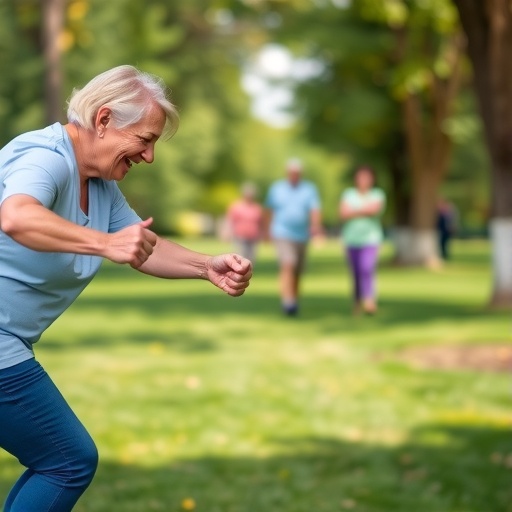
Falls among older adults represent a significant public health challenge globally, often resulting in detrimental outcomes such as fractures, loss of independence, and increased mortality. In recent years, the use of walking frames has become a prevalent support mechanism for individuals prone to instability and falls. However, despite these aids, fall incidents remain a major concern. A groundbreaking study published in BMC Geriatrics in 2026 titled “Frame fit: safety, acceptability and effectiveness of a community-based fall prevention exercise intervention for walking frame users” presents a comprehensive randomized controlled trial that evaluates a novel intervention aimed at reducing falls in this vulnerable population. This research explores the integration of exercise programs specifically designed for walking frame users in community settings, examining not only the safety and acceptability of the program but also its effectiveness in mitigating fall risks.
The underpinning rationale for this intervention stems from the complex interplay of diminished balance, muscular strength, and coordination experienced by walking frame users. Traditional fall prevention strategies often overlook these nuances, treating this group broadly without specialized tailoring. The study’s design incorporates a multidimensional exercise regimen, emphasizing balance retraining, muscle strengthening, and confidence building, all adapted to the distinct biomechanical and psychological profiles of walking frame users. The researchers meticulously crafted the intervention to be deliverable within the community, thereby enhancing accessibility and adherence while simultaneously reducing healthcare system burden.
In terms of methodology, this randomized controlled trial enrolled a substantial cohort of walking frame users recruited from various community centers and clinics. Participants were randomly assigned to either the intervention arm, where they engaged in the fall prevention exercise program, or a control group receiving standard care without targeted exercise guidance. Over the trial period, an array of outcome measures was tracked, including frequency of falls, balance performance assessments, physical function indices, and user-reported quality of life metrics. Importantly, safety was rigorously monitored to ensure the intervention did not inadvertently increase fall risk or cause injuries.
One of the critical elements informing the exercise protocol was the integration of motor learning principles tailored to the challenges unique to walking frame users. This included repetitive, task-specific exercises aimed to enhance neuromuscular control, improve proprioceptive feedback, and foster adaptive movement strategies. The intervention deliberately accounted for variability in individual functional status and cognitive ability, providing scalable and customizable sessions. This flexible approach proved vital in maintaining high levels of participant engagement and minimizing dropout rates, a common hurdle in geriatric exercise programs.
The data emerging from the trial revealed compelling evidence of the intervention’s positive impact. Participants in the exercise group exhibited a statistically significant reduction in fall incidence compared to controls, alongside marked improvements in balance and mobility scores. Notably, the intervention also facilitated enhanced confidence in daily ambulation, a psychological component frequently underappreciated yet pivotal in preventing falls caused by fear-induced gait alterations or activity avoidance. These multifaceted benefits position the program as a promising model for widespread implementation.
Acceptability of the program was systematically evaluated through qualitative feedback and structured questionnaires. Participants consistently endorsed the program’s relevance, accessibility, and perceived value, highlighting how community-based delivery fostered social engagement and provided motivational support. The study underscored the importance of incorporating user-centered design principles when developing interventions for older adults reliant on walking aids, emphasizing empathy, respect, and empowerment throughout the process.
Safety monitoring throughout the study was paramount, given the elevated risk profile of walking frame users. The trial reported no intervention-related adverse events, affirming the robust safety profile of the exercise regimen. This aspect is particularly significant as healthcare providers often hesitate to prescribe exercise for this population out of concern for exacerbating fall risk. The findings challenge such apprehensions and advocate for proactive physical activity promotion tailored to assistive device users.
From a broader perspective, the implications of this research extend beyond immediate fall prevention. Enhanced physical function and mobility achieved through such exercise interventions have been associated with reduced healthcare utilization, lower incidence of secondary complications like pressure ulcers and pneumonia, and overall improvements in independence and life satisfaction. Community-based programs, by virtue of their accessibility, can also mitigate health disparities by reaching underserved populations who may lack access to clinic-based services.
Technologically, the study leveraged precise tools for balance assessment, including force platform measurements and wearable sensors, to capture subtle improvements that traditional clinical scales might miss. This objective data enriched the understanding of mechanistic underpinnings of fall risk reduction, demonstrating how targeted neuromuscular adaptations translated into functional gains. These innovations signify a leap forward in precision geriatric care and personalized rehabilitation.
The research further addressed adherence challenges by incorporating motivational interviewing techniques and behavioral coaching, aligning with contemporary theories in health psychology. This psychosocial dimension was crucial for sustaining long-term engagement, often a limiting factor in exercise-based interventions among older adults. Tracking adherence using digital applications allowed real-time feedback and facilitated remote support, heralding a new era of digitally augmented fall prevention.
Crucially, the interdisciplinary collaboration underpinning this trial highlights the necessity of integrating expertise across geriatrics, physiotherapy, biomechanics, and behavioral science to tackle the multifactorial problem of falls in walking frame users. Such partnerships yield richer insights and innovative solutions, exemplifying the power of cross-disciplinary research endeavors in gerontology.
Looking ahead, the authors advocate for scalability studies to adapt and refine the intervention across diverse community settings, including rural areas and low-resource environments. They also call for integration with telehealth platforms to extend reach and optimize cost-effectiveness. Furthermore, exploring the intervention’s applicability to other assistive device users, such as cane or crutch users, represents a logical next step to expand its public health impact.
In summary, this pioneering study elucidates a viable, safe, and effective exercise-based fall prevention strategy tailored for walking frame users, delivered within community contexts. By demonstrating tangible benefits across physical, psychological, and social dimensions, it sets a new standard for targeted interventions in geriatric fall risk management. As the aging population burgeons worldwide, such innovations are urgently needed to enhance quality of life and reduce the enormous individual and societal burden associated with falls.
This research not only advances scientific understanding but also offers a practical blueprint for healthcare systems aiming to implement evidence-based, patient-centered fall prevention programs. The compelling results are a testament to the transformative potential of combining cutting-edge science with compassionate care. As subsequent studies build on this foundation, the future holds promise for substantially reducing fall-related morbidity and mortality among older adults reliant on walking aids.
Cite Scienmag News
Ophelia Keating. (April 16, 2026). Community Fall Prevention Exercise Proven Safe, Effective. Scienmag. https://scienmag.com/community-fall-prevention-exercise-proven-safe-effective/
Ophelia Keating. "Community Fall Prevention Exercise Proven Safe, Effective." Scienmag, 16 April 2026, https://scienmag.com/community-fall-prevention-exercise-proven-safe-effective/. Accessed 4 September 2026.
Ophelia Keating. "Community Fall Prevention Exercise Proven Safe, Effective." Scienmag. April 16, 2026. https://scienmag.com/community-fall-prevention-exercise-proven-safe-effective/


