


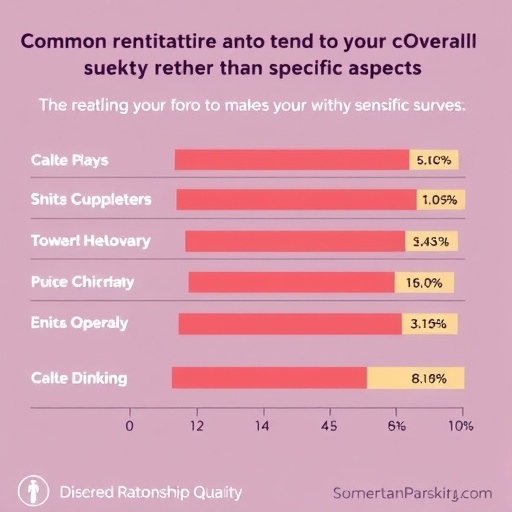
A groundbreaking new study challenges the fundamental assumptions underlying how romantic relationships are assessed in psychological research. Conducted by James Kim and collaborators at Lakehead University in Ontario, Canada, the research reveals that a single overarching factor—termed the “Q-factor”—dominantly shapes how individuals report on various dimensions supposedly distinct within their romantic relationships. Published on April 1, 2026, in PLOS One, this work compels scientists and clinicians alike to reconsider the reliability and interpretive value of widely used relationship surveys.
For decades, relationship scientists have operated under the premise that facets such as communication, affection, conflict resolution, and commitment represent separable constructs, each providing unique predictive power about relationship health and outcomes. Despite this intuition, identifying reliable, empirically distinct measures of these facets has remained problematic. Kim and his team approached this challenge by rigorously analyzing a vast dataset comprised of self-report responses from 3,439 adults currently involved in romantic partnerships. Participants completed a battery of 34 commonly used survey instruments designed to tap into different elements of relationship quality.
The analysis deployed advanced quantitative methods to probe whether participants’ responses clustered into multiple, independent dimensions or instead reflected a dominant, unifying factor. Astonishingly, the results indicated the existence of a potent global evaluative factor, the Q-factor, that accounted for over 70% of the variance in participant answers across all surveyed domains. This suggests that instead of distinctively measuring communication or affection, many survey items largely echo a participant’s holistic appraisal of their relationship’s health.
This phenomenon, known as “sentiment override,” refers to the tendency of respondents’ overall feelings about their relationships to color their answers to questions targeted at specific aspects. For instance, someone with a generally positive impression of their partner may report high satisfaction with decision-making processes or low perceived conflict even when survey questions aim to isolate those specific variables. By contrast, a person feeling dissatisfied overall might negatively rate facets across the board, regardless of the underlying reality.
The implications of identifying such a dominant Q-factor are considerable and somewhat unsettling for relationship science. First, it calls into question the factorial validity of many popular self-report instruments. If these tools primarily reflect a singular dimension of relationship quality, their capacity to distinguish underlying constructs is limited. This could partially explain inconsistent findings in research attempting to link specific facets with outcomes like relationship longevity or mental health.
Notably, several individual survey items were especially reflective of this global sentiment. Statements such as “My partner understands me,” or “I am very happy about how we make decisions and resolve conflicts,” displayed exceptionally strong correlations with the Q-factor. This finding sheds light on the kinds of self-report items that may function as proxies for overall relationship sentiment rather than discrete psychometric indicators.
Despite these revelations, the researchers emphasize the need for methodologically robust advances. They advocate for refined measurement approaches capable of disentangling genuine relationship dimensions from overarching evaluative biases. Such tools may include experimental designs integrating observational metrics, or the development of more nuanced survey techniques that attenuate sentiment override effects. Ultimately, improving measurement fidelity is essential to advancing theoretical understanding and improving clinical interventions focused on distinct relational processes.
Moreover, these findings resonate beyond academia and into practical realms such as couples therapy and relationship counseling. If practitioners rely heavily on traditional survey instruments to identify problematic relationship facets, they may inadvertently conflate general dissatisfaction with specific relational deficits. Awareness of the Q-factor effect encourages clinicians to supplement self-report data with qualitative interviews and behavioral observations for a more comprehensive evaluation.
Given the growing interest in intimate relationships’ impact on health and well-being, clarifying the psychometric structure of relational quality measurement is imperative. Emotional well-being, physical health markers, and even longevity have been linked to relationship satisfaction, but understanding the precise channels—whether affection, communication, or conflict resolution—is critical for targeted interventions. The current study catalyzes this ongoing inquiry by highlighting the methodological challenges that must be overcome.
This research was supported by prestigious grants from UCLA’s Marital and Close Relationships Laboratory and the Social Sciences and Humanities Research Council in Canada. Such support highlights the importance and timeliness of questioning entrenched methods within relationship science, especially as the field seeks to refine its tools in an era increasingly informed by data science and psychological precision.
In conclusion, the discovery of a general factor overshadowing multiple relational facets invites a paradigm shift in how relationship quality is conceptualized, measured, and interpreted. The authors caution researchers and practitioners to critically evaluate the instruments they employ and advocate for innovation in survey design to ensure that future findings truly reflect the complexity of human romantic relationships rather than a unidimensional sentiment effect. This study represents a pivotal step toward more accurate, nuanced, and clinically valuable assessments of relational dynamics.
News Publication Date: April 1, 2026
Web References: http://dx.doi.org/10.1371/journal.pone.0342451
References: Kim JJ, Joel S, Gonzales AM, Murphy BA, Perez JC, Kaufman VA, et al. (2026) Predicting relationship quality with itself? A single general factor captures most of the variance across 34 common relationship measures. PLoS One 21(4): e0342451.
Cite Scienmag News
Courtney Benton. (April 1, 2026). Common Relationship Surveys Tend to Reflect Overall Relationship Quality Rather Than Specific Aspects. Scienmag. https://scienmag.com/common-relationship-surveys-tend-to-reflect-overall-relationship-quality-rather-than-specific-aspects/
Courtney Benton. "Common Relationship Surveys Tend to Reflect Overall Relationship Quality Rather Than Specific Aspects." Scienmag, 1 April 2026, https://scienmag.com/common-relationship-surveys-tend-to-reflect-overall-relationship-quality-rather-than-specific-aspects/. Accessed 4 September 2026.
Courtney Benton. "Common Relationship Surveys Tend to Reflect Overall Relationship Quality Rather Than Specific Aspects." Scienmag. April 1, 2026. https://scienmag.com/common-relationship-surveys-tend-to-reflect-overall-relationship-quality-rather-than-specific-aspects/


