


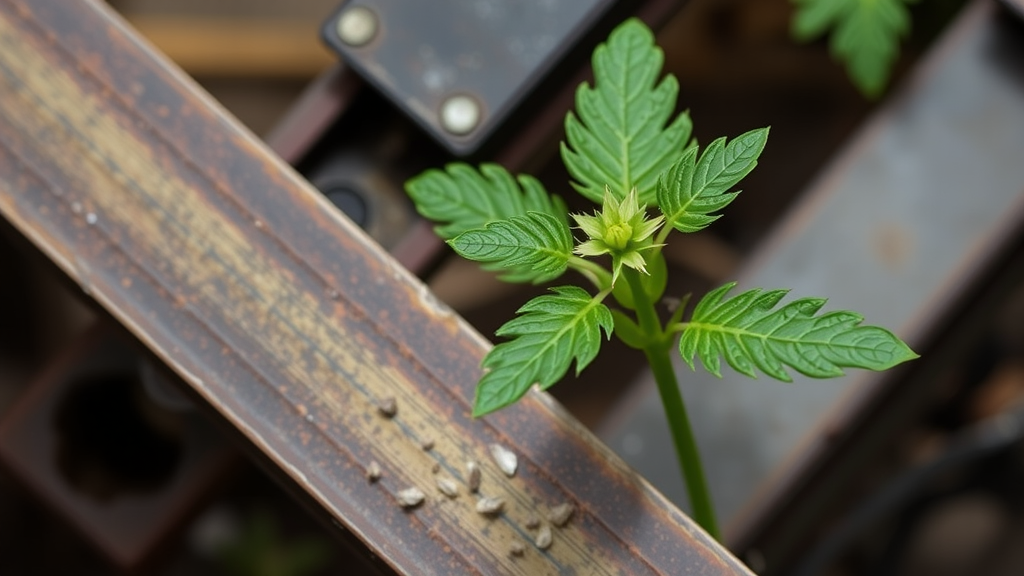
A humble ornamental weed that spreads aggressively across roadsides and abandoned fields may soon find an unexpected second career inside industrial acid-cleaning baths. Researchers at the University of Dodoma in Tanzania have shown that an ethanolic extract of Cosmos sulphureus, a fast-growing member of the sunflower family better known as sulphur cosmos, can suppress the corrosion of mild steel in hydrochloric acid by as much as 92.77 percent. The findings, published in Discover Electrochemistry, combine laboratory electrochemistry with quantum-chemical simulations to explain exactly why the weed’s molecules cling so tenaciously to iron surfaces, and they arrive amid rising industrial demand for corrosion inhibitors that do not poison workers or waterways.
Mild steel is the workhorse metal of pipelines, automobiles, construction, and machinery because it is cheap, ductile, and strong, but its Achilles heel is corrosion. One of the standard industrial remedies is acid pickling, in which hydrochloric, sulfuric, or phosphoric acid strips rust and mineral scale from steel surfaces before further processing. The problem is that once the scale is gone, the acid keeps attacking the freshly exposed metal. Synthetic organic inhibitors can slow this secondary attack, but many are expensive, poorly biodegradable, and environmentally hazardous, which has pushed corrosion scientists toward so-called green inhibitors derived from plant extracts rich in nitrogen, oxygen, sulfur, and phosphorus-bearing phytochemicals capable of bonding to metal surfaces.
Cosmos sulphureus caught the team’s attention because prior phytochemical surveys had already catalogued a dense inventory of flavonols, anthocyanins, chalcones, and related phenolics in its tissues, molecules loaded with hydroxyl, carbonyl, and aromatic groups that are ideal electron donors for coordination with iron. The researchers collected matured aerial parts of the plant around the university gardens, shade-dried and ground them, and extracted roughly 5.56 grams of crude material from 300 grams of powder using a Soxhlet apparatus with 95 percent ethanol, yielding about 1.85 percent by weight. Fourier transform infrared spectroscopy then confirmed the presence of broad hydroxyl stretching near 3307 inverse centimeters, methylene bands at 2925, carbonyl absorptions around 1624, and ester, ether, and phenolic C-O stretches between roughly 1047 and 1268 inverse centimeters, precisely the functional architecture needed for metal binding.
The electrochemical evidence came from a standard three-electrode cell in which mild steel coupons of API X70 grade pipeline steel served as the working electrode in one molar hydrochloric acid at 298 kelvin. Electrochemical impedance spectroscopy, which measures how the metal-solution interface resists charge flow, showed a well-defined semicircular capacitive loop for the blank acid, signaling rapid metal dissolution. As the extract concentration rose from 200 to 1000 parts per million, the charge transfer resistance climbed while the double-layer capacitance fell from 6.55 x 10^-4 to 2.11 x 10^-4 microfarads per square centimeter, a classic signature of organic molecules displacing water and crowding the surface with an insulating barrier. Inhibition efficiency from impedance measurements reached 88.77 percent at the highest concentration, up from 76.93 percent at the lowest, confirming a concentration-dependent protective effect.
Potentiodynamic polarization, which sweeps the electrode potential and extrapolates the anodic and cathodic Tafel branches, delivered the headline number. The corrosion current density collapsed from 3.83 x 10^-4 to 2.77 x 10^-5 amperes per square centimeter in the presence of 1000 ppm of the extract, corresponding to 92.77 percent inhibition. Because the corrosion potential shifted by less than 85 millivolts relative to the blank, the extract qualifies as a mixed-type inhibitor, damping both the anodic dissolution of iron and the cathodic hydrogen evolution. Polarization resistance values rose steadily with inhibitor concentration, and when the temperature was raised to 308 kelvin, efficiency fell to 69.45 percent, indicating that the adsorbed film loosens with heat but remains appreciably stable. The team deliberately capped testing at 308 kelvin to avoid thermal degradation of fragile flavonoid glycosides such as rutin.
Scanning electron microscopy provided the visual proof. Polished steel coupons emerged smooth, coupons bathed in plain hydrochloric acid for eighteen hours came out rough and pitted, and coupons immersed in acid containing the extract retained a comparatively even surface. Together with the sharp drop in double-layer capacitance, which reflects the replacement of high-permittivity water at the interface by a lower-permittivity organic layer, the micrographs support the formation of a continuous protective film that physically bars aggressive chloride ions from reaching the metal.
To understand which of the weed’s countless phytochemicals actually do the work, the team turned to density functional theory calculations on five representative molecules reported in the literature for Cosmos sulphureus: cosmonidin, cosmonidin 4′-O-glucoside, chlorogenic acid, quercetin, and rutin. Geometry optimizations at the B3LYP/6-311G(d,p) level yielded frontier molecular orbital energies, electronegativities, hardness, softness, dipole moments, and the fraction of electrons transferred. High HOMO energies in cosmonidin, chlorogenic acid, and rutin point to facile electron donation, while high softness in cosmonidin 4′-O-glucoside and quercetin indicates molecules that deform easily to bond with the metal. All selected molecules showed a fraction of electrons transferred below 3.6, the threshold beyond which electron-donating ability ceases to correlate with inhibition efficiency, meaning each can feed electron density into iron’s vacant d-orbitals through coordinate bonds.
Local reactivity descriptors sharpened the picture further. Fukui indices and dual descriptors computed with UCA-FUKUI software identified the specific carbon and oxygen atoms most willing to surrender electrons, including particular positions in caffeic acid, chlorogenic acid, cosmonidin, quercetin, and rutin. Mulliken charge analysis flagged electron-rich oxygen atoms in the phenolic and carboxylic groups as the primary donor centers. Monte Carlo simulations in the Adsorption Locator module then placed each molecule over a cleaved Fe(110) surface surrounded by roughly 200 explicit water molecules, and the resulting adsorption energies for chlorogenic acid, cosmonidin, and rutin were consistent with chemisorption, the stronger and more durable of the two adsorption modes. Side views of the most stable configurations show the large planar molecules lying flat against the iron lattice, acting as steric barriers against the corrosive medium.
The proposed mechanism weaves these threads together. Chloride ions first displace water molecules and form an anionic underlayer on the steel, which electrostatically attracts protonated heteroatoms of the phytochemicals. Simultaneously, lone pairs on oxygen and the pi-electron clouds of aromatic rings donate into iron’s empty d-orbitals, anchoring a dense chemisorbed film that suppresses both anodic iron dissolution and cathodic hydrogen liberation. The authors conclude that Cosmos sulphureus extract is a competitive, natural, and sustainable inhibitor suitable for room-temperature acid pickling at around 1000 ppm, and they suggest that deeper experimental and theoretical work could push the efficiency further and pin down the molecular mechanism with even greater precision.
Subject of Research: Green corrosion inhibition of mild steel in hydrochloric acid using Cosmos sulphureus plant extract studied by electrochemistry and computational simulation
Article Title: Electrochemical and computational study of a weed based inhibitor for mild steel corrosion in an acidic medium
Article References: Kotupalli, M. R., & Pulapa, V. K. R. (2026). Electrochemical and computational study of a weed based inhibitor for mild steel corrosion in an acidic medium. Discover Electrochemistry, 3(1), Article 81. https://doi.org/10.1007/s44373-026-00168-5
Image Credits: AI Generated
DOI: 10.1007/s44373-026-00168-5
Keywords: Cosmos sulphureus, green corrosion inhibitor, mild steel, hydrochloric acid, acid pickling, electrochemical impedance spectroscopy, potentiodynamic polarization, density functional theory, Monte Carlo simulation, Fukui indices, plant extract, chemisorption
Cite Scienmag News
Bethany Barker. (September 20, 2026). Common Garden Weed Shows Surprising Power to Shield Steel from Acid Corrosion. Scienmag. https://scienmag.com/common-garden-weed-shows-surprising-power-to-shield-steel-from-acid-corrosion/
Bethany Barker. "Common Garden Weed Shows Surprising Power to Shield Steel from Acid Corrosion." Scienmag, 20 September 2026, https://scienmag.com/common-garden-weed-shows-surprising-power-to-shield-steel-from-acid-corrosion/. Accessed 5 October 2026.
Bethany Barker. "Common Garden Weed Shows Surprising Power to Shield Steel from Acid Corrosion." Scienmag. September 20, 2026. https://scienmag.com/common-garden-weed-shows-surprising-power-to-shield-steel-from-acid-corrosion/


