


Lung cancer has high morbidity and mortality rates worldwide. It is characterized by rapid progression, poor prognosis, and susceptibility to chemotherapy. The most common route of metastasis in lung cancer is through mediastinal lymph nodes (MLN), which significantly affects the stage and prognosis of the disease. Preoperative evaluation of MLN status is critical for clinicians in determining the optimal treatment and extent of surgical dissection in patients with lung cancer. This assessment holds significant importance in predicting patient prognosis, improving survival rates, and enhancing the quality of life.

Credit: Beijing Zhongke Journal Publising Co. Ltd.
Lung cancer has high morbidity and mortality rates worldwide. It is characterized by rapid progression, poor prognosis, and susceptibility to chemotherapy. The most common route of metastasis in lung cancer is through mediastinal lymph nodes (MLN), which significantly affects the stage and prognosis of the disease. Preoperative evaluation of MLN status is critical for clinicians in determining the optimal treatment and extent of surgical dissection in patients with lung cancer. This assessment holds significant importance in predicting patient prognosis, improving survival rates, and enhancing the quality of life.
Currently, the techniques employed for preoperative lymph node diagnosis include computed tomography (CT), magnetic resonance imaging (MRI), positron emission tomography-computed tomography (PET-CT), ultrasound-guided fine-needle aspiration biopsy, and mediastinoscopy. The diagnostic sensitivity and specificity of plain CTs for lymph node metastases were 12.8% and 99.6%, respectively, whereas those of contrast CTs were 22.1% and 90.7%. The assessment of lymph node metastasis using MRI is limited to morphological indicators with low precision, as evidenced by previous research. PET-CT is widely regarded as the most comprehensive and accurate imaging modality for the clinical evaluation of lymph node status. Nevertheless, patients with lung cancer frequently present with acute and chronic pulmonary inflammatory conditions, and the uptake of 18F-Fludeoxyglucose (18F-FDG) by granulomatous and infectious lymph nodes can lead to false positives. Consequently, the PET image of the affected area exhibits an elevated uptake, leading to erroneous positive outcomes. Although ultrasound-guided fine-needle aspiration biopsy and mediastinoscopy are highly precise invasive techniques, they may result in intraoperative or postoperative complications, including bleeding, pneumothorax, and nerve damage. Furthermore, obtaining tissue through invasive procedures can be challenging. Thus, there is an urgent need for a noninvasive approach to precisely determine the status of MLN.
Accurately predicting non-invasive lymph node metastasis poses significant challenges when using conventional diagnostic methods. However, the advancement of artificial intelligence technology, specifically deep learning, presents a promising solution for improving the current diagnostic methods. In contrast to traditional manual recognition features, deep-learning technology employs an end-to-end approach that yields superior diagnostic performance. Its versatility is evident in its successful application in various medical tasks, including medical image classification, detection, segmentation, and registration, as well as in lung cancer diagnosis. Deep learning relies on extensive datasets to train the models. However, acquiring a large number of labeled medical images is challenging for most medical researchers. Consequently, it is imperative to develop deep learning algorithms that exhibit strong classification performance with limited datasets.
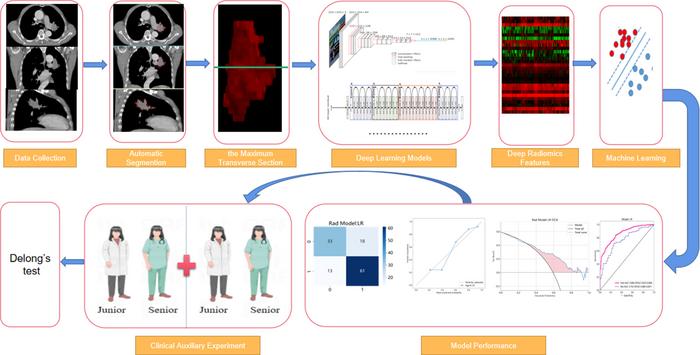
Transfer learning is a potent research approach in the data science community, particularly for specialized deep-learning research involving small datasets. This method can significantly reduce reliance on data volume for model construction. In medical imaging, the issue of limited labeled medical images can be mitigated by applying transfer learning. By leveraging deep transfer learning, it is possible to develop diagnostic models that exhibit strong classification performance even when working with small-sample datasets. Therefore, this study introduces a deep transfer-learning approach to address the present research objectives. Specifically, a categorical auxiliary diagnostic model was constructed to identify positive mediastinal lymph nodes (MLN+) in patients with lung cancer using a limited set of lung cancer images obtained from two medical institutions. Implementing this approach can enhance the diagnostic proficiency of medical establishments in detecting the presence of MLN+ in patients with lung cancer, thereby facilitating the advancement of healthcare management of pulmonary ailments.
Journal
Virtual Reality & Intelligent Hardware
Article Title
Combining machine and deep transfer learning for mediastinal lymph node evaluation in patients with lung cancer
Article Publication Date
27-Jun-2024
Cite Scienmag News
Nathaniel Bowman. (August 16, 2024). Combining machine and deep transfer learning for mediastinal lymph node evaluation in patients with lung cancer. Scienmag. https://scienmag.com/combining-machine-and-deep-transfer-learning-for-mediastinal-lymph-node-evaluation-in-patients-with-lung-cancer/
Nathaniel Bowman. "Combining machine and deep transfer learning for mediastinal lymph node evaluation in patients with lung cancer." Scienmag, 16 August 2024, https://scienmag.com/combining-machine-and-deep-transfer-learning-for-mediastinal-lymph-node-evaluation-in-patients-with-lung-cancer/. Accessed 4 September 2026.
Nathaniel Bowman. "Combining machine and deep transfer learning for mediastinal lymph node evaluation in patients with lung cancer." Scienmag. August 16, 2024. https://scienmag.com/combining-machine-and-deep-transfer-learning-for-mediastinal-lymph-node-evaluation-in-patients-with-lung-cancer/

