


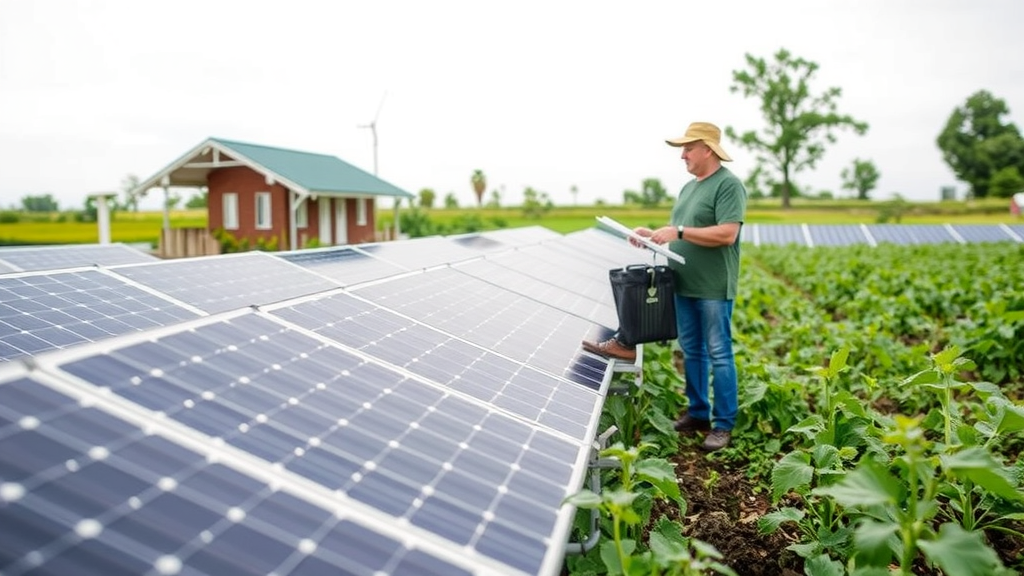
Solar energy has become one of the cheapest and fastest-growing sources of electricity in the world, yet its expansion on land increasingly collides with a stubborn obstacle: local opposition. Across rural communities in North America and Europe, proposed solar farms have met resistance rooted in concerns about losing farmland, changing rural landscapes, and feeling excluded from decisions about local resources. New research published in Nature Communications suggests that agrivoltaics—the practice of installing solar panels on agricultural land while crops or livestock continue to be cultivated beneath and around them—may do more than optimize land use. It may also soften the political polarization and community pushback that have slowed solar deployment, transforming utility-scale solar from a land-use threat into a shared agricultural opportunity.
The study examines why opposition to solar energy on land is so persistent and why it often breaks along political lines. In many regions, attitudes toward large solar installations have become entangled with broader ideological identities, so that questions about a specific project quickly become questions about values, trust, and belonging. Residents who might otherwise support renewable energy in the abstract can mobilize against a concrete project when they perceive it as an industrial intrusion that displaces farming. This dynamic produces a familiar pattern: national polls show broad public support for renewables, while local permitting hearings become battlegrounds where solar proposals stall or fail.
Agrivoltaics changes this calculus by altering what a solar project is perceived to be. Rather than converting farmland into an industrial site, agrivoltaic projects maintain active agricultural production, pairing photovoltaic arrays with crops such as forage, vegetables, or row crops, or with grazing livestock like sheep. From the perspective of a farming community, this reframing matters enormously. The land remains in agriculture, farmers may receive lease income that stabilizes farm finances, and the visual and symbolic character of the landscape is preserved to a greater degree than under conventional ground-mounted solar. The research indicates that this reframing can reduce the perception that solar development and farming are fundamentally at odds.
Technically, agrivoltaic systems come in several configurations. Elevated or stilt-mounted arrays raise panels several meters above the ground with widened spacing between rows, allowing machinery access and sufficient light for understory crops. Interspersed or widened-row designs modify panel spacing within standard racking, trading some generating capacity for improved light distribution. In pastoral systems, sheep graze beneath conventional or elevated arrays, controlling vegetation while benefiting from shade during hot periods. Each configuration involves trade-offs among electricity yield, crop productivity, construction cost, and operational complexity, and the optimal design depends on climate, crop type, and market context.
The biophysical rationale for co-location rests on microclimate effects. Partial shading from panels can reduce heat stress and evapotranspiration in water-limited environments, sometimes improving crop water-use efficiency. In hot climates, shade-tolerant crops such as leafy greens, forage grasses, and certain vegetables have shown maintained or even enhanced yields under modest shading, alongside reduced irrigation demand. Conversely, crops benefit panels as well: transpiration from vegetation cools the air around the modules, and cooler photovoltaic cells operate more efficiently, since the power output of crystalline silicon panels declines with rising temperature. This bidirectional coupling—panels shaping the crop microclimate and vegetation cooling the panels—is what distinguishes genuine agrivoltaic integration from simple land-sharing on paper.
But the new research shifts attention from these engineering questions to a social and political one: does agrivoltaics change how people feel about solar development in their communities? The findings suggest that it can. Where residents understand a proposed project as an agricultural arrangement rather than a land conversion, opposition weakens, and the partisan framing that often dominates energy debates loses some of its force. The mechanism is straightforward in principle: many political disagreements over energy infrastructure are less about technology than about identity and threat. When a project threatens a community’s agricultural identity, resistance becomes a defense of place and livelihood, and it aligns readily with existing ideological divisions. When the project reinforces that identity by keeping land in production and income in farming families, the threat diminishes and the polarization associated with it declines with it.
This has practical implications for how solar projects are planned and permitted. The research implies that developers and policymakers should treat community engagement not as a public-relations exercise but as a design parameter. Projects that genuinely incorporate local farmers—as leaseholders, operators, or partners—rather than merely compensating them, are more likely to earn durable social acceptance. Transparent benefit-sharing arrangements, long-term agricultural commitments written into project agreements, and demonstration sites where residents can see functioning agrivoltaic systems all help convert abstract proposals into tangible, assessable realities. Permitting frameworks could likewise reward co-location designs, streamlining review for projects that demonstrably maintain agricultural output.
The findings also speak to a broader tension in the energy transition. Decarbonizing electricity systems at the pace climate targets require will demand very large areas of land for solar and wind, and that land is unevenly distributed across politically diverse rural regions. If renewable deployment becomes a partisan identity issue, the transition stalls regardless of economic merit. Tools that de-couple clean energy from ideological conflict—by anchoring it in locally valued practices like farming—are therefore strategically important, not merely aesthetically pleasing. Agrivoltaics, in this view, functions as a form of conflict engineering: a design choice that changes the social meaning of infrastructure.
None of this means agrivoltaics is a frictionless solution. Elevated racking is more expensive than conventional ground-mount systems, and added construction cost must be justified by agricultural revenue, lease terms, or policy incentives such as dual-use tariffs or preferential permitting. Not every crop tolerates shading, and the agronomic performance of many crop-panel combinations remains under active field investigation across climates and seasons. Grid connection, land ownership structures, and interconnection queues present their own constraints that no design choice can eliminate. There is also a risk of symbolic adoption, in which projects are marketed as agrivoltaic while grazing token flocks or planting marginal areas, undermining the trust that genuine dual-use systems can build.
Nevertheless, the central lesson is significant: the social acceptance of solar energy is not fixed, and it can be improved by design. By keeping land in production, keeping farmers on the land, and keeping local communities at the center of project benefits, agrivoltaic systems reduce the perception of loss that fuels opposition, and in doing so they weaken the partisan alignment that has made solar siting an increasingly polarized contest. As governments seek to scale renewable generation rapidly, the study suggests that the cheapest way to unlock land for solar may not be legal reform alone, but a redesign of solar itself—so that the panels arrive not as replacements for agriculture, but as its newest, brightest crop.
Subject of Research: The role of agrivoltaics in reducing political polarization and local opposition to utility-scale solar energy on agricultural land.
Article Title: Agrivoltaics can reduce political polarization and local opposition to solar energy on land
Article References: Fesenfeld, L., Sistek, L., Montfort, S., Anderegg, D., Rohrer, J., & Schmidt, T. (2026). Agrivoltaics can reduce political polarization and local opposition to solar energy on land. Nature Communications, 17(1), Article 10263. https://doi.org/10.1038/s41467-026-77141-8
Image Credits: AI Generated
DOI: 10.1038/s41467-026-77141-8
Keywords: agrivoltaics, solar energy, political polarization, local opposition, renewable energy, social acceptance, agriculture, land use, energy transition, photovoltaics, rural communities, Nature Communications
Cite Scienmag News
Faith Mcneil. (September 12, 2026). Combining Crops With Solar Panels May Ease Local Resistance to Clean Energy. Scienmag. https://scienmag.com/combining-crops-with-solar-panels-may-ease-local-resistance-to-clean-energy/
Faith Mcneil. "Combining Crops With Solar Panels May Ease Local Resistance to Clean Energy." Scienmag, 12 September 2026, https://scienmag.com/combining-crops-with-solar-panels-may-ease-local-resistance-to-clean-energy/. Accessed 17 October 2026.
Faith Mcneil. "Combining Crops With Solar Panels May Ease Local Resistance to Clean Energy." Scienmag. September 12, 2026. https://scienmag.com/combining-crops-with-solar-panels-may-ease-local-resistance-to-clean-energy/


