


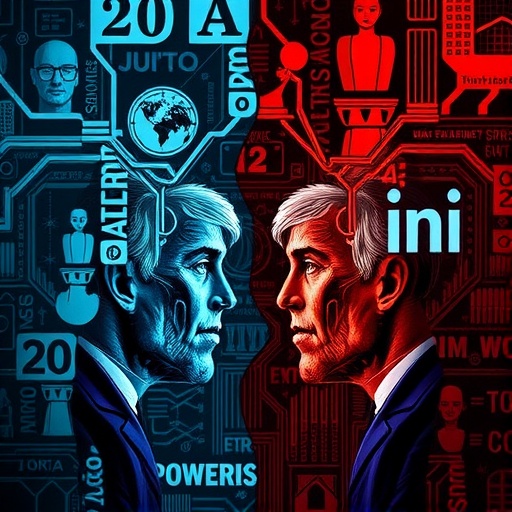
In an era marked by unprecedented political division, understanding the psychological underpinnings that fuel societal polarization has become a critical pursuit for researchers across disciplines. A groundbreaking study published in Communications Psychology by Edinger, Bollen, Makse, and colleagues reveals a compelling connection between cognitive distortions and the intensifying chasm in political attitudes. This research not only sheds light on the mechanisms driving polarization but also opens new avenues for interventions aimed at bridging divides in fragmented democracies.
Political polarization has escalated dramatically over recent decades, particularly in democratic nations where the ideological spectrum has become starkly bifurcated. While sociopolitical factors, media influence, and institutional dynamics have been extensively debated as drivers, this study introduces a cognitive psychological framework that deepens our understanding of how individual patterns of thought exacerbate collective discord. At the core of this research lies the concept of cognitive distortions—systematic errors in thinking that skew perception and judgment.
Cognitive distortions encompass a range of biased thought processes, including black-and-white thinking, overgeneralization, catastrophizing, and selective abstraction. These mental shortcuts, while often unconscious, distort reality and foster rigid worldviews. When applied to political beliefs, such distortions can harden attitudes, limit openness to alternative perspectives, and escalate animosity toward political outgroups. The study meticulously quantifies these relationships through large-scale surveys and network analyses to elucidate how distortions are operative within and across ideological communities.
The researchers employed sophisticated psychometric instruments to assess specific cognitive distortions in participants from diverse political backgrounds. By correlating these distortions with measures of political extremism, identity salience, and affective polarization, the team unraveled patterns that suggest cognitive errors are not peripheral but rather central to the entrenchment of polarized attitudes. Individuals exhibiting high levels of distortions demonstrated increased resistance to conflicting information and heightened susceptibility to partisan biases, underscoring the psychological rigidity that intensifies political fault lines.
Beyond individual cognition, the study harnessed network theory to explore how cognitive distortions propagate through social and political networks. By modeling interactions and information flows within online and offline communities, Edinger and colleagues demonstrated that distorted thinking amplifies echo chambers and feedback loops, thereby reinforcing polarization at a systemic level. Such network dynamics illustrate why polarized groups often become impermeable to mediation efforts, as cognitive distortions both reflect and magnify group cohesion at the expense of cross-cutting dialogue.
Importantly, the research delineates how cognitive distortions contribute to affective polarization—the mutual distrust and dislike between partisans—beyond mere policy disagreement. The emotional dimension of division is accentuated as distorted cognition fosters categorical enemy images, moral absolutism, and identity threats. Through experimental manipulations, the team illustrated that correcting cognitive distortions can attenuate affective polarization, suggesting the malleability of these processes and their potential as targets for depolarization strategies.
Underpinning these findings is an integrative theoretical model that situates cognitive distortions within broader psychological constructs such as motivated reasoning, confirmation bias, and social identity theory. The interplay between these mechanisms renders cognitive distortions both a product and a perpetuant of polarized environments. The authors argue that interventions must therefore operate at multiple levels—individual, relational, and societal—to effectively disrupt entrenched polarization.
Methodologically, the study’s rigor is notable. Employing a mixed-methods approach, it synthesizes quantitative surveys with qualitative interviews and computational simulations. This triangulation ensures a robust understanding of the phenomenon, capturing both the subjective experiences of political adherents and the emergent properties of political ecosystems. The interdisciplinary collaboration among psychologists, data scientists, and political theorists exemplifies the complexity of polarization as a wicked problem demanding multifaceted analysis.
The implications of this work extend beyond academic circles. Policymakers and practitioners engaged in conflict resolution, civic education, and media literacy stand to benefit from its insights. Recognizing the cognitive foundations of polarization enables the design of educational programs that cultivate metacognition and critical thinking skills. Additionally, platforms hosting political discourse might integrate heuristics to detect and mitigate cognitive distortions in real-time, thereby fostering healthier deliberative environments.
Moreover, the findings hold significance for technology companies grappling with the societal impact of algorithmically curated content. Algorithms that exploit cognitive biases inadvertently reinforce distortions and contribute to polarization. Through collaboration informed by cognitive science, these platforms could develop algorithms that promote exposure to diverse perspectives while minimizing cognitive overload and defensive reactions.
The study also raises poignant questions about the ethical dimensions of influencing cognition in democratic contexts. While reducing distortions may promote dialogue and consensus, it also entails influencing deeply held beliefs and identities. This necessitates safeguards ensuring respect for autonomy and pluralism. Future research must therefore navigate the tension between cognitive intervention and democratic values with nuanced ethical frameworks.
Looking ahead, the authors emphasize the need for longitudinal studies to track how cognitive distortions evolve over political cycles and in response to crises. Additionally, cross-cultural investigations are crucial to ascertain the universality of these psychological patterns and to tailor interventions to diverse sociopolitical landscapes. Integrating neuroscientific measures could further elucidate the neural correlates of distorted cognition in political contexts.
In conclusion, this pioneering study marks a significant advance in decoding the psychological architecture of political polarization. By highlighting the outsized role of cognitive distortions, it reframes polarization from a purely social or institutional issue to a fundamentally cognitive one. As democratic societies grapple with fragmentation and discord, harnessing this knowledge offers a promising pathway to rekindling empathy, understanding, and constructive engagement across political divides.
Cite Scienmag News
Glenn Wilkins. (August 3, 2025). Cognitive Distortions Fuel Rising Political Polarization. Scienmag. https://scienmag.com/cognitive-distortions-fuel-rising-political-polarization/
Glenn Wilkins. "Cognitive Distortions Fuel Rising Political Polarization." Scienmag, 3 August 2025, https://scienmag.com/cognitive-distortions-fuel-rising-political-polarization/. Accessed 4 September 2026.
Glenn Wilkins. "Cognitive Distortions Fuel Rising Political Polarization." Scienmag. August 3, 2025. https://scienmag.com/cognitive-distortions-fuel-rising-political-polarization/


