


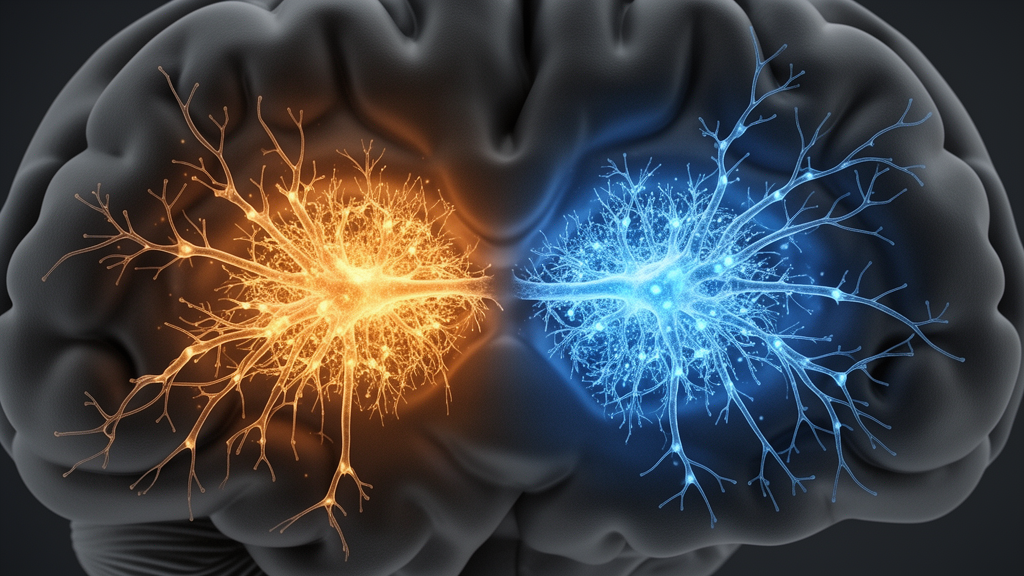
Deep inside the brain’s reward hub, two very different experiences — the euphoric pull of cocaine and the sharp sting of a foot shock — leave behind traces in overlapping but fundamentally distinct groups of neurons. That is the central finding of a new study published in Translational Psychiatry, which used cutting-edge genetic tools to tag, watch, and even artificially reactivate the specific neurons that fire during rewarding versus aversive events. The results reveal that the nucleus accumbens, a structure long known to process both pleasure and pain, does not treat these experiences as two sides of the same coin. Instead, it assigns them to partially overlapping ensembles with different cellular identities, different activity patterns, and dramatically different behavioral consequences.
The research team, led by Carina Soares-Cunha at the Life and Health Sciences Research Institute of the University of Minho in Braga, Portugal, set out to answer a deceptively simple question: when the nucleus accumbens responds to something rewarding like cocaine and something aversive like an electric shock, does it recruit the same neurons or different ones? The answer matters because the nucleus accumbens sits at the crossroads of motivation, reinforcement, and addiction. If reward and aversion share the same neural machinery, then treatments targeting that machinery could inadvertently blunt both positive and negative motivation. If they diverge, the door opens to more precise interventions.
To capture the neurons activated by each experience, the researchers employed an activity-dependent tagging system based on Fos-CreER^T2. Fos is a gene that switches on rapidly when a neuron fires, and by coupling it to a Cre recombinase that can be activated at a chosen moment with tamoxifen, the team could permanently label only those nucleus accumbens neurons that were active during a specific event. One group of mice received cocaine, a potent non-natural reward, while another received foot shock, a classic aversive stimulus. In this way, the cocaine-responsive ensemble and the shock-responsive ensemble were each marked with a fluorescent fingerprint that persisted long after the experience itself had faded.
The first surprise came from the cellular composition of these ensembles. The nucleus accumbens is dominated by medium spiny neurons, the principal output cells of the structure, which come in two flavors defined by the dopamine receptors they express. D1 receptor-expressing medium spiny neurons, or D1-MSNs, are generally associated with reward seeking and approach behavior, while D2 receptor-expressing medium spiny neurons, or D2-MSNs, have been linked to avoidance and inhibition of action. When the researchers examined the tagged populations, they found that the cocaine ensemble consisted predominantly of D1-MSNs, consistent with the idea that a powerful reward preferentially engages the brain’s go signal. The foot shock ensemble, by contrast, contained both D1- and D2-MSNs, suggesting that aversive experiences recruit a broader and more mixed cellular coalition.
But labeling alone could not reveal how these neurons actually behave in real time. For that, the team turned to one-photon calcium imaging in freely moving mice, a technique that uses miniature microscopes to monitor the activity of hundreds of individual neurons while animals go about their business. The recordings showed that acute cocaine primarily excites D1-MSNs while inhibiting most D2-MSNs, a pattern that mirrors the classic push-pull architecture of the striatal system and amplifies the reward signal. Foot shock produced a different signature altogether: excitatory responses in both D1- and D2-MSNs. In other words, the two experiences do not simply flip a shared switch in opposite directions; they drive distinct patterns of activity across the same underlying cell types.
The most striking experiment came next. Using optogenetics, the researchers artificially reactivated the tagged ensembles with light, asking a question that gets to the heart of how experience becomes motivation: if you turn these neurons back on, what does the animal feel? When the cocaine ensemble was reactivated, mice developed a strong behavioral preference for the place where the stimulation occurred, effectively recreating the pull of the drug without the drug itself. Reactivation of the shock ensemble, however, produced only a modest behavioral effect. Despite the fact that both ensembles had been activated by motivationally significant events, only the cocaine-responsive cells carried the power to change preference and reinforcement when replayed.
This asymmetry is the study’s most consequential message. Both cocaine and foot shock engage shared neuronal populations within the nucleus accumbens, yet the functional weight of those populations differs profoundly depending on the nature of the original experience. The findings indicate that rewarding and aversive experiences recruit partially overlapping ensembles with distinct cellular composition, activity dynamics, and behavioral outcomes. A neuron that participates in the shock ensemble does not become a lever for aversive motivation in the same way that a cocaine-ensemble neuron becomes a lever for reward. The representation of motivationally relevant experience in this brain region is therefore not a simple valence map but a structured division of labor.
For addiction science, the implications are significant. The nucleus accumbens has long been a target for deep brain stimulation and other experimental therapies aimed at reducing drug craving, but the field has struggled with the risk of blunting normal motivation and pleasure. By showing that the cocaine ensemble is dominated by D1-MSNs and that its reactivation alone is sufficient to drive preference, the study points toward cell-type-specific strategies that could theoretically disrupt drug-associated memories while sparing the circuits that support aversive learning and everyday motivation. The fact that shock ensembles mix both D1- and D2-MSNs further suggests that aversion in the accumbens is encoded more diffusely, making it less vulnerable to targeted manipulation but also less likely to be accidentally hijacked by reward-directed therapies.
The work also speaks to a broader debate in neuroscience about how the brain represents value. Some theories hold that reward and punishment are encoded on a single continuum of valence, with the same neurons ramping up for good outcomes and down for bad ones. Others propose dedicated channels for approach and avoidance. The new data support a middle path: shared real estate, separate tenants. The same anatomical territory hosts ensembles for cocaine and for shock, and some individual neurons may even belong to both, but the composition, dynamics, and downstream consequences of each ensemble are tailored to the experience that created it. Reactivation experiments provide the causal proof that this difference is not merely correlational — it determines what the brain does with the memory.
As with any animal study, translating these findings to humans will require caution. Cocaine and foot shock are extreme examples of reward and aversion, and the nucleus accumbens in mice may not map one-to-one onto the human striatum. Nevertheless, the technical framework — activity-dependent tagging combined with calcium imaging and optogenetic reactivation — offers a template for dissecting how any motivationally relevant experience, from a first dose of a drug to a traumatic event, becomes embedded in the accumbens circuitry. The study, funded by the Portuguese Foundation for Science and Technology, the European Research Council, and other supporters, and conducted in compliance with EU animal welfare directives, marks a step toward understanding why the brain clings so fiercely to drug memories while treating aversive experiences with a lighter touch. In the economy of the nucleus accumbens, not all activated neurons are created equal — and it is the cocaine ensemble, above all, that holds the keys to preference and reinforcement.
Subject of Research: Distinct cocaine- and shock-responsive ensembles in the nucleus accumbens
Article Title: Distinct cocaine- and shock-responsive ensembles in the nucleus accumbens
Article References: Correia, R., Domingues, A. V., Aguiar, L. A., Cunha-Macedo, M., Vilasboas-Campos, D., Vieitas-Gaspar, N., Jungmann, R. M., Teixeira, E., Coimbra, B., Rodrigues, A. J., & Soares-Cunha, C. (2026). Distinct cocaine- and shock-responsive ensembles in the nucleus accumbens. Translational Psychiatry. https://doi.org/10.1038/s41398-026-04533-1
Image Credits: AI Generated
DOI: 10.1038/s41398-026-04533-1
Keywords: Distinct, cocaine-, shock-responsive, ensembles, nucleus, accumbens, scientific research
Cite Scienmag News
Cassandra Pierce. (October 19, 2026). Cocaine and shock imprint separate neuronal ensembles in the reward hub. Scienmag. https://scienmag.com/cocaine-and-shock-imprint-separate-neuronal-ensembles-in-the-reward-hub/
Cassandra Pierce. "Cocaine and shock imprint separate neuronal ensembles in the reward hub." Scienmag, 19 October 2026, https://scienmag.com/cocaine-and-shock-imprint-separate-neuronal-ensembles-in-the-reward-hub/. Accessed 19 October 2026.
Cassandra Pierce. "Cocaine and shock imprint separate neuronal ensembles in the reward hub." Scienmag. October 19, 2026. https://scienmag.com/cocaine-and-shock-imprint-separate-neuronal-ensembles-in-the-reward-hub/


