


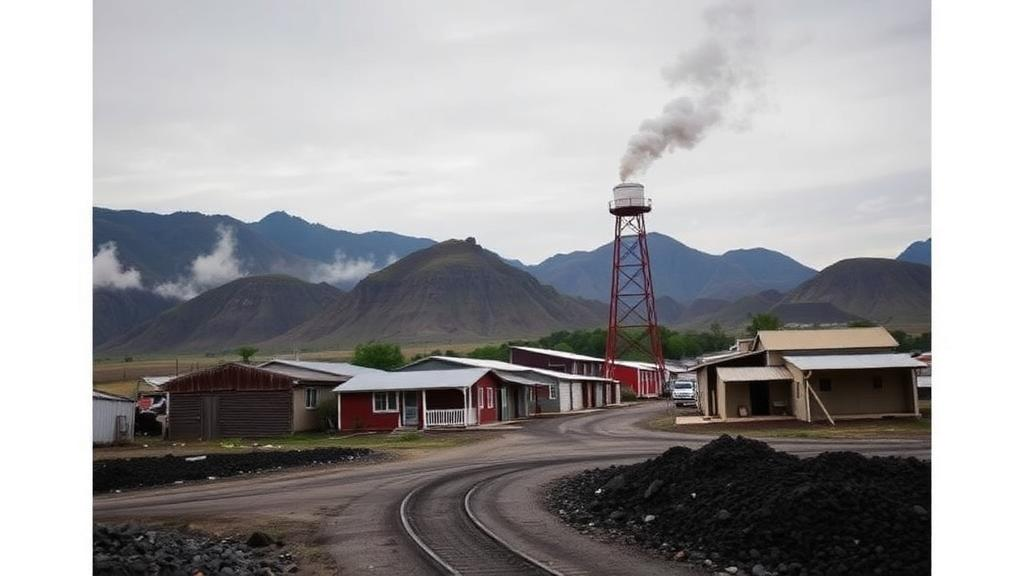
In the hills of northeastern Colombia, a town built on coal is quietly rewriting the script for what a fair energy transition should look like. La Jagua de Ibirico, a municipality in the Cesar Department that grew into one of the country’s most important open-pit coal hubs, has become the focus of a new mixed-methods study published in Heliyon that pairs satellite data and air-quality records with the lived judgments of the people who breathe the dust and mourn the vanished creeks. The research, led by Johana Regino Vergara of Universidad del Magdalena and colleagues, argues that the world’s decarbonization plans routinely fail the very communities that carried the cost of extraction, because planners count money while communities count everything else.
The numbers behind the study’s setting are stark. Colombia extracted roughly 69.3 million tons of coal in 2023, declining to 59.3 million tons in 2024, and La Jagua de Ibirico sits at the heart of that story. The municipality’s population surged by 138 percent between 2005 and 2020 as open-pit operations expanded, even as production in the municipality itself fell from 15.9 million tons in 2012 to 10.9 million tons in 2020. The paradox the researchers set out to examine is precisely this: how can a region plan an energy transition while its economy, institutions, and identities remain welded to the export of a fuel the world is supposed to abandon?
The team’s environmental forensics are unambiguous. Using official forest and hydrographic data from Colombia’s IDEAM and IGAC institutes, delineated against high-resolution Planet satellite imagery in a GIS environment, they found that approximately 315 hectares of forest cover disappeared within the La Jagua mining area between 1990 and 2022, with another 138 hectares lost around the Calenturitas mine. The losses concentrated along riparian corridors, including the Tucuy River, where vegetation once buffered waterways and regulated seasonal flows. Farmers interviewed for the study reported that creeks which once ran year-round now flow only in the rainy season, and that freshwater turtles, native fish, and amphibians have largely vanished from waters they remember as abundant.
Air quality data tell a parallel story of slow-motion harm. Historical records of total suspended particles from the La Palmita station between 2001 and 2010 hovered just below Colombia’s national annual limit of 100 micrograms per cubic meter, while the Boquerón station exceeded that threshold in 2008 and 2009. In 2007, the Ministry of Environment classified sections of the Cesar Mining Corridor as environmental pollution zones, and in 2010 Boquerón was formally declared uninhabitable. Yet as of 2024, a significant proportion of households remained in place, caught in a resettlement process stalled by administrative procedures, budget constraints, and regulatory negotiations. Residents described what researchers call double exposure: simultaneous contact with particulate contamination and institutional neglect. One community leader put it bluntly: We are stuck in the middle, contaminated, forgotten, and silenced.
What distinguishes this study is its refusal to stop at environmental measurement. The researchers deployed a framework known as the plural valuation of nature, aligned with the IPBES Values Assessment, which holds that ecosystems carry economic, social, ecological, cultural, and spiritual meanings simultaneously, and that reducing them to monetary terms erases the very values that make transition pathways legitimate. They surveyed 101 residents, conducted 21 semi-structured interviews across institutional, labor, and community groups, and asked participants to score five economic sectors, mining, agriculture, livestock, tourism, and commerce, across four dimensions: economic contribution, social well-being, ecological sustainability, and cultural compatibility.
The resulting valuation heatmap exposes a contradiction that conventional cost-benefit analysis would miss entirely. Mining scored highest in the economic dimension, with a mean of 3.57 on a five-point scale, reflecting real dependence on jobs, transport, and services. But it scored lowest in the ecological dimension at 2.31, and a paired Wilcoxon signed-rank test across 101 complete pairs confirmed the gap was statistically robust, with a mean difference of 1.27 points and a p-value of 1.79 times ten to the minus nine. Residents associated mining with respiratory illness, unequal benefit distribution, and weakened social trust. Agriculture, by contrast, earned its highest score in the cultural dimension at 4.07, tied to ancestral farming knowledge and food sovereignty, while tourism scored highest on ecological and cultural grounds despite weak current income potential.
Perceptions of decline were strikingly convergent. Soil degradation was cited by 81 percent of respondents, biodiversity loss by 73 percent, water deterioration by 67 percent, food insecurity by 61 percent, and cultural or emotional rupture by 47 percent. Farmers described soil that no longer breathes, where composting and crop rotation have lost their effectiveness and fallow land fails to recover. Women in Boquerón and La Palmita reported heavier domestic burdens hauling water from distant sources. Older residents, particularly women, described the painful erosion of ecological knowledge transmission, from identifying medicinal plants to reading seasonal cues, as planting cycles grew unpredictable and younger generations drifted from the land.
The study’s authors are careful not to romanticize the alternatives. Agriculture in La Jagua de Ibirico is a constrained pathway, limited by the very degradation mining caused: compacted soils, water scarcity, and diminished productivity that will require sustained technical and institutional support to reverse. Tourism is aspirational rather than immediately viable, dependent on air-quality improvement, riparian restoration, infrastructure, and security. The analytical point is subtler and more consequential: plural valuation reveals the direction communities want to travel, even when the road has not yet been built. Ignoring those non-economic values, the researchers argue, reproduces extractivist logic under a green banner, a critique increasingly aimed at transition policies across the Global South where corporate actors have appropriated transition narratives while extraction continues.
Gender emerged as a quietly powerful thread in the findings. Among the 101 respondents, 56 women and 45 men, exploratory chi-square tests found statistically significant associations between sex and both the economic and social valuation of mining. Qualitatively, women were especially vocal on health impacts, water quality, and caregiving burdens, articulating relational and care-based values that shaped deliberation. The authors suggest that future plural valuation exercises in extractive territories adopt gender-sensitive designs to capture these differentiated experiences systematically, rather than leaving them as anecdotal color in participatory workshops.
The deeper lesson radiating from this Colombian coal town is procedural, not merely technical. The Boquerón resettlement saga shows that legal recognition of harm means little without community power over timelines, criteria, and compensation, a textbook case of what environmental justice scholars call procedural justice failure. Residents have responded with community-led air monitoring, participatory mapping of lost territories, and youth-driven documentaries and podcasts documenting environmental injustice. Their articulated demands, compensation for health harms, investment in agroecology and community tourism, legal recognition of territorial practices, and youth training, sketch a transition measured in healing rather than megawatts. As one interviewee told the researchers: The land is wounded, and so are we. Transition means healing both. If the global energy transition is to be just anywhere, this study suggests, it must begin by listening to places like La Jagua de Ibirico, where the invoice for coal was paid long before anyone asked who would collect it.
Subject of Research: Plural valuation of nature and environmental justice in post-extractive transition pathways in a coal-dependent Colombian municipality
Article Title: Plural valuation of nature and environmental justice in post-extractive transitions: The case of La Jagua de Ibirico, Colombia
Article References: Regino Vergara, J., Rincón Ruíz, A., Mejía Brito, A., & Banda Pérez, A. (2026). Plural valuation of nature and environmental justice in post-extractive transitions: The case of La Jagua de Ibirico, Colombia. Heliyon, 12(15), Article e45538. https://doi.org/10.1016/j.heliyon.2026.e45538
Image Credits: AI Generated
DOI: 10.1016/j.heliyon.2026.e45538
Keywords: energy transition, coal mining, Colombia, environmental justice, plural valuation, post-extractivism, air quality, forest loss, participatory research, IPBES, just transition, La Jagua de Ibirico
Cite Scienmag News
Drew Townsend. (October 5, 2026). Coal Country Speaks: What a Colombian Mining Town Taught Scientists About Just Energy Transitions. Scienmag. https://scienmag.com/coal-country-speaks-what-a-colombian-mining-town-taught-scientists-about-just-energy-transitions/
Drew Townsend. "Coal Country Speaks: What a Colombian Mining Town Taught Scientists About Just Energy Transitions." Scienmag, 5 October 2026, https://scienmag.com/coal-country-speaks-what-a-colombian-mining-town-taught-scientists-about-just-energy-transitions/. Accessed 5 October 2026.
Drew Townsend. "Coal Country Speaks: What a Colombian Mining Town Taught Scientists About Just Energy Transitions." Scienmag. October 5, 2026. https://scienmag.com/coal-country-speaks-what-a-colombian-mining-town-taught-scientists-about-just-energy-transitions/


