


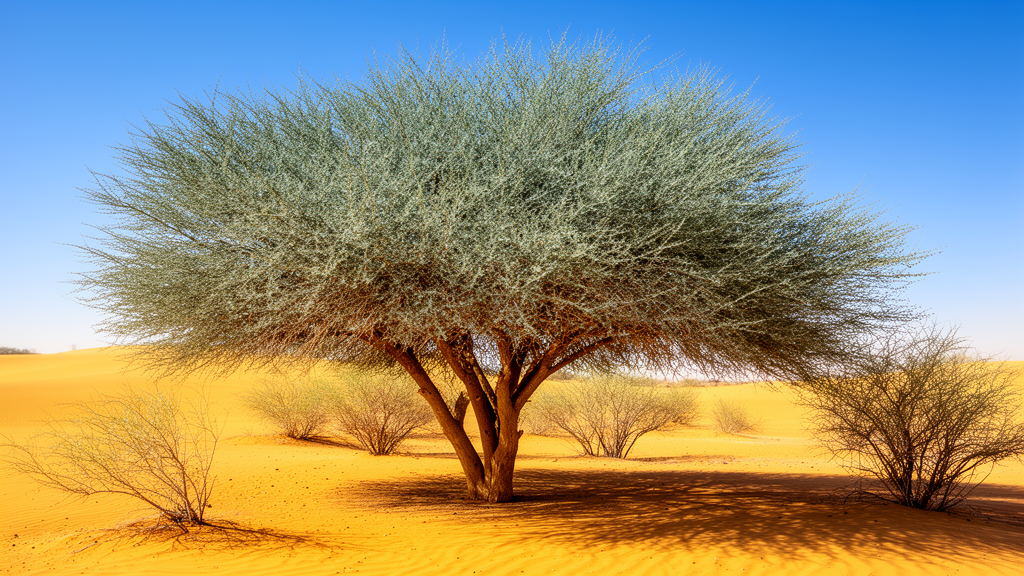
Rising carbon dioxide levels are often described as a fertilizer for the plant world, but new research from the United Arab Emirates shows that this gift is handed out unevenly. A study of three native Fabaceae species has found that the UAE’s iconic Ghaf tree flourishes dramatically under elevated CO2, while two of its leguminous relatives shrink under the very same conditions. The work, published in Innovations in Agriculture, offers one of the clearest portraits yet of how desert plants may diverge sharply in their responses to the changing atmosphere.
The research team, led by Nour ElHouda Debouza with Taoufik Ksiksi at United Arab Emirates University, focused on three arid-adapted legumes: Prosopis cineraria, the revered Ghaf tree; Senna italica, known as Italian senna; and Tephrosia nubica, a shrub that bursts into green and violet blooms after rainfall. All three were collected from sites around Al-Ain City, including the university campus, Al-Ain Zoo, and the local Plants Park Asharij, and all three play important roles in traditional medicine, soil stabilization, and nitrogen fixation.
The experimental design was deliberately simple but revealing. Seeds were subjected to eight different environments: standard greenhouse conditions, three elevated temperatures of 40, 45, and 50 degrees Celsius, elevated CO2 alone, and each of those temperatures combined with CO2 enrichment. For the seedling phase, 15 seeds of each species were grown in pots under a greenhouse control averaging 34.2 degrees Celsius by day and 430 parts per million CO2, and in growth chambers held at 35 degrees Celsius by day with CO2 maintained between 800 and 1000 parts per million, roughly double the ambient level.
The first and perhaps most sobering finding concerned germination. Across all three species, germination percentage fell steadily as temperatures climbed. Elevated CO2 failed to rescue the seeds from heat stress: for P. cineraria and S. italica, germination dropped significantly at all three elevated temperatures, and adding CO2 did not improve the outcome compared to greenhouse conditions. Tephrosia nubica fared somewhat better, showing no significant germination decline under CO2 enrichment alone, but even here the combination of heat and high CO2 offered no germination advantage. The hope that CO2 fertilization might buffer the earliest and most vulnerable stage of a plant’s life against warming was not borne out.
Once the seedlings were established, however, the story changed dramatically, and in a way that split the three species into distinct camps. Prosopis cineraria responded to elevated CO2 with what can only be described as a growth surge. Under CO2 enrichment, the young Ghaf trees produced 670 leaves on average, reached shoot lengths of 40 centimeters, and pushed roots down to 42 centimeters. Their fresh shoot weight reached 2 grams, with dry shoot weight of 0.61 grams, dry root weight of 0.24 grams, and root weight of 0.53 grams, all significantly higher than greenhouse-grown counterparts.
The other two species moved in the opposite direction. Tephrosia nubica showed a significant decline in nearly every measure under elevated CO2, with leaf numbers falling to 138, shoot length dropping to 26 centimeters, root length to 25 centimeters, shoot weight to 2.5 grams lower than controls, and root weight falling from 0.68 grams in the greenhouse to 0.35 grams under enrichment. Senna italica occupied a middle ground, with significant decreases in shoot and root length, reaching just 7.5 centimeters and 29 centimeters respectively, but no significant differences in leaf number, shoot weight, root weight, or dry weights, though trends were visible in several of these measures.
These species-specific outcomes align with broader patterns documented in the CO2 enrichment literature. Elevated CO2 generally boosts leaf-level photosynthesis in C3 plants by increasing carbohydrate availability, which in turn supports greater leaf area, improved water-use efficiency, and enhanced cell division and expansion. Woody species have often shown more pronounced photosynthetic and productivity responses than grassland species in decades of experiments using enclosed chambers and free-air carbon enrichment facilities. The Ghaf tree’s deep-rooted, drought-adapted architecture may position it to capitalize on extra carbon, converting it into both above-ground foliage and an expanded root system.
Why the other two legumes declined remains an open question. The authors note that previous studies have reported negative effects of elevated CO2 on root morphology in some plants, and similar decreases in germination under warming have been documented in Arabidopsis thaliana and several tree species. Possible explanations include physiological limitations, nutrient constraints within the potting mix, or the possibility that the additional carbon investment demanded by rapid growth under high CO2 carries hidden costs for species not adapted to exploit it. Disentangling these mechanisms will require further physiological work that this morphological study was not designed to provide.
The practical implications for the UAE are considerable. Prosopis cineraria holds deep cultural and ecological significance in the Emirates, valued for traditional remedies for asthma, digestive ailments, and skin conditions, for stabilizing and renewing soils, and as a source of aromatic honey from its blossoms. If the Ghaf tree can grow faster and root deeper in a high-CO2 future, restoration and greening programs built around it may benefit. Conversely, Senna italica and Tephrosia nubica, both valued for medicine and soil fertility, may need more targeted conservation attention as atmospheric conditions shift beyond their comfort zones.
The study’s authors emphasize that understanding how individual species respond to changing environmental conditions is vital for forecasting and managing ecosystem dynamics under climate change, particularly in desert ecosystems where the margin for error is thin. The combined influence of temperature and elevated CO2 produced varied responses across germination, leaf production, shoot and root morphology, and biomass, underscoring that climate impact assessments cannot treat native plant communities as a single unit. As CO2 concentrations continue their rapid rise, the fate of the UAE’s native flora may rest less on the atmosphere itself than on which species are equipped to make the most of it.
Subject of Research: Effects of elevated temperature and CO2 on seed germination and early morphology of native UAE Fabaceae species
Article Title: The impact of elevated temperatures and CO 2 on seed germination and early plant morphology: The case of native Fabaceae plants in the UAE
Article References: Debouza, N. E., & Ksiksi, T. (2024). The impact of elevated temperatures and CO2 on seed germination and early plant morphology: The case of native Fabaceae plants in the UAE. Innovations in Agriculture, 7, 1-9. https://doi.org/10.3897/ia.2024.135233
Image Credits: AI Generated
Keywords: elevated CO2, seed germination, Fabaceae, Prosopis cineraria, Ghaf tree, UAE, climate change, desert plants, plant morphology, temperature stress, Senna italica, Tephrosia nubica
Cite Scienmag News
Gavin Prescott. (October 17, 2026). CO2 boost helps UAE’s iconic Ghaf tree thrive while other native legumes struggle. Scienmag. https://scienmag.com/co2-boost-helps-uaes-iconic-ghaf-tree-thrive-while-other-native-legumes-struggle/
Gavin Prescott. "CO2 boost helps UAE’s iconic Ghaf tree thrive while other native legumes struggle." Scienmag, 17 October 2026, https://scienmag.com/co2-boost-helps-uaes-iconic-ghaf-tree-thrive-while-other-native-legumes-struggle/. Accessed 17 October 2026.
Gavin Prescott. "CO2 boost helps UAE’s iconic Ghaf tree thrive while other native legumes struggle." Scienmag. October 17, 2026. https://scienmag.com/co2-boost-helps-uaes-iconic-ghaf-tree-thrive-while-other-native-legumes-struggle/


