


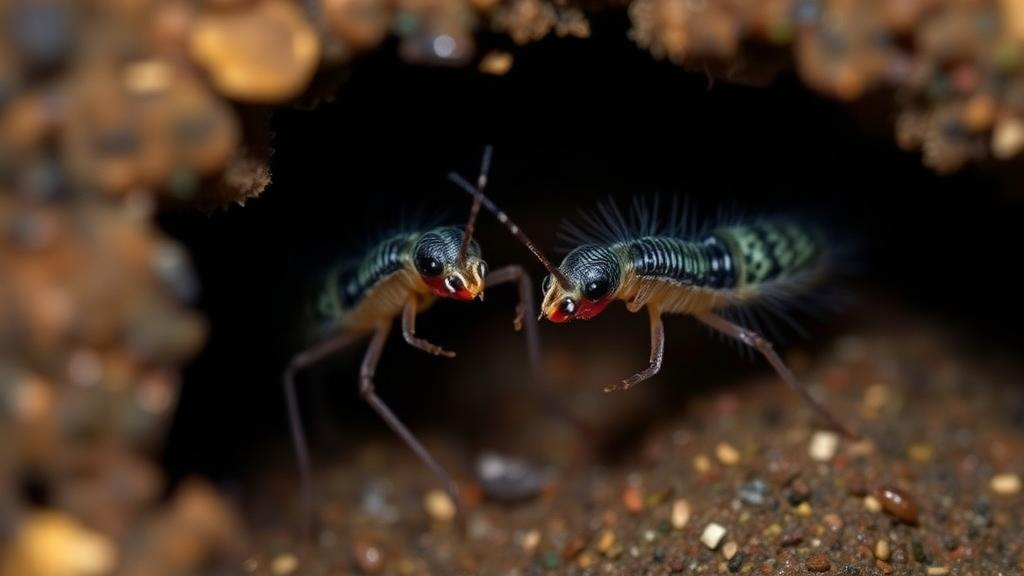
Deep beneath the Hyrcanian forests of northern Iran and the flowstone chambers of Montenegro’s Dinaric Karst, two tiny white creatures have been quietly demonstrating one of biology’s most striking phenomena: convergent evolution. Taxonomists have described two new species of subterranean springtails in the genus Schaefferia, one from Danial Cave in the Alborz Mountains of Iran and the other from Babatuša Cave in Montenegro. Both are completely eyeless, both are strikingly pale, and both carry a rare multi-lobed sensory structure that sets them apart from every other blind relative described so far. The discovery, published in the journal Subterranean Biology, offers a vivid technical portrait of how evolution repeatedly sculpts similar forms in geographically separated caves.
Springtails, or Collembola, are among the most abundant arthropods on Earth, typically living in soil and leaf litter where they feed on fungal hyphae and decaying organic matter. The genus Schaefferia, established in 1900 for a species found in a Moravian cave in the Czech Republic, belongs to the family Hypogastruridae and has a Holarctic distribution, with 35 species described to date. These animals occupy a remarkable range of habitats: some live in surface soil and mountain humus, some in the mesovoid shallow substratum, the network of air-filled voids just below the ground surface, and others exclusively in caves. Representatives of the genus favor cold microclimates, often around 10 degrees Celsius with high relative humidity, conditions that caves provide with remarkable constancy.
The first of the two new species, Schaefferia greensladeae, was collected in Danial Cave, the second largest river cave in Iran, located in the Mazandaran karst area near the southern edge of the Caspian Sea at an altitude of 204 meters above sea level. The cave stretches 2,158 meters in length, with a subterranean river flowing along its entire course beneath the Hyrcanian Forest type of vegetation. Measurements taken in April 2024 recorded a constant air temperature of around 12 degrees Celsius and relative humidity above 73 percent. The holotype, a female, was gathered from the surface of a water puddle in the cave’s dark zone in October 2023, together with two paratypes. The species is named in honor of Professor Penelope Greenslade, an outstanding springtail taxonomist and ecologist.
Schaefferia greensladeae measures about 1.9 millimeters on average and is white in life without traces of pigment. Its most distinctive feature is the postantennal organ, a sensory structure located near the base of the first antennal segment. In this species the organ is large, roughly 33 micrometers in diameter, and bears seven subequal lobes arranged around a central circle. Every other eyeless congener described so far carries fewer than five lobes in this organ. The antenna carries seven to eight blunt cylindrical sensilla on the fourth segment, the claw is enlarged with an internal tooth and a pair of lateral teeth, and the furca, the springing organ characteristic of springtails, is well developed with five dental setae. Long anal spines, nearly 86 micrometers and mounted on papillae, complete the troglomorphic profile.
The second new species, Schaefferia montenegrina, comes from Babatuša Cave near the village of Trnovo in Virpazar, Montenegro, at an altitude of 381 meters above sea level. The cave entrance is a horizontal fissure about ten meters wide and two meters high, and the cave extends a little over 290 meters, with a great main chamber rich in flowstones and small sinter pools. Its galleries are filled with clay deposits up to ten meters thick. Specimens were collected from the dark zone between 2011 and 2015, from the surfaces of water and sinter pools and from rotten wood. The species measures about 1.4 millimeters on average, is fusiform and white without pigment, and carries a smaller postantennal organ of about 17 micrometers in diameter, formed as a rosette of five to six regular oval vesicles.
Despite their shared blindness and multi-lobed postantennal organs, the two species differ in technically diagnostic ways. Schaefferia montenegrina has a claw without internal or lateral teeth, a combination of an elongated claw and missing internal teeth that researchers consider a classic troglomorphic adaptation, whereas Schaefferia greensladeae retains a strong medial tooth on the internal edge of the claw and a pair of basal lateral teeth. The Montenegrin species has two pairs of setae on the first thoracic segment, while the Iranian species has three. The anal spines of the Montenegrin species are shorter than its claws, at about 45 micrometers, while those of the Iranian species are longer than the claws. These differences, together with the number of sensilla on the fourth antennal segment and the pattern of dorsal body setae, justify the recognition of two separate species rather than a single widespread form.
Blindness alone does not necessarily imply cave association. Three edaphic species of Schaefferia from France, S. ariegica, S. coeca and S. subcoeca, are also eyeless yet live in soil. What makes the two new species genuinely troglomorphic is the combination of characters they carry: the absence of eyes and pigment, the elongated claw, and the multi-lobed postantennal organ. Six species of the genus have been reported exclusively from caves, including S. guerrerense and S. oaxacana from Mexico, S. profundissima from the Caucasus, S. kitakamiana from Japan, S. baschkirica from the Urals, and S. hubbardi from the United States. The two new species now join this exclusive subterranean club, and the Iranian species represents the first record of the genus in that country.
The convergent evolution at work here is technically precise. Three blind species of Schaefferia are now known to carry an elongated claw: the two species described in this study and S. profundissima, which was described from Krubera-Voronya, one of the deepest cave systems on Earth, in the Caucasus Mountains. The elongation of the claw evolved independently in three geographically distant karst complexes, the Dinaric Karst, the Alborz Mountains and the Caucasus Mountains. This is a well-documented phenomenon among invertebrates of the deep subterranean realm, where similar selective pressures, permanent darkness, stable temperature, scarce food and restricted movement, repeatedly produce the same suite of adaptations in unrelated lineages. The genus Schaefferia is regarded as a phyletic line of the Ceratophysella denticulata species group, formed as a result of postglacial colonization of the underground environment, and is apparently derived from Ceratophysella groups that successfully invaded caves and became more or less troglomorphic.
The phylogenetic relationships within the genus remain to be clarified by a thorough study combining morphological traits with mitochondrial and nuclear DNA data. This is not an easy task, given the demanding field collections required for these animals, which are usually rare and dispersed in subterranean spaces. The reduction of the furca in Schaefferia, in contrast to the related genera Typhlogastrura and Bonetogastrura, which maintain a fully developed springing organ, may represent an edaphic phenomenon rather than a strictly cave-related one, according to earlier work on the group. Disentangling which characters reflect deep soil adaptation and which reflect cave life will require both molecular evidence and careful ecological study of the habitats where each species lives.
The researchers have provided an updated identification key to the world species of the genus and a table summarizing the diagnostic characters of all eyeless Schaefferia congeners, tools that will help future explorers recognize these animals in caves across the Holarctic realm. The two new species serve as a compelling example of convergent evolution characteristic of invertebrates highly adapted to the deep subterranean environment, a realm that remains one of the least explored frontiers of biodiversity on the planet. As cave explorations continue in Iran, Montenegro and beyond, more such discoveries are likely, each one adding another piece to the puzzle of how life repeatedly invents the same solutions in the darkness underground.
Subject of Research: Convergent evolution underground – two new troglomorphic collembolan species of the genus Schaefferia Absolon, 1900 (Collembola, Poduromorpha, Hypogastruridae) from Iran and Montenegro
Article Title: Convergent evolution underground – two new troglomorphic collembolan species of the genus Schaefferia Absolon, 1900 ( Collembola , Poduromorpha , Hypogastruridae ) from Iran and Montenegro
Article References: Kováč, Ľ., Karaman, M., & Mehrafrooz Mayvan, M. (2025). Convergent evolution underground – two new troglomorphic collembolan species of the genus Schaefferia Absolon, 1900 (Collembola, Poduromorpha, Hypogastruridae) from Iran and Montenegro. Subterranean Biology, 54, 1-22. https://doi.org/10.3897/subtbiol.54.157228
Image Credits: AI Generated
DOI: 10.3897/subtbiol.54.157228
Keywords: Convergent, evolution, underground, troglomorphic, collembolan, species, genus, Schaefferia, Absolon, Collembola, Poduromorpha, Hypogastruridae
Cite Scienmag News
Gavin Prescott. (October 17, 2026). Two New Blind Cave Springtails Reveal Convergent Evolution Underground. Scienmag. https://scienmag.com/two-new-blind-cave-springtails-reveal-convergent-evolution-underground/
Gavin Prescott. "Two New Blind Cave Springtails Reveal Convergent Evolution Underground." Scienmag, 17 October 2026, https://scienmag.com/two-new-blind-cave-springtails-reveal-convergent-evolution-underground/. Accessed 17 October 2026.
Gavin Prescott. "Two New Blind Cave Springtails Reveal Convergent Evolution Underground." Scienmag. October 17, 2026. https://scienmag.com/two-new-blind-cave-springtails-reveal-convergent-evolution-underground/


