


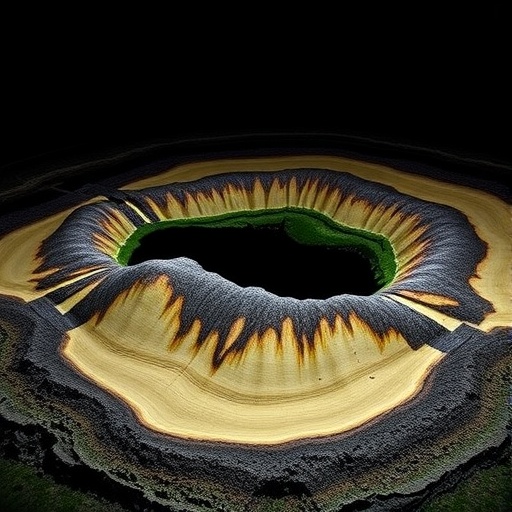
A partially submerged volcanic caldera may be functioning as an unexpected natural laboratory for carbon capture, powered not by forests or engineered machinery but by carbon dioxide rising from deep geological sources. A study by Sandoval-Velasquez, Migliaccio, Diana and colleagues reports that microbial communities living in this extreme environment fix carbon in response to CO₂ degassing, revealing how geology can shape biological productivity in places where conventional ecosystems appear unlikely to thrive.
Calderas are vast volcanic depressions formed when a magma chamber empties and the overlying ground collapses. When a caldera is partly flooded, its waters can become chemically unusual, especially if volcanic gases continue to escape through fractures and sediments. Among those gases, carbon dioxide is particularly important. It is both a greenhouse gas released from Earth’s interior and a fundamental raw material for life. Microorganisms can use dissolved CO₂ as a carbon source, converting inorganic carbon into organic molecules through carbon-fixation pathways.
The research focuses on the relationship between volcanic degassing and microbial carbon fixation. Rather than treating CO₂ only as a pollutant or atmospheric driver, the study examines how a concentrated geological supply can become an energy and carbon resource for microbial ecosystems. In these settings, microbes may occupy a critical position at the base of the food web, transforming carbon dioxide into biomass that can support other organisms or become incorporated into sediments.
Carbon fixation is the biochemical process through which inorganic carbon is converted into organic compounds. Plants perform it through photosynthesis, using light energy to drive the conversion of CO₂ into sugars. In dark, chemically active environments, however, microorganisms may rely on chemosynthesis. They obtain energy by exploiting chemical gradients, including those produced when reduced compounds from volcanic or hydrothermal sources encounter oxygen or other electron acceptors in surrounding water. The result is a biological system that can operate independently of sunlight.
The caldera described in the study is therefore more than a dramatic volcanic landscape. It is a meeting point between deep Earth processes and surface biology. CO₂ released from the subsurface dissolves into water, where it can alter acidity and influence the availability of nutrients and minerals. These chemical changes may create sharply defined microhabitats. Some microbial populations can thrive close to gas-emission zones, while others may be excluded by extreme acidity, oxygen limitation or high concentrations of dissolved gases.
The significance of the findings lies in the way they connect physical geology with microbial ecology. Volcanic degassing does not simply modify the environment from the outside; it can help determine where carbon enters a living system and which organisms are able to exploit it. By tracking microbial carbon fixation in a partially submerged caldera, the researchers highlight a feedback between geological emissions and biological uptake. Microbes may not eliminate the carbon released by the volcano, but they can redirect a portion of it into cells, organic matter and potentially longer-lived environmental reservoirs.
Such systems also offer scientists a valuable analogue for other carbon-rich environments. Similar processes may occur in volcanic lakes, geothermal springs, seafloor hydrothermal fields and deep subsurface habitats. These ecosystems are often difficult to study because their chemistry changes over short distances and because microbial communities can be invisible to the naked eye. Yet their combined activity can influence oxygen levels, acidity, nutrient cycling and the movement of carbon through water and sediments.
The study may also sharpen the scientific understanding of life in extreme environments. Microbes capable of carbon fixation under chemically challenging conditions demonstrate the flexibility of metabolism and the breadth of habitats that can sustain biological activity. This matters beyond Earth science. Volcanic environments on Mars and icy worlds such as Europa and Enceladus are among the places considered promising in the search for potentially habitable conditions. Although the caldera is not a direct model for extraterrestrial life, it provides a terrestrial example of how geological energy and chemical gradients can support ecosystems without relying entirely on sunlight.
At a time when atmospheric CO₂ is central to the climate crisis, the findings offer a more complex picture of the carbon cycle. Geological emissions and biological carbon uptake are often discussed separately, but the caldera shows that they can be tightly linked at local scales. Understanding how microbes respond to natural CO₂ sources could improve estimates of carbon transformation in volcanic regions and help researchers identify biological signals that might otherwise be mistaken for purely chemical processes.
The researchers’ work ultimately presents the caldera as a living interface between the planet’s interior and its surface. Its microbes turn a volcanic by-product into biological material, while the surrounding chemistry determines the boundaries of their survival. The discovery does not suggest that natural microbial communities can offset human carbon emissions, but it does reveal a powerful principle: Earth’s carbon cycle is not controlled by the atmosphere alone. In hidden waters shaped by volcanic gas, microscopic life is actively rewriting the journey of carbon from rock to ecosystem.
Cite Scienmag News
Morgan Morrow. (August 1, 2026). CO₂ Degassing Drives Microbial Carbon Fixation in a Partially Submerged Caldera. Scienmag. https://scienmag.com/co%e2%82%82-degassing-drives-microbial-carbon-fixation-in-a-partially-submerged-caldera/
Morgan Morrow. "CO₂ Degassing Drives Microbial Carbon Fixation in a Partially Submerged Caldera." Scienmag, 1 August 2026, https://scienmag.com/co%e2%82%82-degassing-drives-microbial-carbon-fixation-in-a-partially-submerged-caldera/. Accessed 3 September 2026.
Morgan Morrow. "CO₂ Degassing Drives Microbial Carbon Fixation in a Partially Submerged Caldera." Scienmag. August 1, 2026. https://scienmag.com/co%e2%82%82-degassing-drives-microbial-carbon-fixation-in-a-partially-submerged-caldera/


