

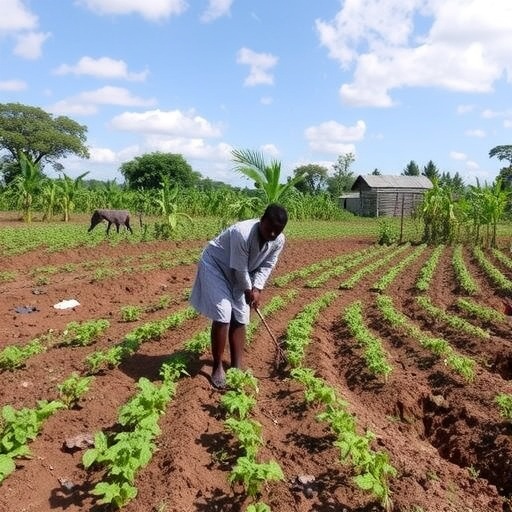
In the face of accelerating climate change and enduring socio-political instability, the adoption of climate-smart agricultural technologies (CSATs) emerges as a critical factor for enhancing food security and resilience in vulnerable regions. Fragile and conflict-affected settings represent some of the most challenging environments where agricultural productivity is often compromised by both environmental shifts and ongoing human conflict. A groundbreaking study published recently in Communications Earth & Environment unveils the multifaceted dynamics influencing the uptake of CSATs in such fragile contexts, providing illuminating insights into pathways for sustainable agricultural development despite persistent adversity.
Fragile contexts commonly endure disrupted governance, resource scarcity, and fractured social fabrics, conditions which pose unique challenges for introducing advanced agricultural innovations. For communities embedded in conflict-affected zones, the intersection of political instability and environmental degradation becomes a compound challenge, often exacerbating food insecurity and undermining livelihoods. The research emphasizes that the successful dissemination and adoption of climate-smart practices in these areas require adaptive frameworks that transcend traditional agricultural interventions to incorporate conflict-sensitive and community-centric approaches.
Climate-smart agricultural technologies encompass a suite of practices and tools designed to increase agricultural productivity sustainably, strengthen resilience against climate variability, and reduce greenhouse gas emissions where possible. These technologies include drought-resistant crop varieties, precision irrigation systems, integrated pest management techniques, and agroforestry practices, among others. However, the pathways to adoption in fragile settings differ substantially from those in stable, resource-rich agricultural systems due to disrupted access to markets, knowledge, and finance.
The analysis highlights socioeconomic constraints as one of the most substantial barriers to CSAT adoption in fragile and conflict-affected regions. Smallholder farmers often have limited access to credit and extension services, crucial levers that facilitate experimentation and scaling of new technologies. Moreover, insecurity and displacement restrict physical access to arable land and farming inputs. The study underscores the necessity for innovative financing mechanisms and mobile extension services that can operate effectively in unstable settings to overcome these economic and logistical hurdles.
Beyond economics, social and cultural dimensions critically shape technology adoption. In conflict-affected areas, trust deficits persist between communities and external actors, including government agencies and international NGOs. This distrust impedes participation in agricultural development programs. By integrating participatory approaches that bolster local leadership and incorporate indigenous knowledge systems, the intervention designs become more attuned to local realities, thus enhancing acceptance and sustainability of climate-smart agricultural practices.
Institutional capacity also emerges as a pivotal context factor. Fragile settings often suffer from weakened institutional frameworks, limited policy support, and inadequate infrastructure. The research calls attention to the role of decentralized governance and community-based organizations in bridging these institutional gaps. Strengthening these local institutions facilitates better coordination of agricultural interventions, dissemination of climate information, and conflict-sensitive service delivery, which collectively foster an enabling environment for CSAT adoption.
Furthermore, technological innovation must be tailored to the specific ecological and conflict dynamics of each setting. Uniform “one-size-fits-all” solutions do not hold in heterogeneous fragile environments where variability in climate risk profiles and conflict intensity demands place-specific strategies. The study presents evidence from diverse case studies demonstrating that adaptive technologies aligned with local agroecological zones and social circumstances dramatically improve outcomes.
In parallel, the research accentuates the value of integrating conflict resolution and peacebuilding efforts with climate-smart agriculture programs. Conflict mitigation strategies embedded within agricultural initiatives enhance social cohesion and create stable conditions necessary for sustainable farming. For example, collaborative land management and equitable resource-sharing frameworks can reduce tensions and build trust among divided communities, thereby fostering a collective sense of purpose in climate adaptation efforts.
The role of data and monitoring systems is another dimension highlighted by the study. Robust data capturing mechanisms enable the identification of vulnerable hotspots and real-time assessment of intervention impacts. In fragile settings, deploying remote sensing technologies and mobile data collection tools allows for ongoing monitoring despite physical access restrictions, informing adaptive management approaches that can respond swiftly to emerging climatic and conflict-related challenges.
Education and capacity building emerge as foundational for empowering local actors to steward climate-smart agriculture independently. Training programs tailored to varied literacy levels and contextualized within local languages and cultural norms enhance knowledge assimilation. Enhancing youth and women’s engagement in these programs is particularly emphasized, as they often constitute the backbone of agricultural labor and innovation in fragile environments.
Climate financing, including access to international climate funds and insurance schemes, presents additional avenues to scale CSAT implementation in conflict zones. However, navigating the stringent requirements and bureaucratic complexities of such funding sources remains a challenge. The study advocates for flexible funding modalities and local-level financial intermediaries that can facilitate successful project design and execution aligned with fragile setting realities.
The findings also address the emerging potential of digital agriculture in fragile contexts. Mobile platforms for weather advisories, pest alerts, and market information can transform how smallholder farmers engage with climate-smart practices. However, digital inclusion requires investments in infrastructure, digital literacy, and trust-building to overcome technological divides exacerbated by instability and marginalization.
Importantly, the study points towards multi-stakeholder partnerships as a linchpin for success. Collaboration among governments, NGOs, research institutions, and local communities enables resource pooling and knowledge exchange that compensate for institutional frailty. Participatory governance models enhance accountability and ensure that interventions reflect collective priorities, thereby sustaining momentum beyond initial project lifespans.
The urgency of addressing climate change impacts within fragile and conflict-affected settings cannot be overstated. With food insecurity projected to rise dramatically in vulnerable regions due to warming temperatures, erratic rainfall, and increased conflict intensity, the scale-up of effective CSATs becomes a global imperative. The comprehensive insights from this research illuminate critical pathways and highlight the complexity of implementing climate adaptation in some of the world’s most precarious environments.
In conclusion, the adoption of climate-smart agricultural technologies in fragile and conflict-affected settings requires an integrative and adaptive approach that recognizes and addresses intersecting environmental and socio-political challenges. By fostering inclusive participation, enhancing institutional resilience, leveraging technological innovation, and embedding peacebuilding within agricultural development, pathways towards sustainable food security and community resilience can be forged. This pioneering study not only charts a roadmap for researchers and practitioners but also signals a hopeful narrative that even in contexts marked by fragility, transformative change in agriculture is attainable.
Subject of Research: Adoption of climate-smart agricultural technologies and practices in fragile and conflict-affected settings.
Article Title: Adoption of climate-smart agricultural technologies and practices in fragile and conflict-affected settings.
Article References:
Nshakira-Rukundo, E., Tabe-Ojong, M.P.J., Gebrekidan, B.H. et al. Adoption of climate-smart agricultural technologies and practices in fragile and conflict-affected settings. Commun Earth Environ (2026). https://doi.org/10.1038/s43247-025-03171-7
Image Credits: AI Generated


