


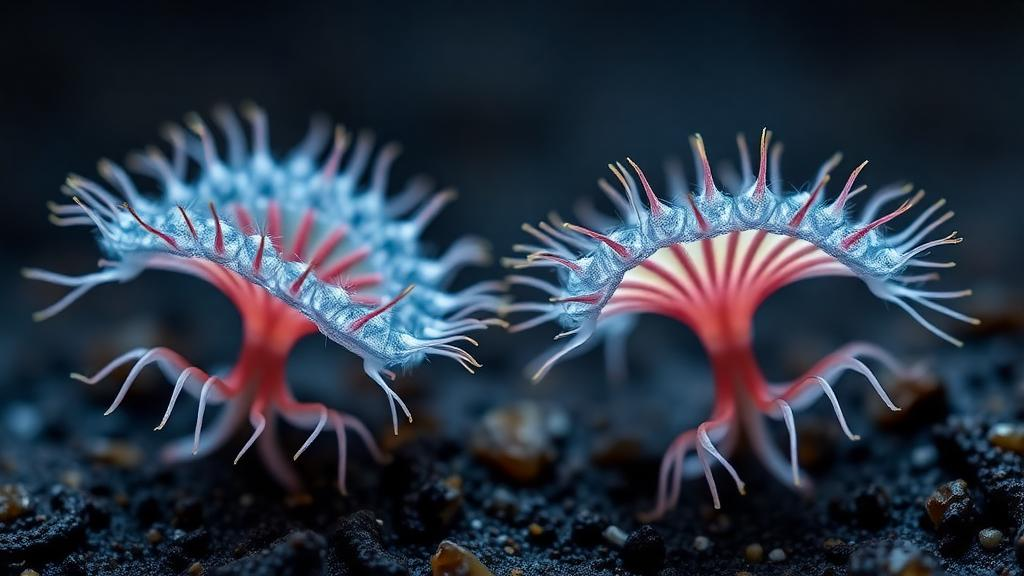
Beneath the moss on a city wall, in the leaf litter of a subtropical forest, and in the soil of a high mountain valley lives an entire menagerie of animals so small that most people will never notice them. Among the most remarkable of these microscopic creatures are the bdelloid rotifers, a group of entirely asexual invertebrates that measure barely a fraction of a millimeter and can survive desiccation, freezing, and even tens of thousands of years in suspended animation. A new large-scale genetic survey of two bdelloid species complexes across China and beyond now reveals that these tiny animals harbor far more hidden diversity than their appearance suggests, and that climate, more than geography or human activity, is the force that has sculpted their distribution across the landscape.
The study, published in the journal Zoosystematics and Evolution, focused on two understudied species complexes: Adineta beysunae and Rotaria sordida. Both are bdelloid rotifers, members of a subclass of over 500 described species known for their obligate parthenogenesis, meaning they reproduce without sex, and for their extraordinary ability to enter anhydrobiosis, a dormant state triggered by drying. Between 2017 and 2025, researchers collected more than 1,300 samples of moss, leaf litter, soil, and lichens from geographically distinct sites across China, supplementing them with publicly available mitochondrial COI sequences from GenBank covering Europe, Africa, and Oceania. From this material they obtained 145 COI sequences for A. beysunae across 15 regions and 194 sequences for R. sordida across 35 regions.
What the mitochondrial barcode revealed was staggering. Phylogenetic analyses combined with automated species delimitation methods identified 10 distinct genetic clades within A. beysunae and no fewer than 58 clades within R. sordida, each potentially representing a cryptic species that is morphologically indistinguishable from its relatives. For R. sordida, this figure dramatically expands on earlier work that had reported only 17 cryptic species from a much smaller sample, and it exceeds even the most clade-rich bdelloid complexes previously documented, such as Adineta vaga with 36 clades. Overall haplotype diversity was extremely high in both species, at 0.973 for A. beysunae and 0.9895 for R. sordida, indicating that nearly every individual sampled carried a unique mitochondrial genotype.
Perhaps the most intriguing finding is that these cryptic lineages do not follow a single biogeographic rule. Instead, the species complexes display a combined pattern of widespread and localized distributions. Several major lineages of both species range across thousands of kilometers of China, overlapping extensively in eastern, central, and southern regions. One R. sordida clade, Clade 6, spans roughly 7,600 kilometers from Switzerland to southwestern China, making it the most widely distributed lineage detected and the only one shared between Europe and China. Yet at the other extreme, dozens of clades were found at only a single sampling locality, and several were restricted to islands, including Hainan Island, the Wanshan Archipelago near Zhuhai, islands in the Pearl River estuary, and Taiwan. Six minor clades of A. beysunae were exclusively insular, and island-restricted R. sordida lineages showed evidence of dispersal between islands without appearing on the adjacent mainland, a signature of oceanic barriers shaping genetic divergence.
Analysis of molecular variance added another layer to the picture. For both species, roughly three-quarters of the total genetic variation, 75.26 percent in A. beysunae and 75.55 percent in R. sordida, occurred within populations rather than among them, indicating limited geographic structuring despite the abundance of distinct lineages. For A. beysunae, Mantel tests showed a significant positive correlation between genetic differentiation and geographic distance, the classic isolation-by-distance pattern. For R. sordida, however, no such correlation emerged, suggesting that geographic distance alone does a poor job of explaining how its lineages are distributed, perhaps because of long-distance dispersal events or broad environmental tolerance.
To determine what actually drives these patterns, the researchers turned to hierarchical partitioning analysis based on distance-based redundancy analysis, a statistical framework that disentangles the unique explanatory power of each predictor while controlling for multicollinearity. They evaluated three categories of drivers: spatial factors such as longitude, latitude, and elevation; climatic variables including annual mean temperature, temperature seasonality, annual precipitation, precipitation seasonality, and mean wind speed drawn from the WorldClim database; and anthropogenic proxies, namely regional GDP and population density. The verdict was clear. Climatic factors explained 53.7 percent of the phylogeographic variance in A. beysunae and 59.8 percent in R. sordida, far outpacing spatial factors at around 36 percent for both species and anthropogenic influences, which contributed only about 10 percent and 5 percent respectively.
Within the climatic suite, the leading variables differed subtly between the species but shared a common theme of environmental harshness and connectivity. For A. beysunae, temperature seasonality accounted for the largest share of explained variance at 13.16 percent, followed by mean wind speed at 11.68 percent. For R. sordida, precipitation seasonality and annual mean temperature led the way. These results make ecological sense for animals whose lives are governed by water. Bdelloid rotifers live in films of moisture on moss and litter, and dehydration forces them to contract and enter dormancy until rehydration. Precipitation therefore directly controls population abundance and community composition. Wind, meanwhile, serves as a dispersal engine: during their desiccated diapausing stage, bdelloids behave like dust grains and can be carried by storms over considerable distances, a mode of transport that may also help them escape fungal pathogens.
The dominance of climate over geography carries broader implications for how scientists think about the biogeography of microscopic life. For decades, the small size of micro-invertebrates and their capacity for multi-vector dispersal led to the assumption that they lacked geographic barriers and were cosmopolitan. Subsequent discoveries of restricted distributions in ciliates, tardigrades, and rotifers, including endemic species in Antarctica and Australia, challenged that view, and molecular tools have since exposed layer upon layer of cryptic diversity within single morphospecies. The new study adds quantitative weight to the argument that environmental selection, not merely physical distance, filters which lineages persist where. Distinct cryptic lineages often exhibit specific niche requirements, and controlled experiments have shown that rotifer lineages from contrasting climates differ in their thermal tolerance, life-history strategies, and gene expression profiles under heat stress.
The findings also underscore how much remains unknown. Many clades were represented by only one individual, and the authors note that low population densities limited genetic sampling of high-altitude lineages on the Qinghai-Tibet Plateau, a region where previous work documented pronounced micro-endemism in other rotifers and crustaceans. Microhabitat variables such as nutrient composition, pH, and moisture content were not quantified, leaving open the question of how fine-scale environmental heterogeneity contributes to lineage divergence. The researchers call for expanded geographic sampling and quantitative microenvironmental measurements to fully resolve the distribution patterns of bdelloid rotifers in China and worldwide.
Beyond its scientific interest, the work has practical consequences for conservation. Cryptic invertebrates are routinely overlooked in biodiversity assessments because their diversity is invisible without molecular data, yet they perform essential roles in decomposition and nutrient cycling. By identifying evolutionarily significant units within widespread morphospecies, studies like this one provide the foundational data needed to prioritize which hidden lineages deserve protection. And as climate change reshapes temperature regimes, precipitation patterns, and wind dynamics across the globe, the finding that these very factors dominate the phylogeography of bdelloid rotifers suggests that even the most resilient microscopic animals, capable of surviving 24,000 years frozen in permafrost, will have their hidden diversity sorted and reshuffled by a changing climate.
Subject of Research: Phylogeography and cryptic genetic diversity of bdelloid rotifer species complexes driven by climatic factors
Article Title: Phylogeography and genetic diversity of Adineta beysunae and Rotaria sordida species complexes ( Rotifera , Bdelloidea ): a combined pattern of widespread and localized distribution driven by climate factors
Article References: Wang, W., Zhang, X., Wang, Q., & Yang, Y. (2026). Phylogeography and genetic diversity of Adineta beysunae and Rotaria sordida species complexes (Rotifera, Bdelloidea): a combined pattern of widespread and localized distribution driven by climate factors. Zoosystematics and Evolution, 102(1), 217-233. https://doi.org/10.3897/zse.102.175772
Image Credits: AI Generated
Keywords: bdelloid rotifers, phylogeography, cryptic species, COI barcoding, genetic diversity, climate drivers, anhydrobiosis, island endemism, China, microinvertebrates, species delimitation, parthenogenesis
Cite Scienmag News
Drew Townsend. (October 18, 2026). Climate, Not Distance, Shapes the Hidden Diversity of Asexual Rotifers. Scienmag. https://scienmag.com/climate-not-distance-shapes-the-hidden-diversity-of-asexual-rotifers/
Drew Townsend. "Climate, Not Distance, Shapes the Hidden Diversity of Asexual Rotifers." Scienmag, 18 October 2026, https://scienmag.com/climate-not-distance-shapes-the-hidden-diversity-of-asexual-rotifers/. Accessed 18 October 2026.
Drew Townsend. "Climate, Not Distance, Shapes the Hidden Diversity of Asexual Rotifers." Scienmag. October 18, 2026. https://scienmag.com/climate-not-distance-shapes-the-hidden-diversity-of-asexual-rotifers/


