Steel corrosion and concrete deterioration quietly eat away at the seismic capacity of reinforced concrete bridges, and a new modeling study shows that the damage climate change inflicts on bridge materials can either amplify or, surprisingly, almost vanish from the earthquake response depending on the type of ground motion that strikes. The finding comes from a detailed finite element investigation of a four-span continuous beam bridge subjected to decades of simulated corrosion under different climate futures, then shaken with three distinct earthquake records.
The study, published in Advances in Bridge Engineering, was led by Pinghe Ni and colleagues, who combined models of chloride-induced corrosion with nonlinear time-history analysis to track how a bridge’s pier-top displacement evolves as materials degrade. Their central question was straightforward: when steel reinforcement loses cross-section and concrete loses strength over a long service life, how does the bridge’s seismic displacement response change, and does the answer depend on whether the earthquake is a violent near-fault pulse or a gentler far-field shake?
To answer it, the researchers first built a chloride diffusion model based on Fick’s second law, then modified it to account for time-varying temperature and relative humidity under climate change. They selected a coastal bridge in Guangdong, China, as the case study, using projected future temperature and relative humidity data for the region under two climate pathways: SSP1-2.6, a relatively mild scenario, and SSP5-8.5, a severe one. Monte Carlo simulation with 10,000 samples quantified when corrosion would begin. Without climate change, the mean corrosion initiation time for the reinforcement was 46.98 years. Under SSP1-2.6 it fell to 30.06 years, and under SSP5-8.5 it dropped further to 29.19 years, meaning that in the harshest climate future, rebar corrosion could begin roughly 18 years earlier than in a static climate.
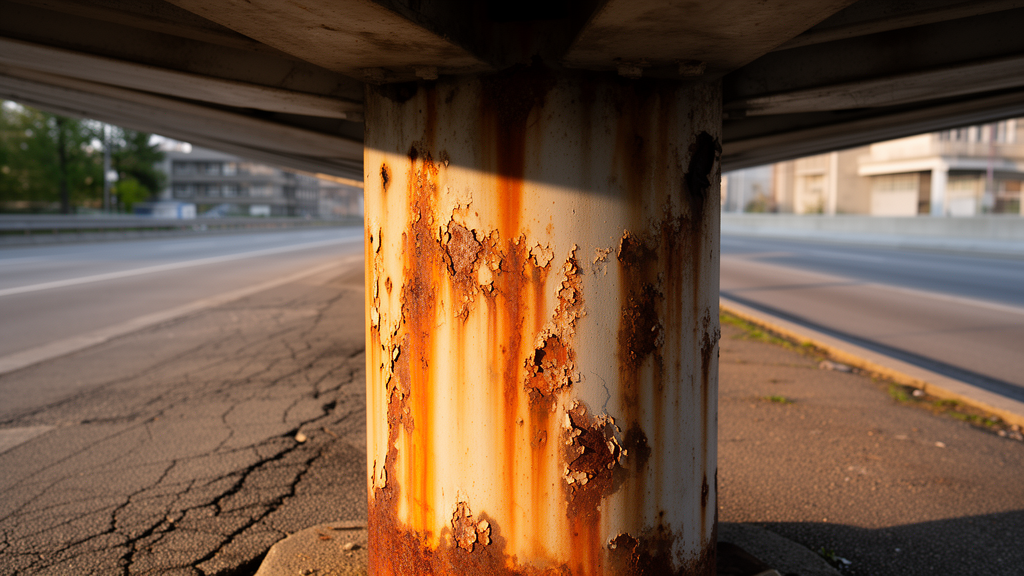
Once corrosion starts, the damage compounds. Pitting corrosion, which the authors note plays the dominant role in reducing load-carrying capacity, eats localized pits into the reinforcing bars, while the accumulation of corrosion products cracks the concrete cover and weakens the bond between steel and concrete. The team applied published reduction models to capture the resulting losses: yield and ultimate strength of the steel decline with mass loss, the elastic modulus drops, and the compressive strength of both cover and core concrete deteriorates. By 100 years of service, the core concrete strength fell from its initial 42 megapascals to 39.80 megapascals without climate change, 34.96 megapascals under SSP1-2.6, and 32.31 megapascals under SSP5-8.5.
These degraded material properties were then fed into an OpenSees finite element model of the bridge, a four-span continuous structure with 50-meter spans, double-column piers 17 meters tall, and a single-box four-chamber girder. The piers, as the key energy-dissipating components, were modeled with nonlinear fiber-section beam-column elements, while the bearings were represented with compression-only and flat-slider behavior. Three earthquake records from the 1994 Northridge earthquake served as inputs: a far-field non-pulsing motion, a near-fault asymmetric pulse, and a near-fault symmetric pulse, each scaled to peak ground accelerations of 0.2g, 0.4g, and 0.6g.
The clearest pattern emerged under far-field shaking. There, pier-top peak displacement rose steadily with corrosion severity. After 75 years of service, at a PGA of 0.2g, the peak displacement was 24.38 millimeters in the static climate scenario, 27.70 millimeters under SSP1-2.6, and 28.00 millimeters under SSP5-8.5. At 0.6g the corresponding values climbed to 74.18, 83.33, and 84.14 millimeters. The abstract reports that pier-top displacement under far-field non-pulse earthquakes is linearly correlated with the corrosion level, and that peak displacement amplitude is mainly governed by PGA, which amplifies the response significantly as it increases.
Under near-fault pulse motions, that tidy relationship broke down. For the near-field asymmetric pulse at 75 years of service, the largest peak displacements occurred in the scenario without climate change, and the smallest under the most severe climate scenario: at 0.2g the values were 33.40, 29.59, and 27.28 millimeters for the static, SSP1-2.6, and SSP5-8.5 cases respectively. The authors attribute this to the strong pulse characteristics and their non-stationary effects dominating the structural response, effectively masking the influence of corrosion degradation. Under the near-field symmetric pulse, the pattern shifted again, with the largest displacements occurring under SSP1-2.6 rather than the harshest scenario, reflecting what the authors describe as increasingly nonlinear and unpredictable behavior when pulse characteristics govern.
Service life added further complexity. Under far-field motion in the SSP1-2.6 scenario, displacement grew consistently with age, from 23.48 millimeters at 25 years to 27.70 millimeters at 100 years for a 0.2g input. But under the near-field asymmetric pulse, the response was distinctly non-monotonic: at 0.2g the peak displacement peaked at 50 years of service and was smallest at 100 years. The authors explain this with a displacement ductility index: at low PGA levels the response is governed by stiffness degradation, so moderately corroded piers displace more, while at high PGA the structure enters the nonlinear stage and peak displacement becomes controlled by ductility and energy dissipation capacity, which are most diminished in severely corroded piers. Under the severe damage condition in SSP1-2.6, the pier damage index was 4.58 at 25 years but only 3.70 at 75 years.
Across all scenarios, one ranking held firm: near-field asymmetric pulse earthquakes produced the largest peak displacements, far-field non-pulsing motions the smallest, and the peak displacement grew substantially with PGA in every case. The authors conclude that pier displacement is primarily controlled by climate scenario, service life, and seismic intensity, and that pulse-type motions, with their concentrated energy, partially mitigate the visible influence of climate change and corrosion on the response while introducing more pronounced nonlinear and uncertain displacement characteristics.
The team is candid about the limits of the work. The results rest on only one ground motion per category, which the authors themselves flag as a reason to treat the findings as preliminary observations, noting that at least seven to ten records per category would be needed for full validation. The material degradation models, though individually verified in prior studies, have not been directly validated as a combined implementation against experimental or field data, and the authors say future work will test the combined model against published corroded column tests. Even so, the study offers a concrete warning for lifecycle assessment: ignoring climate-accelerated deterioration, as earlier work cited by the authors has argued, can make bridge seismic evaluations both unsafe and uneconomical, and the type of earthquake a bridge faces determines whether that deterioration shows up clearly in the response or hides behind the pulse.
Subject of Research: Modeling how climate change-driven corrosion and service life affect the seismic displacement response of a reinforced concrete continuous beam bridge under different ground motion types
Article Title: Seismic performance degradation of reinforced concrete bridges under climate change
Article References: Ni, P., Wu, J., Zhang, W., Huo, J., Bai, Y., & Liu, L. (2026). Seismic performance degradation of reinforced concrete bridges under climate change. Advances in Bridge Engineering, 7(1), Article 32. https://doi.org/10.1186/s43251-026-00220-9
Image Credits: AI Generated
DOI: 10.1186/s43251-026-00220-9
Keywords: climate change, reinforced concrete bridges, seismic performance, chloride-induced corrosion, near-fault ground motions, far-field earthquakes, finite element analysis, OpenSees, pier-top displacement, material degradation, SSP scenarios, time-history analysis
Cite Scienmag News
Denise Maddox. (October 28, 2026). Climate-Driven Corrosion Reshapes How Bridges Shake in Earthquakes. Scienmag. https://scienmag.com/climate-driven-corrosion-reshapes-how-bridges-shake-in-earthquakes/
Denise Maddox. "Climate-Driven Corrosion Reshapes How Bridges Shake in Earthquakes." Scienmag, 28 October 2026, https://scienmag.com/climate-driven-corrosion-reshapes-how-bridges-shake-in-earthquakes/. Accessed 28 October 2026.
Denise Maddox. "Climate-Driven Corrosion Reshapes How Bridges Shake in Earthquakes." Scienmag. October 28, 2026. https://scienmag.com/climate-driven-corrosion-reshapes-how-bridges-shake-in-earthquakes/