


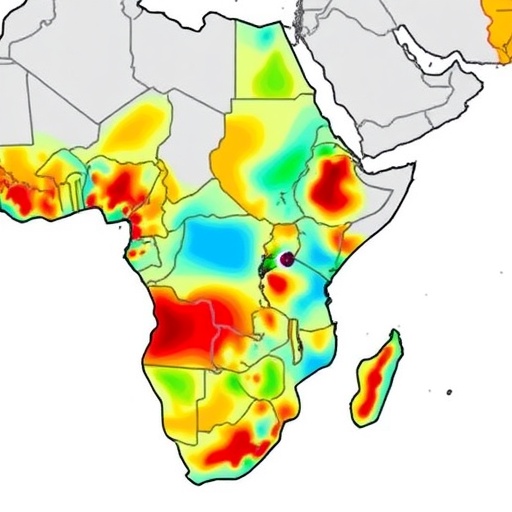
In an era where climate change is exerting unprecedented pressure on global agriculture, a cutting-edge study has emerged offering a beacon of hope for African farmers. The research, spearheaded by Yang, Guarin, Freduah, and colleagues, introduces sophisticated climate-crop models designed to foster adaptive strategies for opportunity crops across Africa. These models provide crucial insights into how the continent’s diverse agricultural landscapes can pivot and thrive amid shifting environmental parameters, pointing toward a future where resilience is engineered through science and innovation.
The continent of Africa, long reliant on agriculture as a foundational economic pillar, faces immense challenges due to climatic variability. Temperature fluctuations, altered precipitation patterns, and extreme weather phenomena jeopardize traditional cropping calendars and the overall viability of staple crops. The profound implications affect food security and economic stability for millions. Against this backdrop, the study’s modeling approach integrates detailed climate projections with crop physiological responses, forming a predictive framework that guides decision-making at local, regional, and continental levels.
At the study’s core are advanced biophysical models that simulate crop growth under a range of climatic scenarios. These models incorporate variables such as temperature, solar radiation, soil moisture, and atmospheric CO2 concentrations to forecast the performance of various “opportunity crops” — those crops with potential for expanded cultivation under future climate regimes. By taking into account soil properties, irrigation practices, and crop phenology, the models generate granular predictions on yield potentials, helping to identify where and when certain crops could optimally succeed.
One of the standout features of the research is its ability to assess multiple climate futures using ensembles of climate model outputs. This approach effectively manages the inherent uncertainty in climate projections, offering robust decision support tools. It highlights which crops may gain regional prominence as conditions evolve and how cultivation patterns can shift to not only sustain but also enhance productivity. This paradigm shift from reactive to proactive agricultural planning is poised to reshape Africa’s food systems profoundly.
The interdisciplinary nature of the work is notable, blending climatology, agronomy, and data science. By tapping into extensive datasets and sophisticated computational techniques, the team harnesses the power of high-resolution climate modeling paired with crop growth algorithms. Their analyses extend beyond static assessments, emphasizing dynamic adaptation pathways over coming decades, which allows policymakers and stakeholders to explore alternative strategies grounded in empirical evidence.
Importantly, the models emphasize “opportunity crops” rather than staple crops alone, recognizing the potential to diversify cropping systems to buffer against climate-induced risks. Crops such as cowpea, millet, sorghum, and pigeon pea, characterized by resilience to drought and heat, are focal points. This crop diversification strategy is crucial to unlocking new agricultural frontiers and improving nutritional outcomes, especially in regions where traditional crops may become less viable.
The study also addresses socio-economic variables by considering smallholder farmer contexts and regional food systems. It recognizes that adoption of new cropping practices hinges on market access, input availability, and farmer knowledge. By integrating climatic insights with agrarian realities, the models offer pragmatic pathways for scaling up adaptive cropping systems that are economically viable and socially acceptable.
Key to the research is the temporal aspect, projecting crop adaptation opportunities through mid-century and beyond. This foresight equips agricultural extension services, governments, and development agencies with a temporal roadmap to target investments, infrastructure development, and research priorities. For example, irrigation infrastructure could be optimized based on predicted shifts in seasonal water availability, thus maximizing the benefits of choosing drought-tolerant crops.
Furthermore, this framework lends itself to integration with satellite remote sensing and ground-truthing to continuously refine predictions and adaptation strategies in near real-time. This iterative capability ensures that models remain responsive to emerging environmental trends and on-the-ground feedback, facilitating a feedback loop between science and practice.
The study’s comprehensive spatial coverage, encompassing diverse agroecological zones across Africa, reinforces its utility at scales relevant to continental food security. It provides a platform for tailoring recommendations to specific biomes—from arid Sahelian landscapes to more humid savanna and equatorial zones—ensuring relevance for heterogeneous farming systems.
Moreover, the outputs reaffirm the urgency of aligning agricultural development with climate resilience initiatives globally. By foregrounding empirical climate-crop interactions, the research underscores the necessity of embedding adaptation into policy frameworks and sustainable development goals. This aligns with broader international efforts to mitigate and adapt to climate change impacts on food systems.
Technologically, the research leverages novel machine learning techniques to enhance model precision and computational efficiency. This integration marks a significant advance in predictive agronomy, enabling more nuanced understanding of complex environmental dynamics, including extreme events such as drought spells and heatwaves that can devastate crop yields.
Overall, this pioneering study exemplifies how data-driven approaches can revolutionize agriculture in vulnerable regions by transforming insights into actionable strategies. It offers a path forward not just for Africa but for other climate-sensitive regions seeking to harness science for resilient food production.
The ambitious scope and interdisciplinary rigor of this research herald a new chapter in agricultural adaptation science. The potential to inform large-scale transformation, underpinned by local realities and future uncertainties, positions these climate-crop models as vital tools in the fight against food insecurity triggered by climate change.
Finally, the authors emphasize the importance of collaboration across scientific, governmental, and farming communities to realize the models’ full potential. By fostering inclusive dialogue and co-creation of adaptive strategies, stakeholders can collectively navigate the complexities of future agricultural systems, ensuring a secure and sustainable food future for Africa’s populations.
Cite Scienmag News
Alan Morgan. (December 18, 2025). Climate-Crop Models Boost Africa’s Crop Adaptation. Scienmag. https://scienmag.com/climate-crop-models-boost-africas-crop-adaptation/
Alan Morgan. "Climate-Crop Models Boost Africa’s Crop Adaptation." Scienmag, 18 December 2025, https://scienmag.com/climate-crop-models-boost-africas-crop-adaptation/. Accessed 4 September 2026.
Alan Morgan. "Climate-Crop Models Boost Africa’s Crop Adaptation." Scienmag. December 18, 2025. https://scienmag.com/climate-crop-models-boost-africas-crop-adaptation/


