

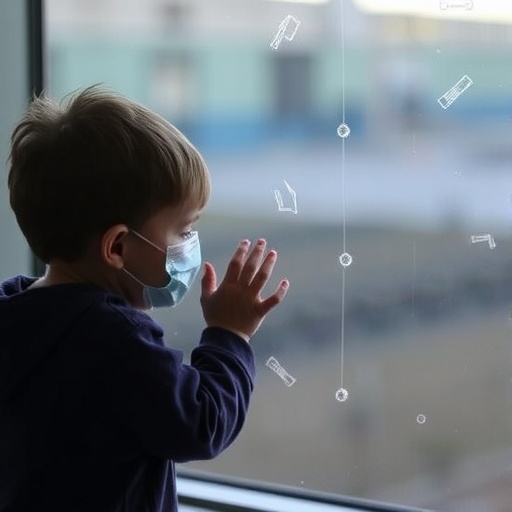
In a groundbreaking study published in Nature Communications, a team of researchers led by Park, Holmdahl, and Howerton have uncovered a compelling explanation for a sudden shift in the seasonality of respiratory syncytial virus (RSV) infections in Japan. Their work delves deep into the intricate relationship between climatic variables and patterns of childhood social mixing, revealing how these two factors have combined to reshape the timing and intensity of RSV epidemics in recent years. This discovery not only sheds light on the complex drivers behind viral seasonality but also carries significant implications for public health planning and epidemic preparedness.
Respiratory syncytial virus is a ubiquitous viral pathogen responsible for respiratory infections predominantly affecting infants and young children. Historically, RSV outbreaks in Japan followed a remarkably consistent seasonal pattern, peaking in the colder months, typically from late autumn through winter. However, recent epidemiological surveillance has demonstrated an abrupt and unexpected transition in this seasonal hallmark, with RSV epidemics now occurring at different times of the year, disrupting conventional assumptions about viral transmission cycles. The reasons for this unprecedented shift were previously unclear, posing challenges for healthcare systems in timing preventive measures and resource allocation.
By harnessing sophisticated mathematical modeling approaches combined with extensive epidemiological data spanning multiple years, the research team embarked on dissecting the mechanisms behind this abrupt shift. They integrated detailed climate records—encompassing temperature, humidity, and precipitation—with social behavior metrics, particularly focusing on the frequency and nature of childhood contacts, such as those occurring in daycare centers, schools, and community settings. Their models revealed that no single factor adequately explained the phenomenon; rather, it was the synergistic interaction between climatic changes and alterations in childhood mixing patterns that precipitated the new RSV seasonality.
One key technical insight from the study lies in the role of temperature and humidity in modulating virus viability and transmission efficiency. Warmer temperatures and higher humidity traditionally suppress RSV survival on surfaces and in aerosols, thereby reducing transmission potential during certain times of the year. Meanwhile, shifts toward milder winters with fluctuating climatic conditions have disrupted this environmental balance. The researchers quantified how incremental climate changes, even those considered subtle in the broader context of global warming, critically influenced the virus’s capacity to persist and spread among susceptible hosts.
Concurrently, changes in social mixing patterns among children emerged as a pivotal factor amplifying or attenuating RSV spread. In recent years, demographic transitions and public health interventions—ranging from alterations in daycare attendance rates to behavioral changes following pandemic-related disruptions—have reshaped how children interact. Reduced density in certain communal settings during typical peak seasons, followed by periods of intensified contact in others, created a shifting mosaic of transmission opportunities. The team employed age-structured contact matrices derived from detailed social surveys, revealing that shifts in the timing and intensity of childhood mixing events strongly aligned with the temporal changes in RSV outbreaks.
This intricate dance between environment and social behavior, the authors argue, constitutes a nonlinear feedback system capable of generating abrupt transitions in virus seasonality. Rather than a smooth, incremental shift, the system can tip suddenly once certain thresholds of climatic conditions and social mixing intensity are crossed. Their mechanistic model simulations faithfully reproduced the observed epidemiological patterns, providing robust validation of their hypothesis. Such threshold dynamics underscore the sensitivity of viral transmission systems to multifaceted ecological pressures.
Importantly, the study goes beyond pure academic inquiry. These insights equip epidemiologists and public health officials with a more nuanced framework to anticipate and manage RSV epidemics. With vaccines against RSV for children and older adults on the horizon, timing immunization campaigns to preempt shifts in seasonality becomes critical. Furthermore, the findings highlight the need for dynamic surveillance systems that simultaneously monitor environmental parameters and social behaviors to detect early warnings of epidemic changes.
The methodology employed in this research also sets a new standard for studying other seasonal infectious diseases sensitive to climate and social dynamics. The integration of high-resolution climatic data, extensive demographic information, and advanced epidemiological modeling offers a blueprint for future investigations into diseases such as influenza and norovirus. This interdisciplinary approach, combining climatology, epidemiology, and social science, exemplifies the leap needed to tackle emerging complexities in infectious disease ecology.
Beyond Japan, these findings carry global relevance, especially as climate change accelerates and societal norms evolve worldwide. Countries with comparable climatic zones or social structures might experience analogous shifts in RSV or similar respiratory pathogens, potentially catching health systems unprepared. The study compellingly argues for incorporating such multifactorial analyses into global health preparedness frameworks—a vital step in mitigating the impact of viral respiratory infections.
The research also explores the potential impact of future climate scenarios on RSV transmission. Through projections using climate models aligned with different greenhouse gas emission pathways, the authors predict further alterations in RSV seasonality could emerge by mid-century. These projections emphasize the urgency of integrating climate adaptability into infectious disease control strategies. Public health policies must be agile, anticipating not only current but emerging epidemiological landscapes shaped by environmental change.
Another intriguing aspect of the study is the elucidation of how behavioral interventions, such as school closures or hygiene campaigns, interact with climatic conditions to modulate RSV outbreaks’ timing. The authors demonstrate that social measures can either reinforce or counteract climatic influences, providing important leverage points for policymakers. For instance, targeted interventions during critical mixing periods or anticipated climatic windows can suppress viral transmission despite otherwise conducive environmental conditions.
Moreover, the detailed age-specific transmission dynamics uncovered offer significant insights into RSV’s epidemiology. By highlighting which age groups act as primary drivers of infection and how their contact patterns vary seasonally, the study informs targeted protective strategies. This granular understanding can optimize vaccination and prophylaxis efforts, enhancing their efficacy and cost-effectiveness.
Overall, the study by Park and colleagues stands as a landmark contribution to infectious disease science. It exemplifies how deep integration of diverse datasets coupled with innovative modeling can unravel perplexing epidemiological phenomena. Their work enriches our understanding of RSV and acts as a harbinger for how a changing world reshapes infectious disease landscapes in unpredictable ways.
As public health authorities digest these insights, the prospect of adapting to shifting viral threat patterns becomes palpable. This research offers a roadmap: by continuously monitoring environmental variables alongside social behavior and leveraging predictive models, societies can stay a step ahead of spontaneous epidemic shifts. In a world increasingly affected by climate variability and evolving human interactions, such forward-looking strategies are not just desirable—they are indispensable.
In conclusion, the sudden alteration in RSV seasonality in Japan, once enigmatic, now emerges as a product of complex interplay between a changing climate and dynamic social mixing among children. This discovery resonates as a clarion call for interdisciplinary vigilance and adaptability in infectious disease management. As the scourge of respiratory viruses continues to challenge health systems, the integrative approach championed by this study lights the path toward resilient, informed responses.
Subject of Research: The interaction between climate change and childhood social mixing patterns in shaping respiratory syncytial virus (RSV) seasonality.
Article Title: Interplay between climate and childhood mixing can explain a sudden shift in RSV seasonality in Japan.
Article References:
Park, S.W., Holmdahl, I., Howerton, E. et al. Interplay between climate and childhood mixing can explain a sudden shift in RSV seasonality in Japan. Nat Commun (2025). https://doi.org/10.1038/s41467-025-66184-y
Image Credits: AI Generated


