

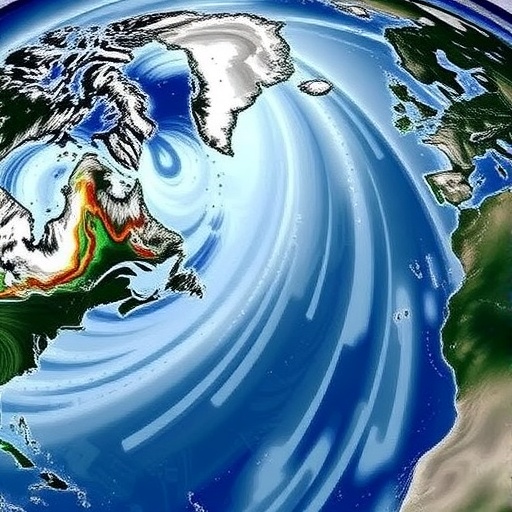
In recent decades, the dynamic processes governing oceanic ventilation in the North Atlantic have attracted intense scientific scrutiny due to their critical role in modulating global climate. A groundbreaking study published in Nature Communications in 2026, led by Guo, H., Koeve, W., and Kriest, I., reveals that significant changes in North Atlantic ventilation over the past thirty years may be intricately linked to anthropogenic climate change. This revelation not only deepens our understanding of ocean-atmosphere interactions but also underscores the vulnerability of oceanic systems to ongoing environmental shifts.
Ocean ventilation refers to the process through which surface waters—rich in oxygen and other atmospheric gases—are transported into deeper layers of the ocean. This mechanism is fundamental for maintaining oceanic health, sustaining marine ecosystems, and regulating carbon storage. The North Atlantic Ocean, in particular, plays a pivotal role because it is the site where surface waters cool and sink, forming deep water masses that drive the global thermohaline circulation, often described as the ocean’s conveyor belt. Changes in ventilation can thus profoundly affect carbon sequestration and heat distribution across the planet.
The research team utilized state-of-the-art observational datasets alongside advanced climate models to trace ventilation trends from the late 20th century through the early 21st century. Their analysis highlights a marked decline in ventilation efficiency over the last three decades. This decline manifests as reduced oxygen penetration into intermediate and deep water layers and diminished renewal rates of these waters. Importantly, such changes appear to coincide temporally with increased surface ocean temperatures and shifts in atmospheric circulation patterns derived from anthropogenic warming.
Mechanistically, the study suggests that warming surface waters inhibit the formation of cold, dense water masses essential for driving deep convection in the North Atlantic. This reduction in water density contrasts diminishes sinking strength, which in turn impairs the vertical exchange of waters. Furthermore, altered wind stress patterns and changes in freshwater input—both consequences of climate change—exacerbate stratification. This stratification further suppresses ventilation by stabilizing surface waters and reducing turbulent mixing that normally facilitates oxygen transport downward.
The implications of declining North Atlantic ventilation reach far beyond regional oceanography. One of the most profound consequences pertains to the ocean’s role as a carbon sink. Since ventilated deep waters help transport carbon from the surface to the seafloor where it can be sequestered for centuries, a slowdown in this process could compromise the ocean’s capacity to mitigate atmospheric CO2 rises. Such a feedback loop represents a potentially self-reinforcing mechanism accelerating global warming trends, an alarming prospect the authors emphasize.
In addition to biogeochemical ramifications, shifts in North Atlantic ventilation affect climatic systems through their influence on the Atlantic Meridional Overturning Circulation (AMOC). A weakened AMOC, documented in various observational studies, is linked to altered weather patterns across Europe and North America, including more severe winters, droughts in the Sahel, and disrupted hurricane activity. The new study’s findings lend further support to the hypothesis that climate-driven ventilation changes may be pivotal drivers behind recent AMOC variability.
Methodologically, the researchers adopted an interdisciplinary approach, combining hydrographic data, oxygen isotope analysis, and biogeochemical tracer measurements. This was complemented by Earth system model simulations forced with historical greenhouse gas emission scenarios, thereby allowing for differentiation of natural variability from anthropogenically induced changes. The robust convergence of multiple lines of evidence strengthens the confidence in the study’s conclusions, highlighting the sophistication of modern marine research efforts.
One notable aspect of the study is its temporal resolution, revealing how decadal-scale changes have unfolded in relation to key climate events, such as the El Niño-Southern Oscillation phases and the North Atlantic Oscillation index variations. By disentangling these influences, the authors demonstrate that while natural climate oscillations contribute to short-term fluctuations, the persistent long-term trend of ventilation decline unmistakably aligns with the trajectory of human-induced climate perturbations.
Data collected from autonomous floats and deep-sea moorings provided unprecedented spatial coverage and continuous record-keeping, enabling precise detection of subtle ventilation dynamics. This advancement in ocean observing systems has been crucial in capturing the complexity of ventilation processes that were previously masked by sparse sampling. The integration of these new data streams marks a transformative step forward in oceanographic monitoring.
Moreover, the study addresses potential future trajectories of North Atlantic ventilation under various emission pathways projected by the Intergovernmental Panel on Climate Change (IPCC). Model scenarios indicate that without aggressive greenhouse gas mitigation, ventilation rates could continue to decline substantially throughout the 21st century, exacerbating negative impacts on both marine biogeochemistry and climate systems. Conversely, stabilizing greenhouse gas concentrations could partially alleviate these trends, emphasizing the importance of global climate policies.
The researchers also discuss the feedback mechanisms linking decreased ventilation to ocean deoxygenation and acidification. Reduced oxygen transport to deeper waters can create hypoxic conditions detrimental to deep-sea organisms, potentially jeopardizing biodiversity and altering ecosystem services. Simultaneously, altered carbon chemistry impacts calcifying organisms, which rely on stable pH conditions for shell formation. Understanding these biotic responses is critical for predicting ecosystem resilience under climate change.
The study’s findings urge the scientific community and policymakers to prioritize enhanced monitoring and modeling of ocean ventilation processes. Given the ocean’s integral role in climate regulation and human livelihoods, delays in addressing ventilation changes could lead to unforeseen consequences. The authors call for international collaboration to better integrate ocean data infrastructures and support sustained observations to improve predictive capabilities and inform adaptive management strategies.
Public awareness of the ocean’s vulnerability and its connection to global climate systems remains low. This research lends itself to widespread dissemination, illustrating the concrete links between human activities and the health of vital ocean processes. Communicating such science effectively could galvanize support for ocean conservation and climate mitigation efforts, positioning marine stewardship as a central element of sustainable development agendas.
In summary, Guo and colleagues present a compelling narrative supported by comprehensive evidence that North Atlantic ventilation has declined significantly over recent decades and that these changes are likely a direct consequence of anthropogenic climate forcing. Their work highlights a critical feedback loop with far-reaching ecological and climatic implications, making a strong case for intensified research and policy action. As humanity grapples with climate change, understanding and protecting ocean ventilation emerges as a key frontier.
This study stands as an extraordinary testament to the power of modern oceanographic science and the urgent need for integrated approaches to confront the growing challenges of a warming world. The North Atlantic, once a symbol of robust ocean circulation, now signals vulnerability. The research not only extends the scientific frontier but also serves as a clarion call to safeguard the ocean’s vital functions for future generations.
Subject of Research: Changes in North Atlantic ocean ventilation over the past three decades and its potential linkage to anthropogenic climate change.
Article Title: North Atlantic ventilation change over the past three decades is potentially driven by climate change.
Article References:
Guo, H., Koeve, W., Kriest, I. et al. North Atlantic ventilation change over the past three decades is potentially driven by climate change. Nat Commun (2026). https://doi.org/10.1038/s41467-025-67923-x
Image Credits: AI Generated


