


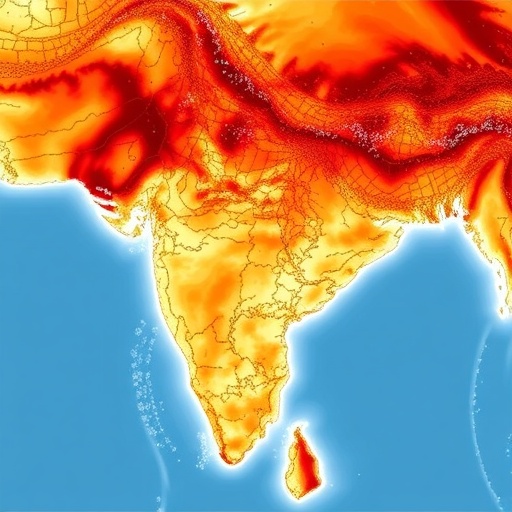
Climate change, an ever-looming phenomenon, continues to reshape our planet in ways that are both profound and alarming. Among the myriad effects attributed to this global crisis, the increase in global evaporative demand stands out as a pivotal aspect influencing various climatic and hydrological systems. A groundbreaking study led by researchers including Karimzadeh, Ahmadi, and Baldocchi sheds light on this critical issue, revealing that climate change has significantly increased evaporative demand across much of the globe, with a notable exception in the South Asian region. This revelation has profound implications for water resources management, agriculture, and environmental sustainability.
The research highlights that evaporative demand refers to the amount of water that could potentially evaporate from soil and transpire through plants under specific atmospheric conditions. This demand is closely linked to temperature, humidity, wind speed, and solar radiation – all factors that are experiencing alteration due to climate change. The findings from this study indicate an alarming global trend: as temperatures rise, the capacity of the atmosphere to draw moisture from the earth’s surface has correspondingly intensified. This increase escalates the challenges faced by regions that are already grappling with water scarcity.
Particularly alarming is the revelation that despite the global trend, South Asia stands as an anomaly. The researchers emphasize that in this densely populated and economically vulnerable region, evaporative demand has not followed the same upward trajectory. This divergence raises critical questions about the underlying climatic dynamics at play and the possible socio-economic implications for the millions who rely on consistent water supplies for their livelihoods. The researchers urge for a deeper understanding of regional climatic anomalies to address the needs of areas that face changing hydrological faces differently.
The implications of increased global evaporative demand are far-reaching. For agriculture, an essential sector in many economies, heightened evaporative stress can reduce soil moisture levels, stressing crops and leading to lower yields. This situation is compounded in regions already facing water shortages, potentially leading to food insecurity. Thus, agricultural resilience is threatened, necessitating innovative water management strategies and crop irrigation techniques that can adapt to a changing climate. Farmers will need to consider alternative crop types that require less water or employ advanced irrigation technologies to mitigate the impacts of increased evaporation.
Moreover, water management policies at both local and national levels will require reevaluation in light of these findings. Policymakers must take into account the varying effects of climate change across different regions when devising sustainability strategies. While some areas might benefit from increased precipitation, others could find themselves grappling with drought-like conditions as demand for water becomes more pronounced. The research emphasizes the necessity for adaptive governance, which can efficiently respond to the dynamic interactions between climate factors and water resources.
This study calls into question the traditional paradigms of hydrological modeling, which often rely on historical data that may no longer be applicable in the face of rapid environmental change. Researchers must develop models that incorporate the latest climatic data to better predict future trends in water availability. Such predictive capabilities are essential for effective risk management, especially in a world where climate variability and extremes are becoming the norm rather than the exception.
Moreover, the role of climate change in altering regional weather patterns cannot be overlooked. The study indicates that regions experiencing reduced evaporative demand may be subjected to other stressors, such as altered precipitation patterns or increased flooding. Given the interconnectedness of climate systems, the effects in one region inevitably ripple through others, establishing a complex web of consequences that demand a multi-faceted approach to climate science and policy.
In light of this latest research, scientists are urged to collaborate across disciplines to deepen their understanding of how climate change influences local hydrology. As a global community, there is an urgent need to share knowledge and resources to address the challenges presented by these shifts. Only through interdisciplinary collaboration can meaningful solutions be crafted to combat the inadequacies in water supply, food security, and regional climate adaptation strategies.
In summary, the findings by Karimzadeh, Ahmadi, and Baldocchi present an urgent call to action for scientists, policymakers, and agricultural stakeholders alike. The insights into increased evaporative demand underscore the necessity for innovative solutions to grapple with the challenges posed by climate change. As the planet undergoes shifts that profoundly affect water resources and agriculture, the focus must not only rest on mitigation strategies but also on adaptation. The echoes of this research will resonate for years to come, setting the stage for critical discussions about climate resilience in the face of ongoing environmental transformations.
As the world grapples with the ramifications of climate change, the paradigm of research and front-line policy must adapt. Acknowledging the variance in climatic impact across different global regions, efforts must align to formulate cohesive strategies that address both environmental preservation and societal needs. This latest study exemplifies how understanding localized climatic nuances can yield insights vital for sustainable management as we navigate an uncertain future.
In conclusion, while the data paints a concerning picture of increasing evaporative demand globally, the divergence observed in South Asia provides a unique platform for understanding regional climate responses. By dissecting the complexities of these developments further, the scientific community can enhance preparedness and foster resilience amidst the uncertainty wrought by climate change.
Karimzadeh, S., Ahmadi, A., Baldocchi, D. et al. Climate change has increased global evaporative demand except in South Asia.
Commun Earth Environ (2025). https://doi.org/10.1038/s43247-025-02959-x
Cite Scienmag News
Sloane Callahan. (December 1, 2025). Climate Change Boosts Evaporative Demand, Excluding South Asia. Scienmag. https://scienmag.com/climate-change-boosts-evaporative-demand-excluding-south-asia/
Sloane Callahan. "Climate Change Boosts Evaporative Demand, Excluding South Asia." Scienmag, 1 December 2025, https://scienmag.com/climate-change-boosts-evaporative-demand-excluding-south-asia/. Accessed 3 September 2026.
Sloane Callahan. "Climate Change Boosts Evaporative Demand, Excluding South Asia." Scienmag. December 1, 2025. https://scienmag.com/climate-change-boosts-evaporative-demand-excluding-south-asia/


