


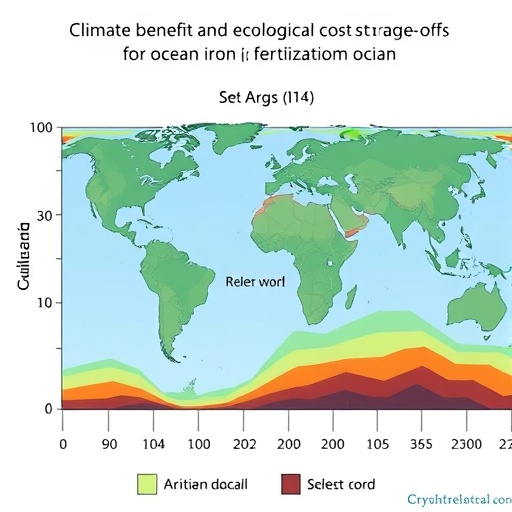

Ocean iron fertilization (OIF) is being discussed as a potential carbon dioxide removal (CDR) strategy1. Yet the trade-offs between climate benefits and ecological costs remain poorly understood2,3,4. Here we use a process-rich ocean biogeochemical model with validated representations of marine biodiversity and biogeochemistry5 to quantify fertilization potential and ecosystem impact across ten ocean biomes over 60 years. We find regional disparities in climate ecosystem trade-offs: biomes with comparable CDR efficiency have contrasting ecological outcomes. The Southern Ocean and the equatorial Pacific achieve the highest efficiencies through distinct pathways: the former through non-local downstream carbon export, the latter through local export with downstream loss, as fertilized blooms deplete macronutrients in source water, suppressing non-local productivity. Consequently, equatorial fertilization reduces energy flows to higher trophic levels, expands oxygen-minimum zones (OMZs) and reduces macrozooplankton biomass. These ecosystem impacts are potentially avoidable by shifting deployment to higher latitudes. Post-fertilization recovery experiments reveal ecosystem resilience in the Southern Ocean but persistent perturbations in the equatorial Pacific owing to regional iron retention. Balancing climate benefits and ecological risks yields three tiers: the Southern Ocean (higher efficiency/lower risk); the equatorial Pacific and global fertilization (higher efficiency/higher risk); and the subtropics (lower efficiency/moderate risk). Sixty years of fertilization yield net CDR of 1.1–5.3 ppm, with more than half re-emitted within decades post-fertilization. The disconnect between local interventions and global outcomes complicates robust carbon crediting and raises equity and governance concerns.
Yu, J., Moore, J.K., Primeau, F.W. et al. Climate benefit and ecological cost trade-offs for ocean iron fertilization.
Nature (2026). https://doi.org/10.1038/s41586-026-10795-y
https://doi.org/10.1038/s41586-026-10795-y
Cite Scienmag News
Violet Maxwell. (July 30, 2026). Climate benefit and ecological cost trade-offs for ocean iron fertilization. Scienmag. https://scienmag.com/climate-benefit-and-ecological-cost-trade-offs-for-ocean-iron-fertilization/
Violet Maxwell. "Climate benefit and ecological cost trade-offs for ocean iron fertilization." Scienmag, 30 July 2026, https://scienmag.com/climate-benefit-and-ecological-cost-trade-offs-for-ocean-iron-fertilization/. Accessed 4 September 2026.
Violet Maxwell. "Climate benefit and ecological cost trade-offs for ocean iron fertilization." Scienmag. July 30, 2026. https://scienmag.com/climate-benefit-and-ecological-cost-trade-offs-for-ocean-iron-fertilization/

