


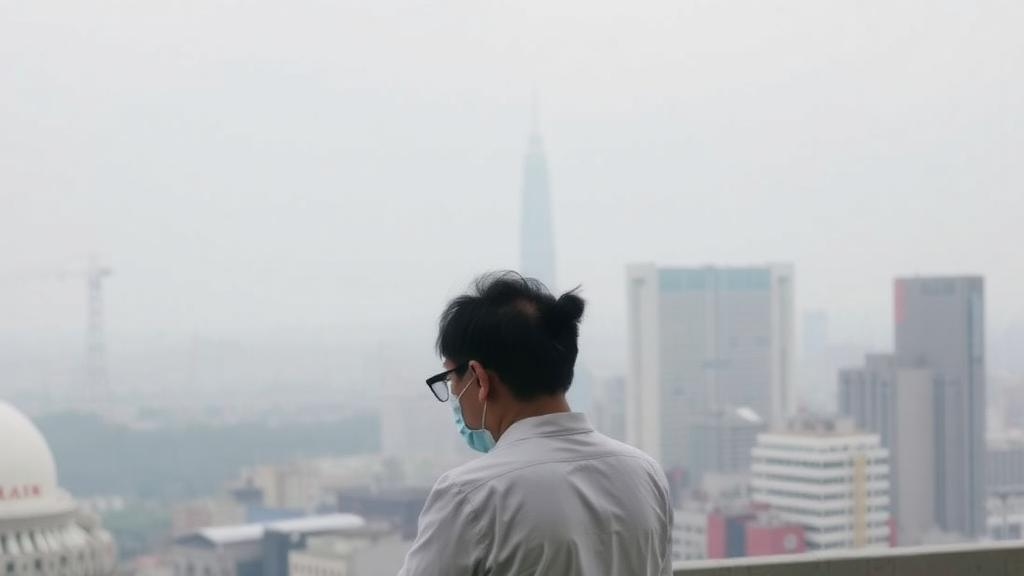
When the air over a Chinese city turns hazy, residents do not just reach for face masks. Increasingly, they reach for their keyboards. A sweeping new study drawing on thirteen years of data from 277 prefecture-level cities has found that as air quality improves, public attention to depressive emotions measurably falls, and when pollution worsens, that attention climbs. The research, published in Frontiers in Psychology, offers some of the most granular evidence yet that the psychological toll of dirty air is not confined to hospitals or clinics but ripples through the everyday digital behavior of millions.
Depression affects an estimated 280 million people worldwide and ranks among the leading causes of years lived with disability. In China, the lifetime prevalence of depressive disorders approaches 7 percent, yet only a small fraction of those affected ever reach specialist care. Most emotional distress therefore never enters a clinical record. It is precisely this sub-threshold pool of distress that the study’s authors, Chao Wang of the Chongqing Mental Health Center and Haitao Zhang of Chongqing University of Education, sought to capture, using internet search behavior as a real-time, population-wide barometer of collective psychological state.
The measurement strategy is elegant in its simplicity. Rather than relying on clinical diagnoses or self-report surveys, which are costly, lagged, and vulnerable to social desirability bias, the researchers turned to the Baidu Index, China’s dominant search engine analytics platform. They aggregated daily search volumes for three keywords spanning a spectrum from general emotional expression to active help-seeking: “depression,” “depressive disorder,” and “what are the symptoms of depression.” These daily figures were summed to city-year totals, combined with equal weight, and log-transformed. To validate the measure, the team correlated it with provincial psychiatric hospital outpatient visit data from the China Health Statistics Yearbook, finding a significant positive correlation of 0.412, strong evidence that online searching tracks real mental health service demand.
On the explanatory side, the study eschewed simple annual average pollution readings in favor of a more policy-relevant metric: the proportion of days in a year meeting China’s national Grade II air quality standard, corresponding to an Air Quality Index of 100 or below. This measure captures a city’s sustained capacity to deliver clean air as a fundamental environmental public good rather than merely its average pollutant load. Data came from official monitoring by China’s Ministry of Ecology and Environment, supplemented for earlier years by counts published in municipal statistical yearbooks and environmental bulletins.
The analytical framework rests on two complementary theories. Environmental stress theory explains how chronic, diffuse pollution becomes a psychological burden: residents appraise polluted air as a threat they cannot escape, generating a sense of coping powerlessness that fuels anxiety, helplessness, and depression. Neurobiologically, chronic stress dysregulates the hypothalamic-pituitary-adrenal axis, suppresses prefrontal cortex function, and over-activates the amygdala, while pollutants themselves can cross the blood-brain barrier, trigger neuroinflammation, and damage emotion-regulating regions such as the hippocampus. Social support theory adds a second layer: clean air is the most widely shared environmental resource a city provides, and its scarcity simultaneously weakens the direct pathway to well-being and erodes the social interactions through which support is produced, since outdoor recreation and informal neighborhood contact decline when residents stay indoors.
The empirical results are striking. In a two-way fixed-effects panel regression controlling for both city and year effects, each one percentage point increase in the proportion of days meeting air quality standards corresponds to an average decrease of approximately 0.47 percent in public attention to depressive emotions. The coefficient is robust across alternative keyword measures, lagged specifications extending up to three years, exclusion of pandemic years, removal of municipalities, restriction to the post-2015 window when all cities reported under the new AQI standard, and controls for five meteorological variables including sunshine duration, temperature, precipitation, wind speed, and humidity. Spatially robust inference using city-clustered, province-clustered, and Conley standard errors at 200 and 500 kilometer distance cut-offs confirms the finding is not an artifact of serial or spatial correlation in the errors.
Endogeneity was addressed through an instrumental variable strategy exploiting the fact that fine particulate matter is transported across city boundaries. The average proportion of compliant days among geographically adjacent cities served as an instrument for the focal city’s own air quality, on the logic that neighboring cities’ compliance is determined by their own emissions and atmospheric transport rather than by the focal city’s search behavior. The first-stage F-statistic of 92.83 far exceeds conventional thresholds, and the second-stage coefficient of -1.157 is larger in absolute value than the fixed-effects estimate, a pattern consistent with attenuation bias in the latter rather than inflation by an omitted confounder. A two-step system GMM estimation, which instruments air quality with its own lags and accounts for the persistence of attention over time, yields a coefficient of -0.433, closely matching the baseline.
Beyond the direct effect, the study uncovers a significant mediating channel through urban unemployment. Better air quality is associated with lower registered unemployment rates, which in turn predict lower public attention to depressive emotions. The indirect effect accounts for roughly 35.4 percent of the total effect, confirmed by a Sobel test statistic of 4.954 and Monte Carlo confidence intervals excluding zero. The mechanism operates on both sides of the labor market: pollution damages workers’ health and reduces effective labor supply, while simultaneously diminishing a city’s attractiveness to high-skilled talent and knowledge-intensive enterprises. Crucially, the psychological cost of a rising unemployment rate extends beyond those who lose jobs, since employed residents read it as a signal of their own insecurity and household members absorb the material and emotional consequences.
Two moderating factors emerge as protective buffers. Healthcare workforce size, measured as the logarithm of licensed physicians, significantly attenuates the negative impact of air quality on attention to depressive emotions, consistent with the idea that adequate medical provision reduces the health anxiety through which pollution is converted into distress. Urban public fiscal expenditure similarly weakens the relationship, with the marginal effect of air quality remaining negative throughout the observed range of spending but shrinking from -0.452 at the sample minimum to -0.138 at the sample maximum. Both findings underscore that public resource allocation plays a critical buffering function in transmitting environmental health effects.
The heterogeneity analysis reveals that the psychological burden of air pollution is far from evenly distributed. The effect is strongest in central and eastern regions, weaker in the west, and statistically imprecise in the northeast, where only 27 cities limit statistical power. Cities experiencing net population outflows show a coefficient roughly 1.88 times larger than those with net inflows, suggesting that residents of shrinking cities are especially psychologically sensitive to environmental degradation. Among resource-based cities, those in the mature stage of extraction, with concentrated heavy industry, exhibit the most pronounced effect, followed by declining-stage cities grappling with transformation pressures. The authors argue these findings call for integrating air quality governance into public mental health strategy, coordinating environmental policy with employment protection, and tailoring interventions to the specific vulnerabilities of different city types, from industrializing central regions to resource-dependent communities facing green transition.
Subject of Research: The relationship between urban air quality and public attention to depressive emotions in China
Article Title: The impact of air quality on public attention to depressive emotions: an empirical examination based on Chinese urban panel data
Article References: Wang, C., & Zhang, H. (2026). The impact of air quality on public attention to depressive emotions: an empirical examination based on Chinese urban panel data. Frontiers in Psychology, 17, Article 1969885. https://doi.org/10.3389/fpsyg.2026.1969885
Image Credits: AI Generated
DOI: 10.3389/fpsyg.2026.1969885
Keywords: air quality, depressive emotions, Baidu Index, public mental health, urban panel data, unemployment rate, healthcare workforce, fiscal expenditure, China, environmental stress, social support, PM2.5
Cite Scienmag News
Russell Cooper. (October 16, 2026). Cleaner Air, Calmer Searches: How China’s Air Quality Shapes Public Attention to Depression. Scienmag. https://scienmag.com/cleaner-air-calmer-searches-how-chinas-air-quality-shapes-public-attention-to-depression/
Russell Cooper. "Cleaner Air, Calmer Searches: How China’s Air Quality Shapes Public Attention to Depression." Scienmag, 16 October 2026, https://scienmag.com/cleaner-air-calmer-searches-how-chinas-air-quality-shapes-public-attention-to-depression/. Accessed 16 October 2026.
Russell Cooper. "Cleaner Air, Calmer Searches: How China’s Air Quality Shapes Public Attention to Depression." Scienmag. October 16, 2026. https://scienmag.com/cleaner-air-calmer-searches-how-chinas-air-quality-shapes-public-attention-to-depression/


