


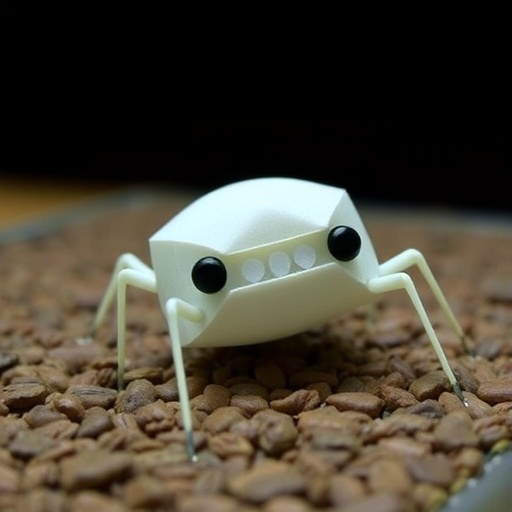
In a groundbreaking advancement at the nexus of materials science and robotics, researchers at Chung-Ang University have unveiled an innovative soft robotic system inspired by the elegant yet efficient crawling mechanism of caterpillars. Their novel approach harnesses asymmetric temperature gradients patterned on paper-based electrodes, driving directional locomotion through differential bending of liquid crystal elastomer (LCE) bilayers. This development marks a significant stride toward simplification, cost reduction, and sustainability in the fabrication of soft robotic devices, potentially revolutionizing applications in environmental monitoring, search and rescue, and beyond.
The intricate motion of caterpillars—characterized by sequential bending and stretching—has long fascinated engineers and scientists seeking versatile and energy-efficient robotic locomotion strategies. By emulating this biologically optimized mechanism, the Chung-Ang University team has tackled one of the key challenges in soft robotics: achieving controlled, directional motion without resorting to complex and bulky heating mechanisms. Traditional soft actuators often rely on uniform or isotropic thermal inputs, which fail to produce the asymmetric bending necessary for crawling-like locomotion. Overcoming this hurdle demanded a novel method to spatially manipulate temperature profiles along the actuator surface.
Central to their approach is the use of cellulose-based paper as the substrate material. Paper’s inherently porous and flexible nature facilitates facile deposition of conductive materials through solution-based electroless plating, a technique that enables precise patterning of copper electrodes with gradations in width. These width variations induce electrical resistance gradients, which under applied voltage, translate into spatially controlled Joule heating patterns. The resulting asymmetric temperature distribution across the substrate drives the underlying LCE layer to bend differentially, generating the sequential deformation required to replicate caterpillar-inspired crawling motion.
Liquid crystal elastomers are unique stimuli-responsive materials that undergo substantial mechanical deformations in response to temperature changes. Their molecular alignment and phase transitions allow precise tuning of bending curvature when subjected to localized heating. By integrating the patterned copper electrodes with a bilayer architecture comprising the LCE and paper substrate, the researchers achieved rapid, repeatable, and controllable bending motions. This efficient electromechanical transduction ensures that the soft robot moves directionally at low voltages, emphasizing energy efficiency—a critical factor for future autonomous systems.
The researchers meticulously optimized electrode widths and spacing to tailor electrical resistance gradients and, consequently, temperature profiles. This allowed fine control over the magnitude and localization of the thermal stimuli, crucial for inducing the desired asymmetric bending. By circumventing the need for elaborate heating circuitry or compartmentalization of actuator segments, the approach streamlines device fabrication. Such simplicity enhances scalability and adaptability of the system to various form factors and functional requirements.
Professor Suk Tai Chang, who led the research, remarked on the inspiration drawn from nature’s elegantly simple yet highly efficient systems. He highlighted that replicating caterpillar locomotion without complex external heating configurations was a key motivation, underscoring the importance of biomimicry not merely as an aesthetic aspiration but as a tactical engineering strategy to reduce system complexity and energy demands.
Assistant Professor Changyeon Lee elaborated on the choice of cellulose paper, emphasizing its eco-friendly credentials alongside its mechanical flexibility and suitability for solution-based electrode patterning. This sustainable material selection aligns with growing trends in green robotics, where biodegradability and environmental impact are becoming pivotal in material choice for emerging technologies.
Beyond locomotion, the thin, lightweight crawler’s design lends itself well to deployment in constrained or hazardous environments inaccessible to humans. Applications envisaged include environmental sensing in delicate ecosystems, structural health monitoring in confined spaces, or operations in disaster zones, where soft robots can traverse uneven terrains with minimal disturbance or damage.
From a fabrication standpoint, the methodology hinges on an electroless plating process to deposit copper electrodes onto paper substrates selectively. This approach eschews lithography or vacuum deposition, thereby reducing production costs and technical barriers. The team’s success in achieving temperature gradient patterning without intricate instrumentation opens pathways toward mass-manufactured, disposable robotics, bridging laboratory proof-of-concepts and real-world utility.
The bilayer assembly, composed of LCE and tailored paper electrode layers, presents a versatile platform where mechanical properties, thermal responses, and actuation behaviors can be customized through material choice and pattern design. This modularity allows potential integration with sensors or energy storage elements, foreshadowing multifunctional soft robotic systems.
In their experimental validation, the researchers demonstrated not only locomotion but control over movement directionality through variation in electrode patterning, which governs asymmetry in thermal distribution and resultant bending sequences. Such command over soft robotic gait is a crucial advance toward autonomous navigation and complex task execution in unstructured environments.
Overall, this study exemplifies how interdisciplinary innovation—involving chemical engineering, materials science, and robotics—can yield lightweight, energy-efficient, and environmentally responsible soft robots. By drawing inspiration from biology and leveraging sustainable materials and facile fabrication, the team has brought us closer to a future where soft robots seamlessly integrate into daily life, performing critical tasks with adaptability and low environmental footprint.
This research was recently published in the journal Advanced Functional Materials on July 30, 2025, further solidifying its relevance and promise within the scientific community. The authors declare no conflict of interest, underscoring the transparency and academic integrity of their work.
News Publication Date: 30-Jul-2025
References: DOI: 10.1002/adfm.202512328
Keywords
Soft robotics, Artificial intelligence, Chemical engineering, Applied sciences and engineering, Robotics
Cite Scienmag News
Bethany Barker. (August 21, 2025). Chung-Ang University Researchers Develop Paper Electrode-Based Soft Robots That Crawl. Scienmag. https://scienmag.com/chung-ang-university-researchers-develop-paper-electrode-based-soft-robots-that-crawl/
Bethany Barker. "Chung-Ang University Researchers Develop Paper Electrode-Based Soft Robots That Crawl." Scienmag, 21 August 2025, https://scienmag.com/chung-ang-university-researchers-develop-paper-electrode-based-soft-robots-that-crawl/. Accessed 5 September 2026.
Bethany Barker. "Chung-Ang University Researchers Develop Paper Electrode-Based Soft Robots That Crawl." Scienmag. August 21, 2025. https://scienmag.com/chung-ang-university-researchers-develop-paper-electrode-based-soft-robots-that-crawl/


