


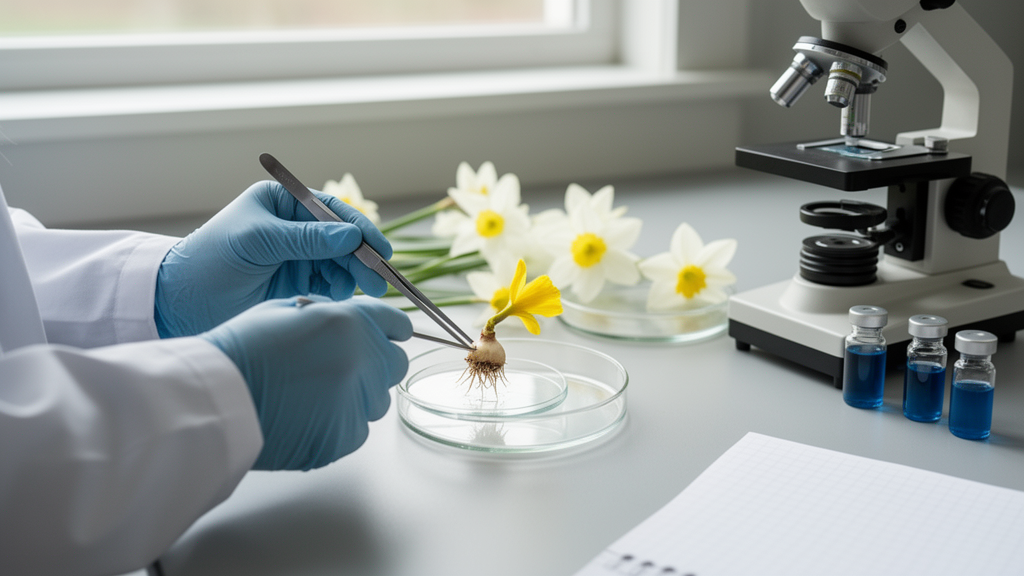
In the hills, cemeteries and coastal scrub of northern Algeria, a quiet botanical mystery has been unfolding for more than a century. Wild daffodils of the genus Narcissus grow across the country in a bewildering array of forms, their white and orange trumpets varying so much from valley to valley that botanists have argued over how many species actually live there. A new study, published in the journal Comparative Cytogenetics, has now peered into the cells of these flowers and counted their chromosomes, providing the most complete karyological picture yet of Algeria’s daffodils and settling several long-standing taxonomic disputes.
The research team sampled 32 natural populations across northern Algeria, following an east-west biogeographic gradient that spans humid Kabyle mountains, semi-arid Oranian plains and the subhumid slopes of the Tlemcen range near the Moroccan border. Seven taxa were examined: Narcissus tazetta, N. pachybolbus, N. papyraceus, N. elegans, N. serotinus in the broad sense including N. obsoletus, and N. cantabricus. From each site the researchers collected bulbs, leaves and flowers from three to ten plants, depositing voucher specimens in the herbarium of the National Agronomic School in Algiers.
The technique at the heart of the study is disarmingly simple in concept. Young roots grown from collected bulbs were treated with colchicine to arrest dividing cells at metaphase, the stage at which chromosomes are most condensed and visible. The roots were then fixed, hydrolysed in hydrochloric acid and stained with Schiff’s reagent using the classic Feulgen method, before being squashed onto slides and photographed under a microscope. With the chromosomes laid bare, the team could count them, classify them as metacentric, submetacentric, subtelocentric or telocentric according to the position of the centromere, and calculate asymmetry indices that reveal how unevenly genetic material is distributed among the chromosomes of a complement.
The results are striking for their diversity. Narcissus tazetta, the polymorphic Mediterranean daffodil long famous for horticultural confusion, proved consistently diploid with 2n = 20 across all ten Algerian and Tunisian populations examined, although one or two supernumerary B chromosomes occasionally turned up. Its karyotype formula in most populations was 10 sm + 10 st, but eastern populations near the Tunisian border showed distinct, less asymmetric formulas, hinting at a subtle east-west genetic structure within the species. Meanwhile N. elegans, which some authors had considered a tetraploid with a base number of x = 5, also showed 2n = 20 in every population, with ideograms suggesting homologous chromosome pairing consistent with a diploid at x = 10.
Perhaps the most satisfying resolution concerns two species that have been muddled since the nineteenth century. Narcissus pachybolbus, discovered near Oran in 1846 and long treated by the great Algerian botanist René Maire as a mere subspecies of N. tazetta, and the paperwhite daffodil N. papyraceus, a relic of ancient cultivation now naturalized in Algiers cemeteries, both turned out to be diploids with 2n = 22. Crucially, however, they differ in karyotype structure and in asymmetry indices: N. pachybolbus carries satellites on two submetacentric and two subtelocentric pairs and possesses the largest total haploid chromosome length in the study at 151.92 micrometres, while N. papyraceus shows satellites on its third metacentric pair instead. Together with morphometric analysis, these data confirm both as full species, vindicating the modern nomenclatural databases that had already separated them.
The N. serotinus complex proved to be the puzzle’s wildest piece. Across the sampled range the team found three chromosome numbers: tetraploid 2n = 20, an unusual 2n = 28, and hexaploid 2n = 30. Multivariate analysis of morphology showed that corona colour tracked the ploidy boundary with remarkable fidelity. Individuals with yellow coronas corresponded to true N. serotinus at the tetraploid and hexaploid levels, while hexaploids bearing bright orange coronas corresponded to N. obsoletus, a natural hybrid thought to combine genomes of N. elegans and N. serotinus. The 2n = 28 cytotypes, found only in the far northwest near Oran and Tlemcen, are likely the product of aneuploid loss of two chromosomes from the hexaploid complement and represent a novel record for the region.
These findings resolve a controversy flagged by the IUCN Red List, which had deemed the presence of true N. serotinus in Algeria doubtful. The study shows that both N. serotinus and N. obsoletus are indeed present, often growing mixed together in the same populations around Algiers, with rarer pure tetraploid N. serotinus populations in the east. The hexaploid hybrid form, previously documented from Spain and suspected across the Mediterranean as far as Syria, is now confirmed as widespread in North Africa, extending from west to east across the country in a range of habitats.
Perhaps the most biogeographically significant result concerns N. cantabricus, a white-flowered hoop-petticoat daffodil of the section Bulbocodii. The two Algerian populations sampled, in the Mansourah forest near Tlemcen and beside Lake Beni Bahdel close to the Moroccan border, proved diploid with 2n = 14 and a symmetrical karyotype dominated by metacentric and submetacentric chromosomes. Until now, diploids of this species were known only from the Cantabrian Mountains and central Spain, while tetraploids occur in Morocco’s Anti-Atlas. The Algerian plants, which occasionally carry a single B chromosome, are therefore the southernmost diploid record in the entire range of this polyploid complex, a find the authors suggest may reflect adaptive responses to aridity at the edge of the species’ distribution.
Beyond the individual species accounts, the study demonstrates how powerfully chromosome structure complements morphology in a genus notorious for hybridization and reticulate evolution. A principal component analysis of 186 individuals scored for 24 morphological traits cleanly separated the tazetta-pachybolbus-papyraceus group from the elegans-serotinus-cantabricus group along the first axis, mirroring the chromosome counts exactly. Characters such as scape length, bulb size, flowers per inflorescence and corona height and colour did the discriminating work, while the karyological data explained the deeper splits. The approach shows that where floral characters fail, cells do not.
Algeria sits at the crossroads of the western Mediterranean floras, linking Iberia, Morocco and Tunisia, yet its cytotaxonomic literature has remained sparse. By filling that gap for one of the region’s most charismatic genera, the study not only settles centuries of nomenclatural quarrels but also provides raw material for understanding how polyploidy and structural chromosome change have shaped daffodil diversity across the Mediterranean basin. For a genus that has enchanted gardeners since antiquity, it turns out the answers to its taxonomic riddles were written all along in the number and shape of its chromosomes.
Subject of Research: Cytotaxonomy and karyotype variation of Narcissus species in Algeria
Article Title: Cytotaxonomic investigations on species of genus Narcissus ( Amaryllidaceae ) from Algeria
Article References: Boukhebache, N. C., Amirouche, N., & Amirouche, R. (2022). Cytotaxonomic investigations on species of genus Narcissus (Amaryllidaceae) from Algeria. Comparative Cytogenetics, 16(1), 55-76. https://doi.org/10.3897/compcytogen.v16.i1.78852
Image Credits: AI Generated
DOI: 10.3897/compcytogen.v16.i1.78852
Keywords: Narcissus, Amaryllidaceae, cytogenetics, karyotype, polyploidy, Algeria, chromosome counting, taxonomics, B chromosomes, aneuploidy, Mediterranean flora, Cytotaxonomic
Cite Scienmag News
Juliet Wilcox. (October 19, 2026). Chromosome sleuthing untangles Algeria’s wild daffodils. Scienmag. https://scienmag.com/chromosome-sleuthing-untangles-algerias-wild-daffodils/
Juliet Wilcox. "Chromosome sleuthing untangles Algeria’s wild daffodils." Scienmag, 19 October 2026, https://scienmag.com/chromosome-sleuthing-untangles-algerias-wild-daffodils/. Accessed 19 October 2026.
Juliet Wilcox. "Chromosome sleuthing untangles Algeria’s wild daffodils." Scienmag. October 19, 2026. https://scienmag.com/chromosome-sleuthing-untangles-algerias-wild-daffodils/


