Researchers have screened a library of porphyrin molecules and their chitosan-bound composites as light-activated antibacterial agents, and found that a small number of silver-metallized composites could inhibit every multidrug-resistant ESKAPE pathogen tested in the laboratory. The work, published in the journal Biomedical Materials Science, compared free-base porphyrins, their metal complexes with silver, zinc, and tin, and chitosan-porphyrin composites (CPCs) against six multidrug-resistant or extensively drug-resistant bacterial isolates, spanning five ESKAPE species.
The motivation behind the study is the growing burden of antimicrobial resistance. The ESKAPE pathogens, comprising Enterococcus faecium, Staphylococcus aureus, Klebsiella pneumoniae, Acinetobacter baumannii, Pseudomonas aeruginosa, and Enterobacter species, sit at the top of the World Health Organization’s 2024 bacterial priority pathogens list and are among the twelve species for which new chemotherapeutics are critically needed. According to the paper, these bacteria can be life-threatening in severely ill and immunocompromised patients, and multidrug-resistant strains have become one of the most important public health challenges worldwide, with some isolates progressing to extensive or even pan-drug resistance.
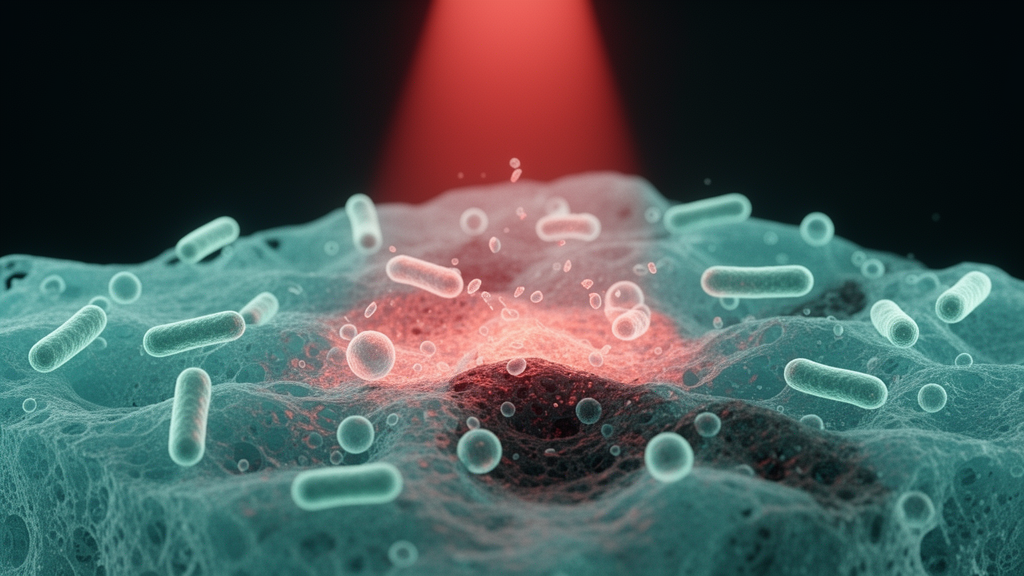
Antibacterial photodynamic therapy, the approach under investigation, is a non-invasive treatment that combines light, a light-sensitive chemical known as a photosensitizer, and oxygen. When illuminated, the photosensitizer generates reactive oxygen species and free radicals, including superoxide anion, hydroxyl radical, hydrogen peroxide, and singlet oxygen. These reactive chemicals damage bacterial macromolecules such as proteins, lipids, and nucleic acids, killing bacteria through membrane disruption, enzyme inactivation, and DNA damage. Because this killing mechanism attacks multiple cellular structures simultaneously and is not degraded by enzymes, the authors note that it is considered less susceptible to the genetic changes that drive antibiotic resistance, making it an appealing alternative strategy.
Porphyrins are recognized as effective photosensitizers for this purpose, with a broad spectrum of action against both Gram-positive and Gram-negative bacteria attributed to their strong affinity for proteins, membranes, DNA, and other biological components. The research team, led by Oluwafemi Bamidele Daramola with colleagues including Nkem Torimiro, synthesized six free-base porphyrins spanning neutral, anionic, and cationic classes: TPP, THPP, TMePP, TPPS, TCPP, and TMPyP. Each was independently metallated with silver, zinc, or tin, metals chosen because their closed-shell configurations have been explored to overcome membrane permeability barriers and increase antimicrobial efficacy against resistant strains. Chitosan, a biocompatible and biodegradable natural polymer derived in this study from the shells of fresh prawns through alkaline hydrolysis of chitin, was then combined with each porphyrin to form the composites.
The test isolates had been molecularly identified by polymerase chain reaction and confirmed as resistant in previous and ongoing research. Both P. aeruginosa isolates, recovered from the milk of different mastitic cows and distinguished by differences in their green pyocyanin pigment production, showed resistance to more than six classes of antibiotics with a multiple antibiotic resistance index of 0.86. A. baumannii displayed a MAR index of 0.44, while K. pneumoniae, E. faecium, and S. aureus were classified as extensively drug-resistant, with MAR indices of 0.8, 0.86, and 0.89 respectively. These profiles confirmed the isolates were suitable for the photodynamic screening.
In the assay, bacterial suspensions adjusted to 0.5 McFarland standard were spread onto Mueller-Hinton agar, and wells filled with the porphyrins, chitosan, their composites, and their metallated derivatives were irradiated with 405-nanometer LED light at an intensity of 5 milliwatts per square centimeter for 10 minutes, delivering a total dose of 3 joules per square centimeter. After incubation, zones of inhibition were measured in millimeters and compared with a streptomycin sulfate positive control. The results revealed sharply species-specific and structure-specific patterns. Free-base porphyrins generally lacked sufficient potency without metallation, and the authors conclude that metal insertion, particularly with zinc and tin, may enhance photodynamic antibacterial activity.
Among the unmodified metallated porphyrins, AgTCPP, SnTHPP, and SnTMPyP showed strong activity against the Gram-negative bacteria P. aeruginosa, A. baumannii, and K. pneumoniae, while AgTMPyP, SnTMPyP, and ZnTCPP inhibited E. faecium and S. aureus. In the neutral series, SnTHPP showed phototoxic activity against five isolates, and ZnTPP was effective against E. faecium. The cationic TMPyP derivatives demonstrated notably higher activity than the neutral and anionic classes, which the authors attribute to the molecule’s positive charge fostering strong electrostatic interactions with negatively charged bacterial membranes. Interestingly, S. aureus remained resistant to all free-base and metallated TMPyP derivatives, a contrast the authors suggest may stem from the thick peptidoglycan layer and catalase-mediated detoxification of that species.
The chitosan composites produced the study’s headline findings. C-AgTMePP, the composite of chitosan with silver-metallized methoxyphenyl porphyrin, exhibited the highest overall potency of any derivative, heavily inhibiting all tested Gram-positive and Gram-negative isolates with zones of inhibition ranging from 21 to 36 millimeters, comparable to the streptomycin control. C-AgTMPyP likewise showed phototoxic activity against every tested isolate, with zones between 17.5 and 26.5 millimeters. Several other composites showed selective activity: C-AgTHPP and C-AgTMePP against P. aeruginosa, C-ZnTHPP, C-SnTHPP, C-AgTMePP, and C-ZnTPPS against A. baumannii, C-AgTHPP, C-ZnTHPP, and C-AgTMePP against K. pneumoniae, and C-AgTPP, C-AgTMePP, C-ZnTPPS, and C-AgTMPyP against S. aureus. However, chitosan conjugation was not universally beneficial. It reduced the potency of several previously active molecules, including derivatives of TPP, TCPP, and SnTMPyP, and all chitosan-TCPP composites were entirely inactive, suggesting the effect is highly dependent on the porphyrin core and the target pathogen.
The authors propose that where composites showed enhanced activity, the mechanism may rely on chitosan’s polycationic properties: electrostatic attraction between the amino groups of chitosan and the negatively charged microbial cell surface may increase membrane permeability, initiate intracellular leakage, and lead to cell death. Chitosan also acts as a carrier with intrinsic antimicrobial action, and its biocompatibility and non-toxic profile make it an attractive delivery system. For the silver-containing composites, the combination may pair photodynamic killing with intrinsic silver ion toxicity, and silver complexation may facilitate cellular penetration and intensify oxidative stress under light radiation. The authors caution, however, that the safety profile of silver-containing porphyrins requires further investigation.
The study’s limitations are explicitly acknowledged. The work was restricted to in vitro experiments comparing free-base, metallated, and chitosan-modified porphyrins only, and characterization of media stability, morphology, hydrodynamic size, surface charge, loading capacities, and release profiles was not performed. The authors call for future in vivo studies focusing on physiological and clinical efficacy, quantification of specific reactive oxygen species, identification of intracellular target sites, and evaluation of long-term stability and cytotoxicity of the composites. Within those boundaries, the screening identifies C-AgTMePP and C-AgTMPyP as the most promising candidates, indicating that neutral and cationic silver-metallated porphyrins incorporated into chitosan complexes may hold potential as alternative therapeutic agents against multidrug-resistant infections, pending the validation that only animal and clinical studies can provide.
Subject of Research: Screening of porphyrins and chitosan-porphyrin composites as light-activated antibacterial agents against multidrug-resistant ESKAPE pathogens
Article Title: Comparative screening of porphyrins and chitosan-porphyrin composites as potential antibacterial photodynamic inactivation photosensitizers against multidrug-resistant ESKAPE pathogens
Article References: Daramola, O. B., George, R. C., Olajide, A. A., Adeyemi, F. M., & Torimiro, N. (2026). Comparative screening of porphyrins and chitosan-porphyrin composites as potential antibacterial photodynamic inactivation photosensitizers against multidrug-resistant ESKAPE pathogens. Biomedical Materials Science, 1(1), Article 6. https://doi.org/10.1186/s44495-026-00007-0
Image Credits: AI Generated
DOI: 10.1186/s44495-026-00007-0
Keywords: antimicrobial resistance, ESKAPE pathogens, photodynamic inactivation, porphyrins, chitosan, photosensitizers, multidrug-resistant bacteria, metalloporphyrins, reactive oxygen species, in vitro screening, silver, antibacterial alternatives
Cite Scienmag News
Denise Maddox. (October 28, 2026). Chitosan-Porphyrin Composites Show Light-Activated Killing of Drug-Resistant Bacteria. Scienmag. https://scienmag.com/chitosan-porphyrin-composites-show-light-activated-killing-of-drug-resistant-bacteria/
Denise Maddox. "Chitosan-Porphyrin Composites Show Light-Activated Killing of Drug-Resistant Bacteria." Scienmag, 28 October 2026, https://scienmag.com/chitosan-porphyrin-composites-show-light-activated-killing-of-drug-resistant-bacteria/. Accessed 28 October 2026.
Denise Maddox. "Chitosan-Porphyrin Composites Show Light-Activated Killing of Drug-Resistant Bacteria." Scienmag. October 28, 2026. https://scienmag.com/chitosan-porphyrin-composites-show-light-activated-killing-of-drug-resistant-bacteria/