


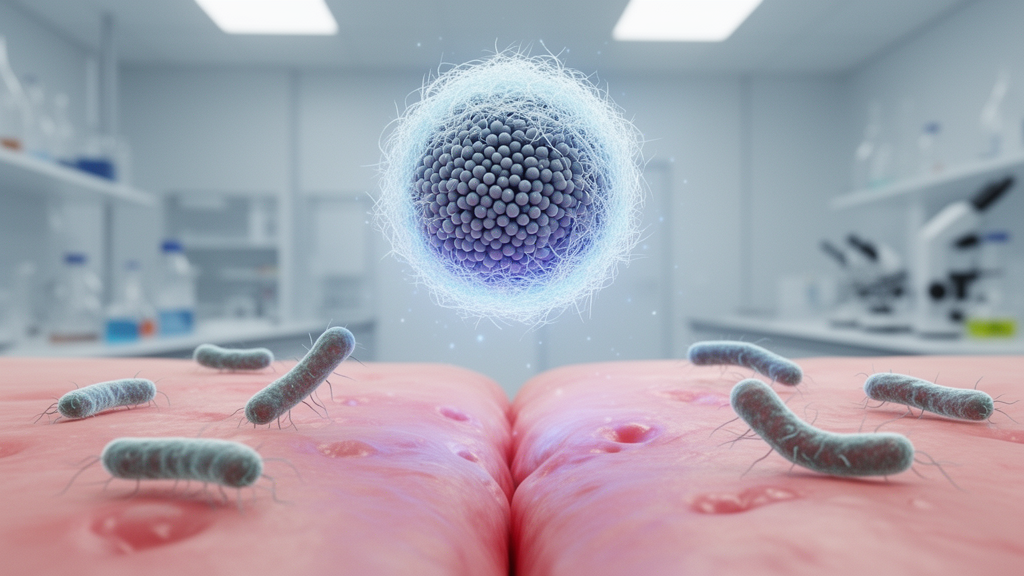
Multi-drug-resistant microbial pathogens remain one of the most stubborn obstacles in modern medicine, prolonging hospital stays and driving up treatment costs for infected wounds. A new in vitro study published in Applied Nanoscience reports the fabrication of chitosan biopolymer-coated titanium/coumarin nanoparticles, produced through an emulsification process, as a multifunctional candidate for both antimicrobial action and wound repair. The composite, abbreviated TiO2/CU@CS, pairs a titanium oxide core with coumarin, all wrapped in chitosan, a cationic biopolymer able to interact with bacterial surfaces.
The laboratory results point to a synergistic effect when titanium and coumarin act together. In testing, the nanoparticles produced a zone of inhibition measuring 23 millimetres against Escherichia coli and 20 millimetres against Staphylococcus aureus. Plate count assays added quantitative weight to these observations: at a maximum dose of 100 micrograms per millilitre, the TiO2/CU@CS nanoparticles eliminated approximately 90 percent of bacterial colony-forming units derived from human pathogens. The authors attribute part of this activity to the chitosan coating itself, whose cationic groups adhere to bacterial cell walls through electrostatic interactions, a mechanism that kills bacterial cells and enhances wound sterilisation.
Antifungal performance was also assessed. The nanoparticles produced significant colony reduction against infectious fungi including Aspergillus fumigatus and Candida albicans. This breadth of activity, spanning bacteria and fungi, is what positions the material as multifunctional rather than a single-purpose antibacterial agent, according to the study team led by Prabhu Raju, K. Mahendraprabhu and Surendirakumar Kannaiah.
Safety and wound repair were examined alongside the antimicrobial work. A cytotoxicity assay confirmed that the fabricated nanoparticles were non-toxic under the tested conditions, which the authors describe as supporting their suitability for biomedical applications. In wound healing studies, the group treated with TiO2/CU@CS nanoparticles showed the fastest cell movement and re-epithelialization process, the stage at which new epithelial cells migrate across a wound surface to restore the skin barrier.
The findings are framed strictly as an in vitro assessment, and that scope matters. Zones of inhibition, plate counts and cell-based assays measure activity in controlled laboratory settings. The abstract itself positions the composite as a promising candidate for bacterial-infected wounds, a forward-looking claim grounded in the laboratory data rather than a demonstrated clinical benefit. What the Applied Nanoscience team has demonstrated is a fabrication route, a measurable synergistic antibacterial effect with specific inhibition zones, a roughly 90 percent reduction in colony-forming units at 100 micrograms per millilitre, antifungal activity against two fungal species, a non-toxic cytotoxicity profile in vitro, and accelerated cell movement in wound healing assays. Those are concrete, quantified laboratory observations, and they give the TiO2/CU@CS composite a defined starting point for further evaluation.
Subject of Research: Chitosan-coated titanium oxide/coumarin nanoparticles for antimicrobial activity and wound healing assessed in vitro
Article Title: Fabrication of chitosan-coated Titanium oxide/coumarin nanoparticles for wound healing and antimicrobial applications: an in vitro assessment
Article References: Raju, P., Mahendraprabhu, K., & Kannaiah, S. (2026). Fabrication of chitosan-coated Titanium oxide/coumarin nanoparticles for wound healing and antimicrobial applications: an in vitro assessment. Applied Nanoscience, 16(6), 58. https://doi.org/10.1007/s13204-026-03189-z
Image Credits: AI Generated
DOI: 10.1007/s13204-026-03189-z
Keywords: nanoparticles, chitosan, titanium oxide, coumarin, antimicrobial resistance, wound healing, Escherichia coli, Staphylococcus aureus, Aspergillus fumigatus, Candida albicans, in vitro study, biomedical applications
Cite Scienmag News
Kristina Jarvis. (October 25, 2026). Chitosan-Coated Titanium Oxide Nanoparticles Show Antimicrobial and Wound Healing Promise in Vitro. Scienmag. https://scienmag.com/chitosan-coated-titanium-oxide-nanoparticles-show-antimicrobial-and-wound-healing-promise-in-vitro/
Kristina Jarvis. "Chitosan-Coated Titanium Oxide Nanoparticles Show Antimicrobial and Wound Healing Promise in Vitro." Scienmag, 25 October 2026, https://scienmag.com/chitosan-coated-titanium-oxide-nanoparticles-show-antimicrobial-and-wound-healing-promise-in-vitro/. Accessed 25 October 2026.
Kristina Jarvis. "Chitosan-Coated Titanium Oxide Nanoparticles Show Antimicrobial and Wound Healing Promise in Vitro." Scienmag. October 25, 2026. https://scienmag.com/chitosan-coated-titanium-oxide-nanoparticles-show-antimicrobial-and-wound-healing-promise-in-vitro/


