


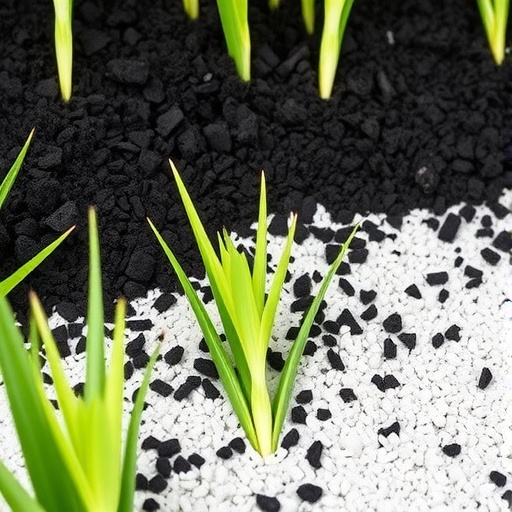
Arsenic contamination in paddy fields poses a serious risk to global food safety, as the flooded conditions typical to rice cultivation amplify the solubility and uptake of this toxic element. A breakthrough study has revealed that biochar functionalized with chitosan—a natural biopolymer derived from chitin—can effectively immobilize arsenic in soil environments, thereby reducing its accumulation in rice plants, including the edible grains.
The research demonstrated that fresh chitosan-coated biochar diminished bioavailable arsenic in contaminated paddy soils by over 21%, and crucially, lowered arsenic content in rice grains by more than 43% compared to untreated soils. Remarkably, even after six months of natural aging in real soil conditions, the modified biochar sustained significant reductions in arsenic uptake, while concurrently enhancing root system development and plant resilience.
What sets chitosan-functionalized biochar apart is its dual mechanism: it not only adsorbs arsenic within soil matrices but also alters arsenic’s distribution inside the rice plant. Advanced imaging techniques revealed a preferential localization of arsenic at rice root and leaf cell walls, effectively sequestering the toxin away from metabolically sensitive organelles and soluble fluids where it could disrupt vital physiological functions like photosynthesis and respiration. This cellular compartmentalization marks a substantial advance in contaminant mitigation by limiting arsenic’s bioavailability inside the plant.
In stark contrast, conventional biochar lacking chitosan coating unexpectedly increased arsenic bioavailability in soil, likely due to its alkaline nature promoting arsenic desorption from iron and aluminum oxide minerals. This finding signals caution against the unmodified use of biochar for arsenic remediation, as it could inadvertently exacerbate toxicity risks.
Further probing revealed that iron-rich coatings formed on the rice roots and biochar surfaces generated physical and chemical barriers that inhibit arsenic migration into plant cells. Even though the natural aging process reduced some binding capacities of the material, the aged chitosan-biochar continued to stimulate root growth metrics such as length and surface area, and modulated the release of organic acids and stress-related compounds from roots, highlighting its multifaceted role in enhancing plant stress tolerance.
These findings emerged from a controlled greenhouse pot experiment involving arsenic-contaminated soils and rice cultivation over 130 days under flooded conditions. The study underscores the critical importance of considering natural aging and real-world soil interactions when assessing the long-term efficacy of soil amendments for environmental remediation.
By combining advanced materials science with plant physiology insights, this research lays a foundational path toward scalable, sustainable biochar amendments. Such innovations promise safer rice production in arsenic-impacted regions and could serve as a blueprint for remediating other heavy metal contaminants in agricultural systems worldwide.
Keywords
Arsenic contamination, biochar, chitosan, rice paddy, soil remediation, plant stress tolerance, environmental chemistry, bioavailability, heavy metals, sustainable agriculture
Cite Scienmag News
Alan Morgan. (July 13, 2026). Chitosan-Boosted Biochar May Prevent Arsenic Contamination in Rice. Scienmag. https://scienmag.com/chitosan-boosted-biochar-may-prevent-arsenic-contamination-in-rice/
Alan Morgan. "Chitosan-Boosted Biochar May Prevent Arsenic Contamination in Rice." Scienmag, 13 July 2026, https://scienmag.com/chitosan-boosted-biochar-may-prevent-arsenic-contamination-in-rice/. Accessed 4 September 2026.
Alan Morgan. "Chitosan-Boosted Biochar May Prevent Arsenic Contamination in Rice." Scienmag. July 13, 2026. https://scienmag.com/chitosan-boosted-biochar-may-prevent-arsenic-contamination-in-rice/


