


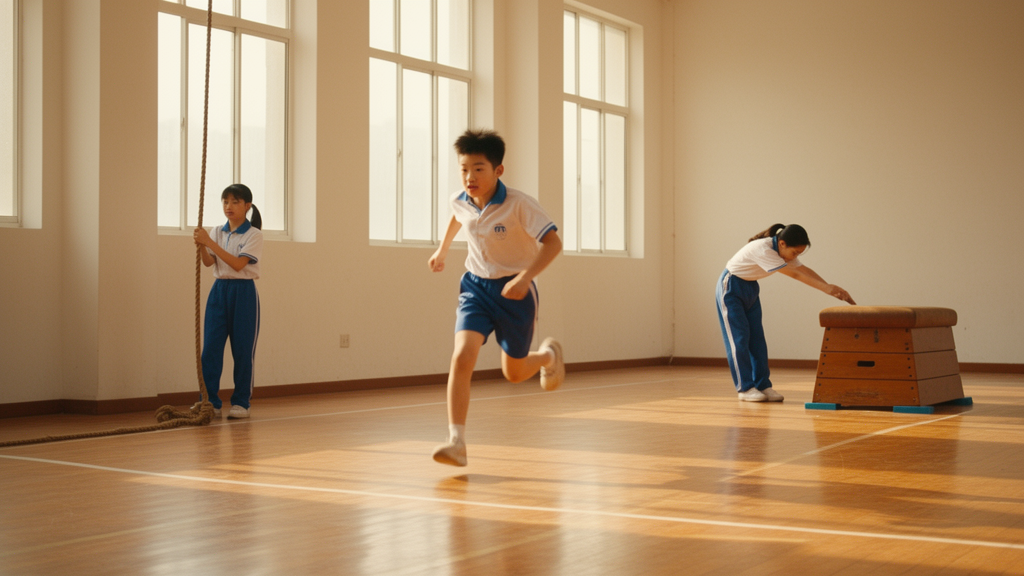
Why do some people seem drawn to the burn of a hard workout while others will do almost anything to dodge it? A research team in China has now taken one of the most direct psychological probes of that question and tested whether it works in a new language and culture. In a study published in Frontiers in Psychology, Yijun Liu and Qiang Zhou of Nanchang University translated and validated the Physical Effort Scale, an eight-item questionnaire that measures a person’s stable tendency to approach or avoid physical effort, and then used it to map how those tendencies cluster within more than 1,200 Chinese university students. The findings suggest that the way young adults relate to effort is not a single dial but a two-dimensional landscape, and that where students sit in that landscape lines up with how they regulate emotions, how motivated they are to exercise, and how much they actually move.
The Physical Effort Scale occupies a deliberately different niche from the instruments most exercise scientists know best. The familiar Rating of Perceived Exertion, or RPE, captures a momentary, state-like judgment: how hard does this particular bout of exercise feel right now? The PES, by contrast, was developed by Cheval and colleagues to capture a trait-like behavioral tendency, asking whether a person generally seeks out or steers away from situations that demand physical effort. The distinction matters because effort perception research has shown that the subjective experience of effort is not a simple readout of physiological demand. It is shaped by motivation, attentional allocation, and self-regulation, and it feeds directly into decisions about whether to initiate, sustain, or abandon physically demanding actions. A scale that measures who tends to embrace effort, rather than how effortful one task feels, could therefore be a useful predictor of exercise participation and adherence.
Crucially, the PES treats approach and avoidance as two related but distinguishable dimensions rather than opposite poles of a single bipolar construct. A person’s score on one dimension does not conceptually fix their score on the other, so the scale can in principle detect people who are high on both, low on both, or high on one and low on the other. Before the Chinese team could exploit that flexibility, however, they had to establish that the instrument behaves the same way in Chinese as it does in the original linguistic context, where it was first developed, and in Japanese, where it has already been adapted. Cross-cultural scale adaptation is a technical gauntlet: two bilingual translators independently produced forward translations, which were synthesized into a preliminary version, back-translated into English by two different bilinguals, and then reviewed by an expert panel of three sport psychologists, one psychometrician, and one linguist for semantic, conceptual, and cultural equivalence. A pilot test in 173 university students, of whom 157 provided valid responses, led to minor wording refinements before the final version was locked in.
The main validation rested on 1,273 students drawn from six universities spanning eastern, central, and western China, including Southwest University, Ningbo University, Henan University, Nanchang University, Jiangxi Normal University, and Nanchang Hangkong University. The sample was almost perfectly balanced by gender, with 630 males and 643 females, and evenly spread across all four academic years. Data were collected online between April and May 2026 through an anonymous survey, with careful screening that excluded incomplete responses, patterned or careless answering, and completions under 180 seconds. The researchers then randomly split the sample into two independent subsamples, 653 participants for exploratory factor analysis and 620 for confirmatory factor analysis, a design that guards against the circularity of validating a factor structure on the same data used to discover it.
The psychometric results were strikingly strong. In the exploratory analysis, the Kaiser–Meyer–Olkin measure of sampling adequacy reached 0.919, and two factors extracted by principal axis factoring accounted for 80.10 percent of the total variance, with standardized loadings between 0.807 and 0.890 and no substantial cross-loadings. Internal consistency was high, with Cronbach’s alpha of 0.935 for the approach dimension and 0.913 for avoidance, and corrected item–total correlations ranging from 0.769 to 0.856. Test–retest reliability, assessed in 106 participants who completed the scale twice, yielded an intraclass correlation coefficient of 0.794, within the range commonly classified as good. Confirmatory factor analysis in the second subscale produced a nuanced picture: the comparative fit index of 0.996, Tucker–Lewis index of 0.994, and standardized root mean square residual of 0.016 all indicated excellent fit, but the root mean square error of approximation came in at 0.119, well above the conventional 0.06 benchmark. The authors handled this honestly, noting that RMSEA can be unstable in models with few degrees of freedom but that the elevated value means overall fit should be interpreted cautiously. They also permitted correlated residuals between two pairs of avoidance items whose content overlaps, which flags possible local dependence worth re-examining in future samples.
Convergent and discriminant validity checks passed their standard thresholds. Composite reliability exceeded 0.92 for both dimensions and average variance extracted exceeded 0.75, well above the usual criteria of 0.70 and 0.50. The latent correlation between approach and avoidance was −0.469 and the heterotrait–monotrait ratio was 0.441, consistent with two empirically distinguishable dimensions. Multigroup confirmatory factor analysis then established metric and scalar measurement invariance across gender and across academic year, meaning the scale measures the same construct the same way in men and women and in freshmen through seniors. The authors again cautioned that elevated RMSEA values in the configural models warrant care, and that the study tested invariance only within the Chinese sample, not across cultures.
With the scale validated, the team turned to the more novel question: how do approach and avoidance tendencies jointly vary across individuals? Using latent profile analysis, a person-centered statistical method that identifies empirical subgroups based on patterns of scores, they compared one- through six-profile solutions. Information criteria kept improving with more profiles, but the four- to six-profile solutions contained vanishingly small classes of 0.31 to 1.41 percent, so the researchers retained a three-profile solution with entropy of 0.770 and a smallest class representing 14.93 percent of the sample. The result was three configurations: a Balanced profile containing 59.07 percent of students with moderate approach and moderate avoidance, an Avoidance-Oriented profile with 14.93 percent showing low approach and high avoidance, and an Approach-Oriented profile with 26.00 percent showing high approach and low avoidance. The authors are careful to note that the profiles were largely ordered along a continuum from low approach–high avoidance to high approach–low avoidance, so they are best read as descriptive configurations of the joint distribution rather than evidence of qualitatively distinct natural subgroups.
The profiles told a coherent story when compared on external variables using the Bolck–Croon–Hagenaars method, which accounts for classification uncertainty. The Approach-Oriented profile showed the highest cognitive reappraisal, at an estimated mean of 6.107 on a 7-point scale, followed by the Balanced profile at 5.172 and the Avoidance-Oriented profile at 4.242, with the same ordering for expressive suppression. On exercise motivation, the Approach-Oriented profile scored highest on autonomous regulation, external regulation, and introjected regulation, and lowest on amotivation, with the Avoidance-Oriented profile at the opposite extreme. The authors resist calling the Approach-Oriented profile globally more adaptive, because elevated external and introjected regulation are controlled rather than autonomous forms of motivation, and simultaneous elevation of both emotion-regulation strategies does not map neatly onto a uniformly beneficial pattern. Still, the motivational gradient is clear: students who embrace effort report far more reasons to exercise and far less motivational absence than those who avoid it.
The behavioral differences were equally telling. The Approach-Oriented profile reported an estimated 2,567.50 MET-minutes per week of total physical activity, compared with 2,011.18 for the Balanced profile and 1,966.57 for the Avoidance-Oriented profile, and the Approach-Oriented group exceeded both others at p < 0.001 while the latter two did not differ. Moderate-to-vigorous physical activity followed the same pattern, at 1,503.91 versus 1,032.09 and 970.89 MET-minutes per week. Weekly exercise frequency was higher in the Approach-Oriented profile than in the Balanced profile, though not significantly different from the Avoidance-Oriented group. Notably, the Balanced and Avoidance-Oriented profiles, despite very different effort configurations, showed no detectable difference in overall activity, suggesting that high approach combined with low avoidance is the configuration consistently tied to higher movement. Profile membership also differed by academic major, with 43.6 percent of physical education students classified as Approach-Oriented versus 22.2 percent of other majors, but the main activity pattern held when physical education students were excluded from the analysis.
The study has limits the authors acknowledge plainly. The cross-sectional design cannot establish whether effort tendencies cause motivational regulation or activity, or the reverse; the latent profiles’ longitudinal stability is unknown; self-report measures carry recall bias, social desirability, and common method bias, with Harman’s single-factor test suggesting the first unrotated factor accounted for 59.606 percent of variance; and the university sample limits generalizability. Future work, they suggest, should test profile reproducibility in independent samples, use longitudinal designs and ecological momentary assessment to track change over time, complement self-reports with accelerometer data, and examine cross-cultural measurement invariance directly. Even so, the findings give exercise scientists in Chinese-speaking contexts a validated tool for a construct that has been gaining theoretical weight, including within the Theory of Effort Minimization in Physical Activity, which proposes that effort-related aversion drives people to minimize exertion. If the way students relate to effort is measurable, stable, and tied to how much they move, then understanding who avoids effort, and why, may become a practical target for interventions aimed at getting young adults off the sidelines and into motion.
Subject of Research: Psychometric validation of the Chinese Physical Effort Scale and latent profiles of physical-effort approach and avoidance among Chinese university students
Article Title: Psychometric validation of the Chinese Physical Effort Scale and profiles of physical-effort approach and avoidance among Chinese university students
Article References: Liu, Y., & Zhou, Q. (2026). Psychometric validation of the Chinese Physical Effort Scale and profiles of physical-effort approach and avoidance among Chinese university students. Frontiers in Psychology, 17, Article 1959219. https://doi.org/10.3389/fpsyg.2026.1959219
Image Credits: AI Generated
DOI: 10.3389/fpsyg.2026.1959219
Keywords: Psychometric, validation, Chinese, Physical, Effort, Scale, profiles, physical-effort, approach, avoidance, university, students
Cite Scienmag News
Philip Murphy. (October 17, 2026). Chinese Validation Reveals Three Profiles of How Students Approach or Avoid Physical Effort. Scienmag. https://scienmag.com/chinese-validation-reveals-three-profiles-of-how-students-approach-or-avoid-physical-effort/
Philip Murphy. "Chinese Validation Reveals Three Profiles of How Students Approach or Avoid Physical Effort." Scienmag, 17 October 2026, https://scienmag.com/chinese-validation-reveals-three-profiles-of-how-students-approach-or-avoid-physical-effort/. Accessed 17 October 2026.
Philip Murphy. "Chinese Validation Reveals Three Profiles of How Students Approach or Avoid Physical Effort." Scienmag. October 17, 2026. https://scienmag.com/chinese-validation-reveals-three-profiles-of-how-students-approach-or-avoid-physical-effort/


