


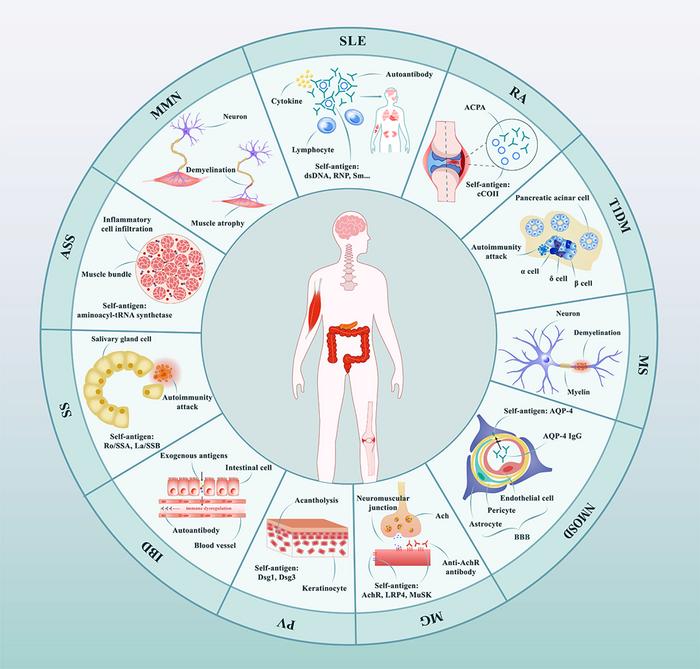
Autoimmune disease (AID) refers to the condition in which the immune system identifies the body’s own cells and tissues as foreign, resulting in systemic inflammation. The immune system’s self-attack via autoreactive B and T immune cells and autoantibodies—antibodies against body’s own proteins—may present as mild to severe symptoms, ranging from fever and body pain to skin allergies and digestive disorders. Current therapeutic strategies against AID involve the use of immunosuppressants, glucocorticoids, and monoclonal antibodies. However, these approaches have various limitations such as increased susceptibility to opportunistic infections and lack of sustained response.

Credit: Chinese Medical Journal
Daishi Tian from Huazhong University of Science and Technology
Autoimmune disease (AID) refers to the condition in which the immune system identifies the body’s own cells and tissues as foreign, resulting in systemic inflammation. The immune system’s self-attack via autoreactive B and T immune cells and autoantibodies—antibodies against body’s own proteins—may present as mild to severe symptoms, ranging from fever and body pain to skin allergies and digestive disorders. Current therapeutic strategies against AID involve the use of immunosuppressants, glucocorticoids, and monoclonal antibodies. However, these approaches have various limitations such as increased susceptibility to opportunistic infections and lack of sustained response.
In recent years, chimeric antigen receptors (CAR)-T cell therapy, which was originally developed to treat and manage cancer, has been employed in preclinical and clinical studies to treat AID. CAR-T therapy involves the use of modified T cells with chimeric antigen receptors (CARs) to specifically target autoreactive immune cells and autoantibodies. In this regard, a team of researchers led by Professor Daishi Tian, Professor Wei Wang, and Dr. Chuan Qin, from the Department of Neurology, Tongji Hospital, Tongji Medical College, Huazhong University of Science and Technology, China, performed a comprehensive bibliometric analysis to identify and evaluate CAR-T cell therapy as a form of treatment for AID. Their insightful review article was published on 12 April, 2024 in the Chinese Medical Journal.
Explaining the motivation behind their research work, Prof. Tian says, “The triumph of CAR-T cell therapy in eradicating pathological B cells and achieving sustained remissions has propelled researchers to explore its potential application in autoimmune diseases, such as systemic lupus erythematosus (SLE), multiple sclerosis (MS), pemphigus vulgaris (PV), etc., all of which are characterized by autoreactive B cells and diverse autoantibodies.” The team analyzed 210 records from 128 academic journals and observed an increasing research trend in the field of CAR-related therapy.
The study provides an overview of the applicability of CAR-T therapy for common AIDs such as rheumatoid arthritis (RA), SLE, type 1 Diabetes Mellitus (T1DM), and other AIDs of the nervous system like MS, neuromyelitis optica spectrum disorder (NMOSD), and myasthenia gravis. Early studies have yielded promising results, with CAR-T cells demonstrating effectiveness in reducing disease activity and improving patients’ quality of life. Additionally, AIDs generally have a lower burden of target antigens compared to hematological tumors. This translates to a potentially lower dose of CAR-T cells required, minimizing the risk of side effects often seen in cancer treatment. However, CAR-T cell therapy for autoimmune diseases remains in its early stages. Long-term data on safety and efficacy is limited, and researchers are actively addressing challenges such as potential relapse and the persistence of CAR-T cells within the body.
Furthermore, researchers are continuously exploring ways to refine CAR-T cell therapy for AIDs. This includes advancements in CAR structure to enhance targeting specificity and minimize off-target effects. Chimeric antigen receptor armored recognition T (CAAR-T) cells are also being developed to eliminate only autoreactive B cells while leaving healthy B cells unharmed. Additionally, chimeric antigen receptor natural killer (CAR-NK) cells and chimeric antigen receptor regulatory T cells (CAR-Treg) cells offer a more targeted approach. CAR-Tregs were used to target specific myelin proteins and resulted in reversal of MS and prevented relapse in vivo. CAAR-T cells also exhibited success in treating PV in a preclinical experiment. Currently, a phase-1 clinical trial of anti-Dsg3 CAAR-T cell therapy to target the autoantibody causing mucosal PV is underway.
The review also highlighted the beneficial role of CAR-T cells against autoimmune-mediated central nervous system disorders, which are limited in many therapies due to the existence of blood brain barrier. The study noted that in a clinical trial, CAR-T cells were successfully shown to be highly effective and safe for treating refractory/relapsed NMOSD.
Despite the promising results, challenges faced by CAR-T therapy include managing adverse effects such as cytokine release syndrome characterized by an overactive immune response triggered by the treatment. And other adverse events, such as hematotoxicity, immune effector cell-associated neurotoxicity syndrome, secondary tumor, which were observed in the treatment of hematological malignancies, warrant concern when applied to treat AID.
“To further advance this field, additional experiments should be conducted with larger sample sizes, longer experimental timelines, and rigorous long-term safety monitoring. By building upon the knowledge gained from CAR-T treatment for hematological tumors, there is an opportunity to optimize the clinical application of CAR-related therapy for R/R autoimmune diseases,” says Prof. Tian.
Sustained research efforts and innovation in the field of CAR-T therapy may revolutionize the treatment landscape for autoimmune diseases.
***
Reference
Titles of original papers: Dawn of CAR-T cell therapy in autoimmune diseases
Journal: Chinese Medical Journal
Journal
Chinese Medical Journal
Method of Research
Literature review
Subject of Research
Not applicable
Article Title
Dawn of CAR-T cell therapy in autoimmune diseases
Article Publication Date
12-Apr-2024
COI Statement
None.
Cite Scienmag News
Nathaniel Bowman. (April 22, 2024). Chinese Medical Journal review article highlights the potential and promise of CAR-T cell therapy in autoimmune diseases. Scienmag. https://scienmag.com/chinese-medical-journal-review-article-highlights-the-potential-and-promise-of-car-t-cell-therapy-in-autoimmune-diseases/
Nathaniel Bowman. "Chinese Medical Journal review article highlights the potential and promise of CAR-T cell therapy in autoimmune diseases." Scienmag, 22 April 2024, https://scienmag.com/chinese-medical-journal-review-article-highlights-the-potential-and-promise-of-car-t-cell-therapy-in-autoimmune-diseases/. Accessed 4 September 2026.
Nathaniel Bowman. "Chinese Medical Journal review article highlights the potential and promise of CAR-T cell therapy in autoimmune diseases." Scienmag. April 22, 2024. https://scienmag.com/chinese-medical-journal-review-article-highlights-the-potential-and-promise-of-car-t-cell-therapy-in-autoimmune-diseases/

