


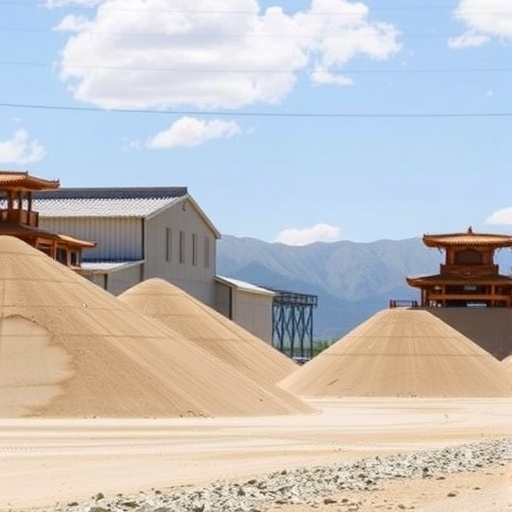
In recent years, China’s rapid urbanization and industrial growth have sparked unprecedented demand for construction materials such as sand, gravel, and crushed stone—collectively termed aggregates. These materials serve as fundamental inputs for infrastructure, housing, and various engineering projects. However, a groundbreaking study published in Nature Communications by Ren, Jiang, Behrens, and colleagues reveals a compelling shift in this trend: an emerging decline in aggregate demand coupled with promising pathways for circular transitions within the sector. This revelation not only challenges existing resource consumption paradigms but also highlights sustainable trajectories for global construction and mining industries.
The study meticulously analyzes aggregate consumption data across China’s multi-decade economic expansion, uncovering subtle but definitive deceleration in demand growth. Traditionally, aggregates have been extracted at massive scales from natural sources such as rivers, quarries, and coastal beds, contributing to environmental degradation including habitat destruction and riverbank erosion. China’s historical consumption levels, which once seemed destined to climb indefinitely in parallel with urban sprawl and infrastructure megaprojects, now exhibit signs of maturity and consolidation. This phenomenon marks an inflection point with broad implications for future resource strategies.
Key drivers underlying this demand decline include evolving construction technologies, regulatory shifts, and enhanced material efficiency. High-performance concrete formulations and prefabrication techniques have reduced aggregate volumes per unit structure by optimizing material properties and construction methods. Moreover, government policies have targeted ecological preservation by limiting aggregate extraction in ecologically sensitive areas and encouraging alternative sourcing. Incentives to adopt recycled aggregates from demolition debris and industrial by-products have also gained momentum, fostering circularity and resource recovery.
Ren and colleagues adopted a rigorous systems modeling approach integrating physical production data, policy scenarios, and lifecycle assessments. This comprehensive synthesis enabled them to project future trajectories not only for demand but also for supply-side interventions geared toward circular economy principles. Their scenario analysis explores how enhanced recycling rates, substitution practices, and material reuse can collectively offset reliance on virgin aggregates, thereby mitigating environmental pressures while sustaining economic development ambitions.
One of the most striking technical findings concerns the potential for extensive recycling of construction and demolition waste (CDW), which constitutes a largely underutilized resource stock. The authors demonstrate that with optimized logistics, sorting technology, and material standards, recycled aggregates can replace a significant proportion of natural sand and gravel in structural applications. This transition requires overcoming technical challenges such as contamination control, material strength consistency, and regulatory acceptance, but it is technologically feasible and economically advantageous.
The research also highlights the role of digital innovation in enabling circular aggregate systems. Digital tracking platforms, powered by Internet of Things (IoT) sensors and blockchain verification, can enhance traceability and quality assurance for recycled materials. This innovation allows for real-time monitoring of resource flows, supports compliance with environmental standards, and provides transparency for construction stakeholders. By incentivizing material recovery and reuse through smart contracts and digital marketplaces, the aggregate sector can foster a robust circular economy ecosystem.
Environmental benefits of this transition are manifold. The reduction in natural aggregate extraction alleviates pressure on riverine ecosystems, coastal zones, and quarry landscapes, promoting biodiversity conservation and landscape restoration. Lowering the carbon footprint associated with mining operations and transport logistics significantly contributes to China’s commitment to carbon neutrality by 2060. Such sustainable resource stewardship aligns with global climate goals, positioning the construction industry as a key contributor to environmental resilience.
Furthermore, economic implications of declining demand and circular transitions are profound. Resource-efficient construction reduces raw material costs and dependency on finite natural reserves, enhancing supply chain resilience. The development of recycling infrastructure and related technologies stimulates green jobs and innovation-driven economic sectors. However, the industry must navigate transitional challenges including investment needs, capacity building, and harmonization of standards to unlock these benefits at scale.
The study also critically examines the social dimensions of aggregate circularity. By minimizing environmental harms associated with aggregate mining, communities near extraction sites stand to experience improved health and livelihoods. Participation of local stakeholders in resource management and recycling initiatives can foster social inclusion and equitable economic opportunities. Importantly, transparent governance mechanisms are vital for ensuring that the benefits of circular transitions are widely shared and do not exacerbate inequalities.
Ren et al.’s work provocatively challenges assumptions that aggregate demand is inexorably tied to economic growth. Instead, it illustrates how decoupling material consumption from economic development is possible through technological innovation, regulatory frameworks, and systemic transformation. As China is both the largest consumer and a major innovator in construction materials, these findings carry global significance, offering a blueprint for other emerging economies facing similar sustainability dilemmas.
The implications for global supply chains cannot be overstated. With China accounting for a substantial share of the world’s aggregate consumption and production, its shift towards circularity is likely to reverberate globally. International markets may experience altered demand dynamics, impacting aggregate-exporting countries and related industries. This calls for adaptive industrial policies and collaboration to harness circular economy opportunities within transnational material flows.
This study represents a landmark contribution, offering a holistic, data-driven framework for understanding and steering the future of aggregate resource systems. The integration of empirical data, technical feasibility assessments, and policy scenarios provides a robust basis for decision-making. Stakeholders ranging from policymakers and industry leaders to environmental organizations can derive actionable insights to balance resource use efficiency, economic viability, and ecological integrity in the built environment.
Looking ahead, continued advances in material science—such as development of alternative binders, nanomaterial additives, and bio-based construction products—could complement aggregate circularity by further reducing resource intensity. Cross-sectoral collaboration between construction, waste management, and technology sectors will be essential for scaling circular solutions. Additionally, broadening the scope of circular assessments to include social justice and cultural dimensions is crucial for holistic sustainability.
In summary, the research by Ren and colleagues heralds a new chapter in the life cycle of aggregates in China, demonstrating that declining demand and systemic circular transitions are achievable and desirable. This evolution not only supports environmental goals but also fosters economic resilience and social wellbeing. As the world grapples with finite resource limits and climate imperatives, the lessons from China’s aggregate journey offer hope and direction for sustainable infrastructure development worldwide, potentially inspiring a transformative shift in how humanity constructs the future.
Cite Scienmag News
Denise Maddox. (October 21, 2025). China’s Sand, Gravel Demand Drops Amid Circular Shift. Scienmag. https://scienmag.com/chinas-sand-gravel-demand-drops-amid-circular-shift/
Denise Maddox. "China’s Sand, Gravel Demand Drops Amid Circular Shift." Scienmag, 21 October 2025, https://scienmag.com/chinas-sand-gravel-demand-drops-amid-circular-shift/. Accessed 3 September 2026.
Denise Maddox. "China’s Sand, Gravel Demand Drops Amid Circular Shift." Scienmag. October 21, 2025. https://scienmag.com/chinas-sand-gravel-demand-drops-amid-circular-shift/


