

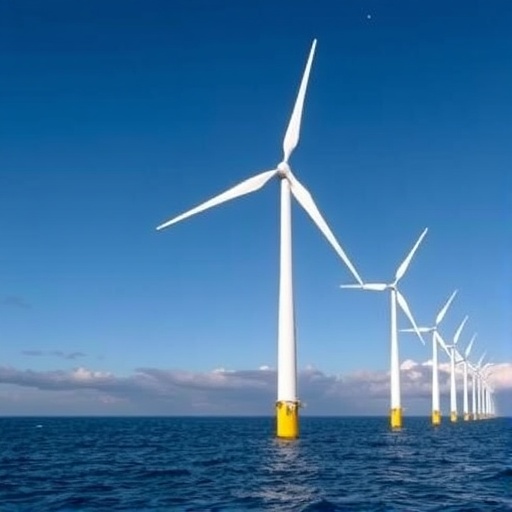
In a groundbreaking study poised to redefine the future of renewable energy in one of the planet’s most ambitious countries, researchers have unveiled significantly lower estimates of China’s offshore wind potential than previously thought. This revelation arises from the application of sophisticated farm-scale spatial modeling combined with a detailed analysis of wake effects—factors that have historically been overlooked or underestimated in broad-scale assessments of offshore wind energy resources. Published in Nature Communications in 2026 by Xu, Yin, Hu, and their colleagues, this work calls for a reconsideration of China’s renewable energy strategies amid global decarbonization efforts.
Offshore wind energy has been heralded as a pillar in the global shift towards sustainable power generation, especially for nations with extensive coastlines like China. Previous estimates of China’s offshore wind capacity suggested a vast and promising reservoir sufficient to meet a significant proportion of the country’s rapidly increasing electricity demand. However, these estimates were largely based on aggregate wind speed data and did not fully account for the spatial heterogeneity within wind farms or the complex atmospheric interactions between individual turbines. By integrating farm-scale spatial modeling with wake effect analyses, Xu et al. have introduced a more nuanced and technically robust framework that highlights inherent limitations in wind resource exploitation.
Wake effects arise due to the disruption of wind flow caused by upstream turbines, resulting in reduced wind speeds and increased turbulence for downstream machines. This phenomenon, while well recognized in wind farm design, has often been simplified or inadequately modeled in large-scale assessments. Xu and colleagues implemented high-resolution spatial simulations across multiple proposed offshore development sites, meticulously capturing the wake-induced power deficits and variability within extensive turbine arrays. Their findings demonstrate that the impact of wake losses is significantly more pronounced than earlier estimates suggested, with a material reduction in the net power output attainable from planned offshore wind farms.
The methodology employed by the research team leverages the integration of physical atmospheric models with turbine-level operational data. By applying computational fluid dynamics combined with spatially explicit turbine layout patterns, the model creates a detailed picture of wind resource distribution and energy yield potential at farm scale. This approach contrasts with conventional methods that rely on extrapolating single-point or averaged meteorological measurements, which can neglect interactions at the turbine cluster level. The enhanced granularity of the modeling reveals critical bottlenecks in turbine placement and highlights the necessity for optimized farm design to mitigate wake losses.
Critically, the study shows that assuming a linear addition of individual turbine outputs—common in previous national resource assessments—grossly overestimates the total energy potential. The nonlinear interactions between turbines and the turbulent wake regimes reduce overall efficiency. This discovery has profound implications for policymakers and industry stakeholders who base capacity expansion plans on aggregate figures unaffected by such spatial effects. With China’s ambitious targets for offshore wind reaching tens of gigawatts by mid-century, accurate predictions of real-world yield are essential for realistic infrastructure investments and grid integration strategies.
Furthermore, Xu et al. emphasize the geographical heterogeneity of wake impacts, identifying zones within the continental shelf where wake interactions cluster more intensely due to prevailing wind directions and turbine density. This spatial insight is critical for site selection, suggesting that some regions previously deemed prime for offshore wind development may yield limited returns relative to their scale and cost. By contrast, underutilized locations with favorable wake dynamics might emerge as more viable alternatives, a perspective that could shift the trajectory of China’s offshore wind deployment in the coming decades.
This recalibration of wind potential also intersects with environmental and engineering constraints. The study’s refined power output estimates shed light on the balance between maximizing energy production and minimizing ecological disruption. For instance, denser turbine arrangements intended to boost capacity must be reevaluated against wake-induced efficiency losses and potential impacts on marine biodiversity. The modeling framework presented by the authors offers an advanced tool to navigate these complex trade-offs, enabling designs that are power-optimized yet environmentally sustainable.
From a technical standpoint, the research employs large-scale numerical simulations validated against empirical data from existing offshore wind farms, ensuring robustness and credibility. The coupling of atmospheric flow dynamics with real-world turbine performance data sets a new standard in wind resource assessment. This blend of empirical validation with theoretical modeling provides a template for future assessments worldwide, encouraging a move towards farm-scale resolution analyses rather than regional or national aggregates in isolation.
The timing of this research coincides with China’s broader decarbonization agenda and the global race to expand renewable energy portfolios. The revelation that yield potentials are lower than previously anticipated could pose challenges for achieving carbon neutrality goals and necessitate recalibration of investment flows into offshore wind infrastructure. It also underscores the importance of diversified renewable mixes, including solar, onshore wind, and emerging technologies like tidal power, to attain a resilient and efficient energy system.
Additionally, the study raises awareness about the technological evolution required in turbine design and farm configuration. Mitigating wake effects through innovative rotor designs, adaptive control systems, and dynamic turbine spacing could enhance performance. Xu and his team advocate for integrating their modeling insights into turbine engineering and micro-siting decisions, promoting a feedback loop between resource assessment and technology development that improves overall system viability.
The implications extend beyond China’s borders. Given the country’s leadership in offshore wind manufacturing and deployment, a downward adjustment in potential raises questions about global supply chains, cost projections, and competitive positioning. Other countries embarking on offshore wind investments might benefit from adopting similar high-resolution modeling techniques to refine their resource estimates and infrastructure strategies, potentially reshaping international markets and technological cooperation frameworks.
In summary, this landmark study presents a sobering but necessary refinement of China’s offshore wind energy potential, balancing optimism with technical realism. By introducing farm-scale spatial modeling and a rigorous account of wake effects, Xu et al. have provided the renewable energy sector with invaluable insights that can drive smarter design, planning, and policy decisions. The wind resource remains significant, but harnessing it effectively demands greater scientific precision and operational sophistication than previously acknowledged.
As the world grapples with climate change and the attendant energy transition, such empirical and methodological advances serve as crucial stepping stones. They remind us that leveraging nature’s power is a complex endeavor requiring deep understanding of physical processes and systemic interactions. This research not only recalibrates expectations but also inspires innovation, marking a vital contribution to the global renewable energy discourse.
Future investigations building on these findings may explore dynamic wake control strategies, interactions between offshore wind development and marine ecosystems, and synergies with storage and grid management technologies. Xu and his colleagues have set a new benchmark, inviting the energy research community to integrate farm-scale perspectives into mainstream renewable energy planning, ultimately steering investments and policies towards a more sustainable and feasible energy future.
Subject of Research: Offshore wind energy potential assessment in China using farm-scale spatial modeling and wake effect analysis.
Article Title: Substantially lower estimates in China’s offshore wind potential using farm-scale spatial modeling and wake effects.
Article References:
Xu, S., Yin, G., Hu, P. et al. Substantially lower estimates in China’s offshore wind potential using farm-scale spatial modeling and wake effects. Nat Commun (2026). https://doi.org/10.1038/s41467-026-68655-2
Image Credits: AI Generated


