


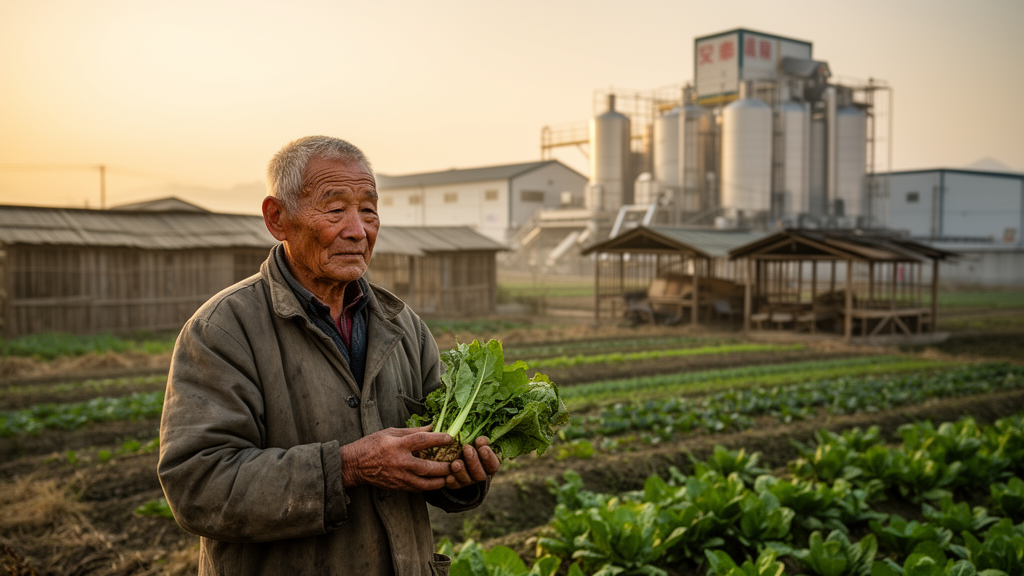
When China passed its 2006 Agricultural Product Quality and Safety Law, the goal was straightforward: make the food reaching consumers safer. The statute made quality and safety standards mandatory technical norms, restricted which agricultural inputs could be used, enforced withdrawal intervals for drugs and chemicals, required production records and pre-sale testing from organized producers, and barred the sale of any agricultural product that failed to meet the standard. What a new study now reveals is the other side of that ledger. The law’s obligations, largely fixed costs that do not shrink proportionally with the size of a farm, appear to have pushed marginal producers out of regional food production, and the output they shed was not picked up by the farms that remained.
The research, published in Frontiers in Sustainable Food Systems, examines the law across 284 Chinese prefecture-level cities from 2001 to 2018. Because the statute took effect nationally and synchronously on 1 November 2006, no city is legally untreated; what differs is how much pre-law production the mandate had to reach. The team built a continuous exposure measure from each city’s standardized per-capita animal-source food output between 2001 and 2005, treated 2006 as a transition year, and took 2007 as the first full year of implementation. A difference-in-differences design then asked whether cities more exposed to the mandate changed differently after the law than cities less exposed, with city and year fixed effects absorbing permanent output differences and nationwide shocks.
The baseline answer is a contraction of roughly 5 percent. Cities one standard deviation higher on the pre-law exposure distribution, equivalent to the difference between a city producing about 90 kilograms of animal-source food per resident before the law and one producing about 180, produced about 4.6 percent less per capita after implementation, a figure that shifts to 3.6 percent with economic and demographic controls and stays essentially unchanged when city-year weather, including temperature, precipitation, hot days and dry days, is added. Stability under weather controls matters because animal-source production responds directly to climate; it rules out the possibility that the gradient traces a differential climatic path rather than a differential regulatory burden.
One obvious objection is that exposure is built from the pre-law level of the very outcome being measured. Any transitory component of that level reverts mechanically, and reversion alone could produce a negative post-law coefficient without any behavioral response, a problem economists have recognized since Ashenfelter’s work on training programs. The team therefore re-estimated the design with exposure recomputed from 2001 to 2003 alone and estimation restricted to 2004 through 2018, so the window generating the measure shares no observations with the window generating the outcome variation. The negative gradient survived and sharpened, at roughly 4.5 percent, estimated more precisely than the full-window version despite a quarter fewer observations. Mean reversion is not what generates the result.
The timing carries theoretical weight. Nothing happens for three years. The exposure gradient is flat through 2009, turns negative in 2010, and widens through 2017. A statute imposing a one-time retrofit cost would produce a level shift at implementation and a flat path thereafter; the data show a gap that opens slowly and keeps opening. That shape fits successive continuation decisions, as producers draw down working capital, postpone documentation, or continue on temporary arrangements until an inspection, a renewal, or an investment decision makes the cost unavoidable. It also fits any slow-moving change correlated with pre-law animal-food intensity, such as the reallocation of land and labor out of agriculture or the consolidation of livestock into integrated operations. The discriminating work is done not by the timing but by three further tests.
The first is the sectoral boundary. If cities with large animal-food sectors were simply in general decline for reasons unrelated to food-safety law, the gradient should appear wherever those forces operate. It does not. Within the statute’s legal scope, animal-source food, grain and primary-sector value added contract by 4.6, 5.2 and 5.1 percent respectively, and all three remain significant under the leave-out design. Outside that scope, secondary-sector and tertiary-sector value added per capita are economically and statistically indistinguishable from zero in every specification. High-exposure cities were not in general decline; their decline stopped at the line the statute draws.
The second test is a dose-response within animal-source food. The contraction concentrates in aquaculture, the most compliance-intensive segment, where perishability, cold-chain requirements and residue-testing density are highest and the associated equipment and documentation are close to pure fixed costs at the producer level. Aquatic output falls by 4.7 percent, meat is intermediate and marginal, and dairy is small and indistinguishable from zero. Aquaculture is also the only segment that survives every hardening of the specification, retaining significance under weather controls, under the leave-out exposure, and under province-by-year fixed effects, the last of which removes the average effect entirely. When identification is restricted to within-province-year variation, what remains is the segment where the fixed compliance burden is heaviest.
The third and sharpest test concerns producer scale. A fixed continuation cost binds where the recoverable surplus is small, so the same mandate should remove more output where farms are smaller. Using predetermined arable land per capita as a proxy for the output over which an indivisible compliance investment can be spread, the team finds a positive, sizeable and stable interaction: each additional standard deviation of baseline farm scale offsets roughly four percentage points of the contraction. Cities at the bottom of the farm-scale distribution show declines near 9 percent, while cities at the top are indistinguishable from zero. Crucially, this gradient survives province-by-year fixed effects and year-specific trends in baseline economic structure, both of which absorb the average exposure gradient entirely. Comparing cities within the same province and year, or within the same development trajectory, the mandate still bites harder for smaller farms.
Because the design works on regional quantities rather than producer histories, it identifies output a region no longer produces rather than the departure of identified producers. The city panel cannot separate producers who stopped from producers who stayed and shrank, and it cannot observe plant closure, ownership change, or relocation across a city boundary. But the most natural version of relocation can be tested: if production moved from more exposed to less exposed cities, cities whose provincial neighbors were heavily exposed should have gained after implementation. They did not. The peer coefficient is negative rather than positive, meaning neighbors of exposed cities contracted alongside them rather than absorbing what they lost, the opposite of a zero-sum transfer within a province. Production is also not consumption: animal-source food moves freely between cities, so the results speak to where food is produced rather than to what residents eat.
The findings point to a distributional result about regulatory architecture rather than a verdict on food-safety regulation. The consumer-protection rationale of the 2006 law is not in question, and the analysis contains neither safety outcomes nor willingness to pay, so it cannot determine the net social value of the statute. What it does show is why formally equal obligations have unequal continuation effects, and where. The estimates also bracket a design space: a companion study finds that designation under China’s agricultural quality-and-safety county pilot program, which bundles subsidy, technical assistance and geographical-indication branding with the standard, raises county agricultural growth, whereas an unfunded statutory obligation raises the private fixed cost without offsetting it. Shared public testing laboratories, pooled certification services, technical assistance, interoperable traceability tools and graduated implementation schedules all reduce the fixed private cost of reaching the same standard without exempting any food from safety requirements. Agriculture-dependent prefectures with limited fiscal capacity and small holdings are where such support would relieve most of the estimated burden, and the farm-scale interaction, which survives the most demanding specifications, is the estimate on which a recommendation can most safely rest.
Subject of Research: Economics
Article Title: Fixed compliance costs and producer selection in regional food production: evidence from China's 2006 agricultural product quality and safety law
Article References: Feng, X., Bi, J., & Yang, M. (2026). Fixed compliance costs and producer selection in regional food production: evidence from China's 2006 agricultural product quality and safety law. Frontiers in Sustainable Food Systems, 10, Article 1959282. https://doi.org/10.3389/fsufs.2026.1959282
Image Credits: AI Generated
DOI: 10.3389/fsufs.2026.1959282
Keywords: food safety, regulatory incidence, fixed compliance costs, producer selection, China, agricultural economics, aquaculture, farm scale, difference-in-differences, food systems, Fixed, compliance
Cite Scienmag News
Daisy Hatcher. (October 15, 2026). China’s food safety law quietly shrank regional food production, and small farms paid the price. Scienmag. https://scienmag.com/chinas-food-safety-law-quietly-shrank-regional-food-production-and-small-farms-paid-the-price/
Daisy Hatcher. "China’s food safety law quietly shrank regional food production, and small farms paid the price." Scienmag, 15 October 2026, https://scienmag.com/chinas-food-safety-law-quietly-shrank-regional-food-production-and-small-farms-paid-the-price/. Accessed 15 October 2026.
Daisy Hatcher. "China’s food safety law quietly shrank regional food production, and small farms paid the price." Scienmag. October 15, 2026. https://scienmag.com/chinas-food-safety-law-quietly-shrank-regional-food-production-and-small-farms-paid-the-price/


