


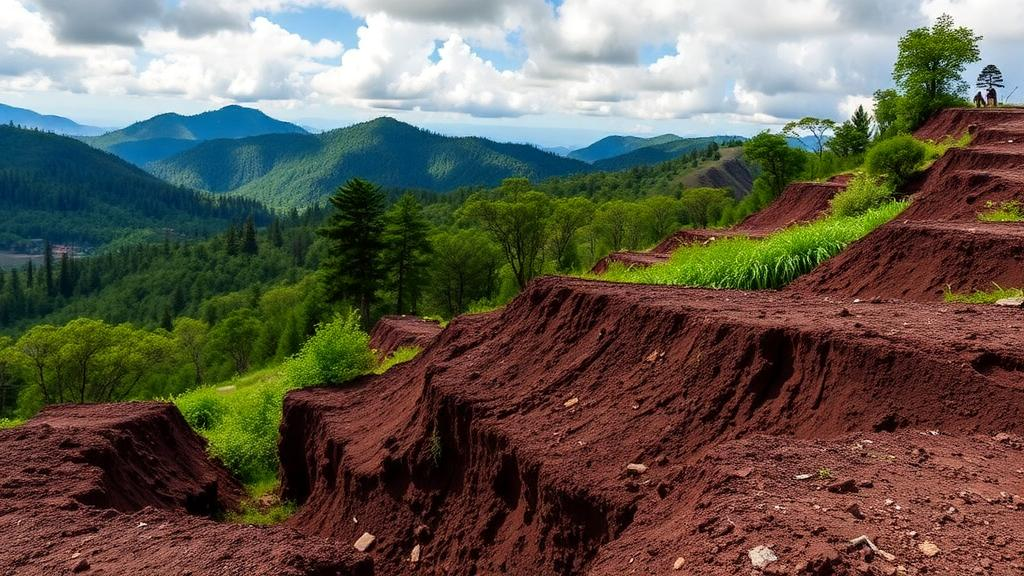
High in the central Ecuadorian Andes, some of the planet’s most carbon-rich soils are quietly being dismantled. A new field study in Chimborazo Province has quantified, with unusual precision, how much soil organic carbon vanishes when páramo grasslands and native montane forests are converted into croplands, pastures, and exotic tree plantations. The answer is staggering: on average, 88.1 tonnes of carbon per hectare disappear from the top 30 centimeters of soil, equivalent to roughly 323 tonnes of carbon dioxide per hectare. For a landscape where soils of volcanic origin can hold more carbon per unit area than lowland tropical rainforest, the finding reframes these high-altitude ecosystems as climate infrastructure whose loss carries consequences far beyond the Andean ridge line.
Soil organic carbon is the second largest carbon reservoir at the Earth’s surface, with global stocks estimated at approximately 1,500 petagrams of carbon in the upper meter of soil and up to 2,400 petagrams when the top two meters are considered. Through its influence on soil structure, aggregation, nutrient availability, and water retention, this reservoir underpins climate regulation, biodiversity, and ecosystem functioning. Yet it is also acutely sensitive to disturbance. Deforestation, agricultural expansion, grazing intensification, and fire all alter organic matter inputs, disrupt soil physical properties, and accelerate microbial mineralization, and globally, soil degradation and land-use change are estimated to contribute around 3 gigatonnes of carbon dioxide per year to the atmosphere.
The research team, led by scientists from the Escuela Superior Politécnica de Chimborazo in Ecuador and the University of Santiago de Compostela in Spain, focused on three localities in Chimborazo Province: Achupallas in the south, Columbe in the central sector, and Quimiag in the northeast. These areas share a broadly comparable pedogenic context, dominated by Andosols of volcanic origin characterized by low bulk density and a high capacity to stabilize organic matter. Between October 2023 and May 2024, the researchers collected 144 soil samples from the 0 to 30 centimeter layer across five land-use categories: natural páramo, native forest, croplands, pastures, and exotic plantations of pine and eucalyptus. The sampling design used a stratified grid approach, with 500 by 500 meter cells overlaid on maps of each locality, 250 by 250 meter sampling blocks within each cell, and three 20 by 20 meter plots per block, from which five subsamples were combined into composite samples.
The results confirm what the team hypothesized. Natural ecosystems, comprising páramo and native forests, held significantly higher soil organic carbon stocks, averaging 264.1 tonnes of carbon per hectare, than the anthropogenically transformed land uses, which averaged 176.0 tonnes per hectare. The difference of 88.1 tonnes of carbon per hectare was statistically robust across the study area. Pastures showed the most marked decline in carbon stocks, while croplands and exotic forest plantations occupied intermediate positions. In Quimiag, páramo soils reached 396.5 tonnes of carbon per hectare, among the highest values recorded for surface layers of high-Andean soils anywhere in the tropical Andes. In Columbe, where páramo is the dominant natural ecosystem, the contrast was equally stark: páramo soils held 248.0 tonnes of carbon per hectare, while pastures held 116.4, croplands 110.8, and exotic plantations just 56.9 tonnes per hectare.
The physical and chemical signatures of this transformation are visible in the soil itself. Natural ecosystems exhibited more acidic pH values than intervened systems, a consequence of the alkalinizing effect of ash from pre-cultivation burning and the application of lime-based amendments by farmers. This shift toward near-neutral pH reduces the solubility of iron, aluminum, and manganese and the reactivity of their hydroxides, weakening the organo-mineral complexes that physically protect soil organic matter from microbial attack. Meanwhile, soil bulk density in intervened areas rose to between 0.57 and 1.31 grams per cubic centimeter, compared with 0.29 to 0.75 grams per cubic centimeter in natural ecosystems, indicating a loss of porosity and infiltration capacity that accompanies the depletion of the organic matrix.
To translate these stock differences into climate-relevant terms, the researchers applied the stock-difference approach recommended by the Intergovernmental Panel on Climate Change for the Agriculture, Forestry and Other Land Use sector. This method quantifies potential emissions based on temporal variations in soil carbon stocks rather than direct measurements of soil carbon dioxide fluxes. By combining field-measured carbon differences with multitemporal land-use data derived from Landsat satellite imagery classified for the years 2000 and 2020, the team estimated an average annualized soil carbon loss of 4.4 tonnes of carbon per hectare per year, corresponding to approximately 16.15 tonnes of carbon dioxide equivalent per hectare per year across the 20-year period. The classification accuracy, assessed using confusion matrices with 210 reference points per locality, ranged from 87 to 89 percent overall.
At the local scale, the estimates varied considerably. In Achupallas, where the conversion of páramo and forest was most extensive, soil carbon losses reached 70.0 gigagrams of carbon per year, equivalent to 256.7 gigagrams of carbon dioxide equivalent annually. In Columbe, the transformation of the moorland generated estimated emissions of 193.0 gigagrams of carbon dioxide equivalent per year, while in Quimiag, where far less area was affected, the associated emissions were considerably lower at 5.28 gigagrams per year. At the regional scale, the páramo ecosystems of Chimborazo Province cover approximately 196,053 hectares and collectively store around 51,299 gigagrams of carbon as soil organic carbon. Under a theoretical scenario involving complete conversion of these ecosystems to anthropogenic land uses, potential emissions would reach approximately 9,405 gigagrams of carbon dioxide equivalent per year, representing a substantial fraction of Ecuador’s annual national emissions.
The researchers emphasize that these figures represent potential emissions resulting from the loss of soil carbon reserves, not direct measurements of atmospheric fluxes. The estimates are subject to uncertainty associated with spatial soil variability, land-use classification errors that typically range between 5 and 15 percent, and the conversion of soil organic matter to soil organic carbon using the Van Bemmelen factor of 1.724. A sensitivity analysis using alternative conversion factors of 1.9 and 2.0 reduced the estimated mean carbon loss from 88.1 to 80.0 and 76.0 tonnes per hectare respectively, and the corresponding carbon dioxide equivalent estimates from 323.1 to 293.2 and 278.5 tonnes per hectare. Despite these reductions, the overall pattern remained evident, with natural ecosystems consistently holding higher carbon stocks than transformed land uses.
The magnitude of the estimated losses places the high-Andean soils of Chimborazo among the most carbon-dense surface layers documented in the tropical Andes, exceeding values reported for the páramos of Peru and Colombia and approaching the upper limit of the range documented for Ecuador. The mean carbon stock of 264.1 tonnes per hectare in the top 30 centimeters is higher than the 100 to 200 tonnes per hectare typical of lowland tropical rainforest and the approximately 74 tonnes per hectare of tropical montane forest. This exceptional storage capacity arises from the combination of low temperatures, high soil moisture, and the short-range-order minerals of volcanic ash soils, which together inhibit microbial decomposition and promote the long-term stabilization of organic matter in organo-mineral complexes.
The findings underscore that the first three decades following land-use conversion represent a critical period of accelerated mineralization, during which the labile fractions of soil organic carbon are rapidly depleted before ecosystems reach a new quasi-equilibrium state. The researchers argue that the protection and sustainable management of these high-carbon ecosystems should be considered a priority within regional land-use planning strategies, particularly for climate change mitigation. Future research incorporating repeated long-term measurements, deeper soil layers, and spatially explicit assessments will be essential to reduce uncertainty in emission estimates and to better quantify the dynamics of these fragile but globally significant carbon reservoirs.
Subject of Research: Effects of land-use change on soil organic carbon stocks and potential CO2-equivalent emissions in the Ecuadorian Andes
Article Title: Land-use change effects on soil organic carbon stocks and potential CO2-equivalent emissions in the Ecuadorian Andes
Article References: Damián-Carrión, D., Echeverría-Guadalupe, M., Silva-Padilla, C., Armijos-Arcos, F., Rivera-Castillo, F., Merino, A., & Otero, X. L. (2026). Land-use change effects on soil organic carbon stocks and potential CO2-equivalent emissions in the Ecuadorian Andes. Spanish Journal of Soil Science, 16, Article 17377. https://doi.org/10.3389/sjss.2026.17377
Image Credits: AI Generated
Keywords: soil organic carbon, páramo, Ecuadorian Andes, land-use change, Andosols, carbon emissions, climate mitigation, volcanic soils, Chimborazo, IPCC stock-difference, montane forest, soil degradation
Cite Scienmag News
Violet Maxwell. (October 15, 2026). Andean Soils Lose Vast Carbon Reserves When Páramo and Forests Are Converted. Scienmag. https://scienmag.com/andean-soils-lose-vast-carbon-reserves-when-paramo-and-forests-are-converted/
Violet Maxwell. "Andean Soils Lose Vast Carbon Reserves When Páramo and Forests Are Converted." Scienmag, 15 October 2026, https://scienmag.com/andean-soils-lose-vast-carbon-reserves-when-paramo-and-forests-are-converted/. Accessed 15 October 2026.
Violet Maxwell. "Andean Soils Lose Vast Carbon Reserves When Páramo and Forests Are Converted." Scienmag. October 15, 2026. https://scienmag.com/andean-soils-lose-vast-carbon-reserves-when-paramo-and-forests-are-converted/


