

Thursday, July 9, 2026
Science
No Result
View All Result
  • Login
  • HOME
  • SCIENCE NEWS
  • CONTACT US
  • HOME
  • SCIENCE NEWS
  • CONTACT US
No Result
View All Result
Scienmag
No Result
View All Result
Home Science News Social Science

Children Show Early Signs of Political Bias Development

July 9, 2026
in Social Science
Reading Time: 2 mins read
0
Children Show Early Signs of Political Bias Development

Children Show Early Signs of Political Bias Development

65
SHARES
587
VIEWS
Share on FacebookShare on Twitter
ADVERTISEMENT

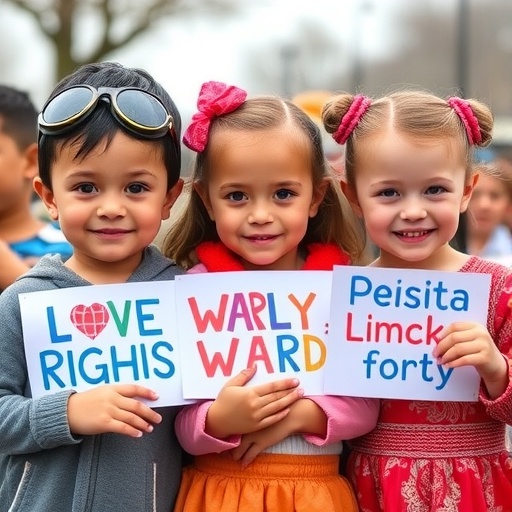
New research reveals that partisanship emerges surprisingly early in childhood, demonstrating that even young children aged five to nine exhibit biased loyalty to their social groups when interpreting ambiguous information. A team of psychologists led by Andrei Cimpian from New York University designed a series of controlled experiments to explore how group affiliation influences children’s judgments, uncovering nuanced insights about the developmental roots of partisan behavior.

In their study, children were assigned to deliberately created social groups distinguished solely by colored t-shirts—green or orange. After choosing their group, children were presented with pairs of characters, each making conflicting claims about ambiguous images, such as animals that could be interpreted as either horses or cows. The setup differentiated a “group condition,” where characters were clearly labeled as in-group or out-group members, and a control condition, where no group distinctions were made despite identical visual cues.

Strikingly, children in the group condition were consistently more likely to side with the claims of their in-group characters, often disregarding the visual evidence. This effect underscored that partisanship at this early age is less about discerning truth and more about affirming group loyalty, revealing how social identity shapes perception well before adolescence.

To probe whether this partisan bias could be modulated, the researchers implemented two key modifications in subsequent experiments. First, they introduced privacy, informing children that their answers would remain confidential, removing public social pressures. Second, they offered rewards contingent on accuracy, incentivizing truthful reporting. Both adjustments significantly diminished partisan bias; children who responded privately or were motivated to be accurate reported observations more in line with objective evidence.

These findings suggest that young children’s group-based distortions in belief are malleable and driven primarily by social motivations rather than entrenched cognitive convictions. The implications extend to understanding how early experiences foster political and social partisanship. If social incentives and conditions influence children’s proclivity to favor group-aligned information, interventions promoting privacy or emphasizing accuracy might serve as critical tools in mitigating biased reasoning.

Moreover, this research shifts the paradigm around the origins of partisan thinking, highlighting how the need for social belonging can override objective assessment from a young age. It also points to a hopeful avenue: encouraging environments that reduce social accountability or elevate the value of truth may counteract divisive tendencies before they harden into adult ideologies.

Published in the journal Cognition, this study provides a foundational framework for future investigations into the developmental trajectory of partisanship. By combining experimental rigor with developmental psychology, this work bridges gaps in understanding how group identity interacts with evidence processing during formative years. As Election Day 2026 approaches, these insights offer critical reflections on how political allegiances might be shaped well before teens can cast their ballots.

Subject of Research: People
Article Title: Investigating the origins of partisanship: What motivates children to preferentially endorse their ingroups’ claims?
News Publication Date: 3-Jul-2026
Web References: http://dx.doi.org/10.1016/j.cognition.2026.106629
Image Credits: Image courtesy of Bethany Lassetter
Keywords: Human behavior, Human social behavior

Tags: children's early political biasdevelopment of partisan behavior in young childrendevelopmental psychology of political partisanshipearly childhood social cognition and group favoritismearly signs of bias and loyalty in children aged fiveexperimental studies on group bias in childrenformation of in-group and out-group perceptions in early childhoodimpact of social affiliation on children's interpretation of ambiguous informationinfluence of social groups on children's judgmentrole of visual cues and group labels in children's decision-makingsocial identity and group loyalty in childhood
Share26Tweet16
Previous Post

Genetic Adaptations Enable Survival of Earth’s Highest-Dwelling Mammal

Next Post

New Statistical Tool Evaluates Benefits of Personalized Medical Interventions

Related Posts

Stirling Review Reveals How Modern Design Strains the Brain
Social Science

Stirling Review Reveals How Modern Design Strains the Brain

July 9, 2026
Scientists develop AI to monitor smart vapes with digital displays
Social Science

Scientists develop AI to monitor smart vapes with digital displays

July 9, 2026
Center for BrainHealth Appoints Dr. Sexton to Lead Global Brain Health Initiatives
Social Science

Center for BrainHealth Appoints Dr. Sexton to Lead Global Brain Health Initiatives

July 9, 2026
East Asian Herbal Medicine Enhances Schizophrenia Treatment Outcomes
Social Science

East Asian Herbal Medicine Enhances Schizophrenia Treatment Outcomes

July 9, 2026
Small PowerPoint tweaks greatly improve learning outcomes
Social Science

Small PowerPoint tweaks greatly improve learning outcomes

July 9, 2026
USC Rossier Traces 250 Years of Youth-Led Educational Change
Social Science

USC Rossier Traces 250 Years of Youth-Led Educational Change

July 9, 2026
Next Post
New Statistical Tool Evaluates Benefits of Personalized Medical Interventions

New Statistical Tool Evaluates Benefits of Personalized Medical Interventions

  • Mothers who receive childcare support from maternal grandparents show more

    Mothers who receive childcare support from maternal grandparents show more parental warmth, finds NTU Singapore study

    27656 shares
    Share 11059 Tweet 6912
  • University of Seville Breaks 120-Year-Old Mystery, Revises a Key Einstein Concept

    1061 shares
    Share 424 Tweet 265
  • Bee body mass, pathogens and local climate influence heat tolerance

    682 shares
    Share 273 Tweet 171
  • Researchers record first-ever images and data of a shark experiencing a boat strike

    546 shares
    Share 218 Tweet 137
  • Groundbreaking Clinical Trial Reveals Lubiprostone Enhances Kidney Function

    531 shares
    Share 212 Tweet 133
Science

Embark on a thrilling journey of discovery with Scienmag.com—your ultimate source for cutting-edge breakthroughs. Immerse yourself in a world where curiosity knows no limits and tomorrow’s possibilities become today’s reality!

RECENT NEWS

  • Neoadjuvant Immunotherapy Shows Promise for High-Risk Localized Prostate Cancer
  • Satellites Track Penguin Poo Color to Reveal Climate Change Impact
  • Doctors struggle to learn from experiences that challenge AI recommendations
  • Genome Editing in Rats Advances Accurate ER+ Breast Cancer Models

Categories

  • Agriculture
  • Anthropology
  • Archaeology
  • Athmospheric
  • Biology
  • Biotechnology
  • Blog
  • Bussines
  • Cancer
  • Chemistry
  • Climate
  • Earth Science
  • Editorial Policy
  • Marine
  • Mathematics
  • Medicine
  • Pediatry
  • Policy
  • Psychology & Psychiatry
  • Science Education
  • Social Science
  • Space
  • Technology and Engineering

Subscribe to Blog via Email

Enter your email address to subscribe to this blog and receive notifications of new posts by email.

Join 5,146 other subscribers

© 2025 Scienmag - Science Magazine

Welcome Back!

Login to your account below

Forgotten Password?

Retrieve your password

Please enter your username or email address to reset your password.

Log In
No Result
View All Result
  • HOME
  • SCIENCE NEWS
  • CONTACT US

© 2025 Scienmag - Science Magazine

Discover more from Science

Subscribe now to keep reading and get access to the full archive.

Continue reading
