


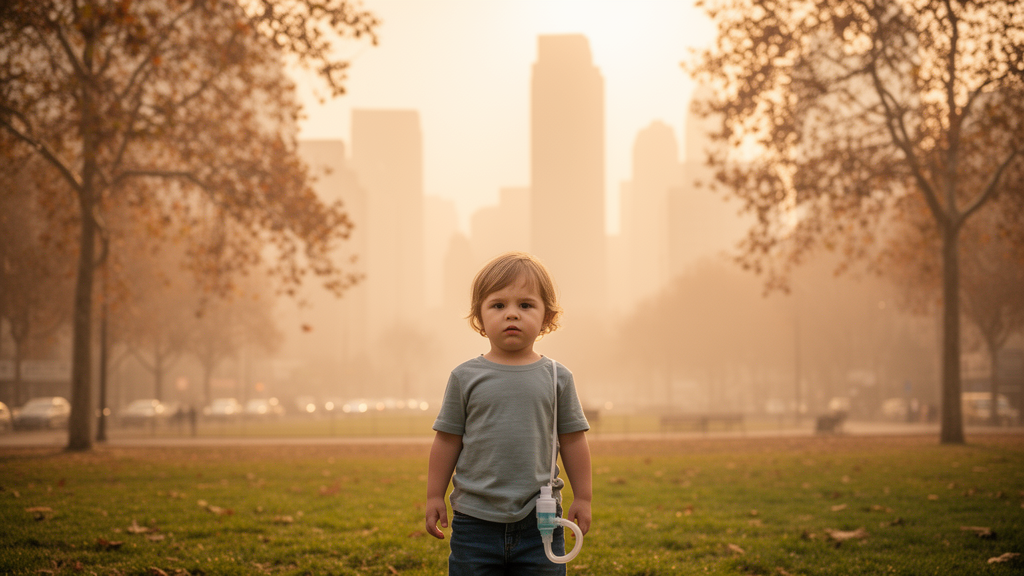
A twenty-one-year global analysis of 149 countries has found that the drivers of child and adolescent asthma change in distinct patterns as nations move through different stages of urbanization, shifting from air pollution-dominated risks toward climate and lifestyle-related vulnerabilities. The study, published in npj Urban Sustainability, used panel data covering 2000 to 2020 to trace how urban development and air quality transitions shape asthma incidence in young people.
The research team applied clustering and coupling coordination analysis to identify four evolutionary stages of urbanization. These were labeled Early Urbanization with Emerging Pollution, Rapid Urbanization with Pollution Accumulation, Decelerating Urbanization with Pollution Mitigation, and Mature Urbanization with Pollution Control. Each cluster groups countries sharing similar trajectories of city growth, pollution levels, and environmental conditions over the two-decade study period.
The timing of peak pollution and peak disease did not coincide, a finding with potentially significant implications for public health planning. Fine particulate matter concentrations, known as PM2.5, reached their highest levels during the rapid urbanization stage, when cities expand quickly and emissions accumulate. Asthma incidence, however, peaked later, during the decelerating stage, when urban growth slows and pollution mitigation efforts are underway.
To probe these stage-specific patterns, the researchers employed generalized additive models. The models revealed substantial heterogeneity in asthma determinants across the four clusters, meaning that the same risk factors do not operate uniformly in countries at different stages of development.
In the earliest stage, marked by emerging pollution, asthma risk was driven by PM2.5 exposure together with a large youth population. Countries in the rapid urbanization cluster were dominated by the impact of PM2.5, underscoring the central role of particulate air pollution during phases of intense urban expansion.
The picture changed markedly in the decelerating stage, where high temperature and obesity emerged as the primary risk factors for childhood and adolescent asthma. This transition suggests that as air quality improves, climatic stress and lifestyle-related conditions become the dominant vulnerabilities, even though asthma incidence reaches its maximum during this same phase.
Countries in the mature urbanization stage, where pollution control is well established, remained sensitive to temperature as a risk factor. Notably, the analysis identified green space and wind speed as protective factors in these settings, hinting that vegetation cover and air movement may help buffer young populations against asthma in heavily urbanized environments.
The authors note that global evidence on how asthma risk factors evolve across development stages had remained limited, and their staged framework offers a way to interpret that heterogeneity. Because the analysis draws on country-level panel data, the stage-specific patterns reflect aggregated national trajectories from 2000 to 2020 rather than individual-level measurements.
The overall message is that asthma prevention strategies cannot be one-size-fits-all. In rapidly urbanizing countries, controlling PM2.5 remains the central priority, while in more developed settings, heat and obesity demand attention alongside the protective roles of green space and wind speed. The researchers argue that these shifting determinants necessitate stage-specific public health interventions tailored to where a country sits along its urbanization trajectory.
Subject of Research: Stage-specific environmental and lifestyle determinants of child and adolescent asthma across global urbanization trajectories
Article Title: Heterogeneity of child and adolescent asthma determinants across urbanization stages: a 21-year global analysis
Article References: Yang, Y., Zhao, X., Gao, Y., Pi, P., Wang, Y., Zhou, Y., Luo, Z., Li, G., Liu, H., & Wan, Q. (2026). Heterogeneity of child and adolescent asthma determinants across urbanization stages: a 21-year global analysis. npj Urban Sustainability. https://doi.org/10.1038/s42949-026-00487-x
Image Credits: AI Generated
DOI: 10.1038/s42949-026-00487-x
Keywords: asthma, children and adolescents, urbanization, PM2.5, air pollution, temperature, obesity, green space, global health, npj Urban Sustainability, Heterogeneity, child
Cite Scienmag News
Kayla Dunham. (October 23, 2026). Childhood Asthma Risks Shift From Air Pollution to Climate as Cities Mature, 21-Year Global Study Finds. Scienmag. https://scienmag.com/childhood-asthma-risks-shift-from-air-pollution-to-climate-as-cities-mature-21-year-global-study-finds/
Kayla Dunham. "Childhood Asthma Risks Shift From Air Pollution to Climate as Cities Mature, 21-Year Global Study Finds." Scienmag, 23 October 2026, https://scienmag.com/childhood-asthma-risks-shift-from-air-pollution-to-climate-as-cities-mature-21-year-global-study-finds/. Accessed 23 October 2026.
Kayla Dunham. "Childhood Asthma Risks Shift From Air Pollution to Climate as Cities Mature, 21-Year Global Study Finds." Scienmag. October 23, 2026. https://scienmag.com/childhood-asthma-risks-shift-from-air-pollution-to-climate-as-cities-mature-21-year-global-study-finds/


