


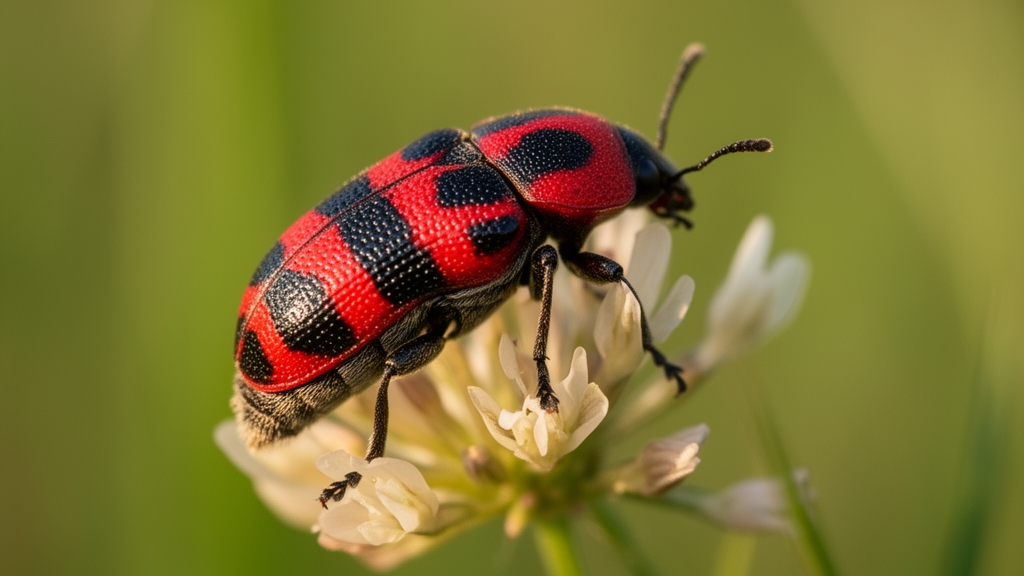
In the mountains and valleys of the South Caucasus, a family of beetles dressed in vivid reds, blues and blacks has been quietly slipping through the cracks of science. Checkered beetles, the Cleridae, are among the most striking insects of the Palaearctic region, yet in Georgia — known to its own people as Sakartvelo — their diversity has remained astonishingly poorly documented for more than a century. A new study published in the journal Caucasiana has now assembled the country’s first comprehensive checklist of these beetles, confirming 18 species and, in doing so, revealing just how much of the nation’s insect life still waits to be discovered.
Checkered beetles belong to the superfamily Cleroidea, a group that includes roughly 3,500 described species worldwide. They are most often encountered on flowers in moist, sunny habitats or lurking beneath tree bark, where many species hunt other insects. Although the family is often described as primarily plant-feeding, its members display a remarkable range of diets: some are predators, while others scavenge on animal remains. One familiar example is Trichodes apiarius, the bee-pirate beetle, whose red-and-black banded body is a familiar sight on European flowers and which is known to raid honeybee hives as a scavenger. This ecological versatility makes the Cleridae an interesting group for understanding how insects partition habitats across landscapes as varied as those of the Caucasus.
Despite their conspicuous appearance, Georgia’s checkered beetles have been catalogued only in fragments. The earliest substantive account came from the German naturalist Alfred Radde, whose 1899 survey of Caucasian fauna reported just four species for the country. In 1915, the entomologist Zaitsev expanded the national list to 16 species, drawing on collections made across the region in the early twentieth century. After that, the trail went largely cold. Only in 2022 did researchers report three Cleridae species from the Lagodekhi Protected Areas, and a subsequent national biodiversity compilation brought the tally to 18 species. Even so, the authors of the new study emphasize that distribution data for the family in Georgia remain sporadic and incomplete, scattered across old literature, museum drawers and, increasingly, the photo libraries of amateur naturalists.
To build the new checklist, the research team cast a deliberately wide net. They combed published articles and online databases covering the Caucasus and Georgia, extracting occurrence records from the Global Biodiversity Information Facility (GBIF) and the Georgian Biodiversity Database. They also turned to the Caucasus Barcode of Life project, or CaBOL, a regional initiative that combines specimen collection with DNA barcoding, and to the dry entomological collections housed at the Institute of Zoology of Ilia State University, where old, unpublished material had never been formally documented. Specimens from the barcoding project were identified using the classic identification keys of Richter and Krivolutskaya, and the taxonomy of the entire list was validated against the Catalogue of Palaearctic Coleoptera.
Perhaps the most striking methodological choice was the decision to treat social media as a legitimate source of biodiversity data. The researchers mined the Facebook page Wildlife of Georgia, where members of the public post photographs of animals encountered across the country, alongside the international citizen science platform iNaturalist. For a country where formal entomological surveys have been sparse, these platforms proved to be a surprisingly rich vein of records, contributing numerous observations of the genus Trichodes from locations ranging from Tbilisi’s Lisi Lake to the alpine meadows near Mestia in Svaneti. The approach reflects a growing recognition among conservation scientists that smartphone-wielding naturalists can fill gaps that professional surveys, constrained by funding and logistics, cannot.
Not every record came with clean coordinates. Many of the localities cited in the older literature are vague, sometimes naming only a town or a mountain pass, so the team georeferenced historical sampling sites using Google Earth Pro, with accuracy varying from record to record. The resulting distribution map shows a heavy concentration of records in the central part of the country — around Tbilisi, Mtskheta, Gori, Borjomi and Bakuriani — with additional clusters in the eastern Kakheti region near Lagodekhi and Telavi. Large portions of western Georgia, and much of the high Caucasus, remain essentially blank on the map, a gap the authors attribute to patchy survey effort rather than genuine absence of beetles.
The checklist itself reads like a tour of Georgian landscapes. The genus Trichodes, the flamboyant flower-climbing beetles, is the best represented, with four species including the widespread T. apiarius, documented from dozens of sites spanning lowland steppes to alpine meadows at over 2,200 meters. The wood-associated genus Opilo contributes three species, including Opilo mollis, recently recorded in a deciduous forest near Tbilisi through the CaBOL barcoding program. Thanasimus formicarius, the ant-like bark beetle hunter, shows up in records stretching from Radde’s nineteenth-century surveys to a 2022 hand collection under bark in a mixed broadleaf forest dominated by Caucasian hornbeam. Other entries include the metallic blue Korynetes caeruleus, recorded at Borjomi and Manglisi, and Tillus elongatus, found in the Eldari steppes of Kakheti.
Two species on the list carry a question mark. Clerus mutillarius and Dermestoides sanguinicollis are included because the Catalogue of Palaearctic Coleoptera indicates their presence in the area, but no precise Georgian locality has ever been published, and the authors note that targeted fieldwork is needed to confirm that they actually occur in the country. At the same time, the study points in the other direction as well: several Trichodes species known from neighboring countries are strong candidates for future discovery in Georgia. Trichodes sipylus is distributed in Armenia, Azerbaijan and Turkey, while T. ephippiger and T. longissimus occur in Turkey, and T. persicus is known from Armenia and Azerbaijan, with its closest recorded occurrence in Gyumri, just across the border. Given the continuity of habitats across these frontiers, the authors consider it likely that these beetles will eventually be found on Georgian soil.
The study’s voucher specimens, photographed alongside the checklist, provide a visual record of the family’s diversity in the country, from the elongated, wasp-like Opilo taeniatus swept from the Kvernaki ridge near Gori to the four-spotted Trichodes quadriguttatus observed at Lisi Lake in the capital. Each record in the list is anchored to coordinates, elevation, collection method and, where available, a unique CaBOL or GBIF identifier, making the dataset immediately usable for future ecological and biogeographic work. This level of documentation matters because checkered beetles, as predators of bark beetles and other forest insects, play functional roles in the health of the Caucasus’s extensive broadleaf and mixed forests, and because baseline species lists are the foundation upon which any monitoring program must stand.
What emerges most clearly from the new checklist is a portrait of a country whose insect fauna is known only in outline. A century and a quarter after Radde counted four checkered beetles in Georgia, the modern tally stands at 18 — a number built from tsarist-era expeditions, Soviet-era museum drawers, DNA-barcoded field collections and Facebook photographs. The authors are explicit that the surveyed area remains patchy and that most of the country still needs to be studied to produce comprehensive distributional data for the family. For a nation sitting at the crossroads of Europe and Asia, with habitats ranging from humid Colchic forests to arid steppes and high alpine meadows, the checkered beetles may prove to be only the first of many groups whose true diversity in the Caucasus is finally brought into focus.
Subject of Research: A checklist of checkered beetle (Cleridae) species diversity and distribution in Georgia
Article Title: Checklist of checkered beetles ( Coleoptera , Cleridae ) from Sakartvelo (Georgia)
Article References: Iskandarova, T., & Japarashvili, S. (2023). Checklist of checkered beetles (Coleoptera, Cleridae) from Sakartvelo (Georgia). Caucasiana, 2, 205-210. https://doi.org/10.3897/caucasiana.2.e109026
Image Credits: AI Generated
DOI: 10.3897/caucasiana.2.e109026
Keywords: Cleridae, checkered beetles, Georgia, Caucasus, biodiversity, checklist, citizen science, GBIF, iNaturalist, entomology, species distribution, Caucasus Barcode of Life
Cite Scienmag News
Gavin Prescott. (October 18, 2026). Checkered Beetles of Georgia Get Their First Modern Checklist, Blending Century-Old Records with Citizen Science. Scienmag. https://scienmag.com/checkered-beetles-of-georgia-get-their-first-modern-checklist-blending-century-old-records-with-citizen-science/
Gavin Prescott. "Checkered Beetles of Georgia Get Their First Modern Checklist, Blending Century-Old Records with Citizen Science." Scienmag, 18 October 2026, https://scienmag.com/checkered-beetles-of-georgia-get-their-first-modern-checklist-blending-century-old-records-with-citizen-science/. Accessed 18 October 2026.
Gavin Prescott. "Checkered Beetles of Georgia Get Their First Modern Checklist, Blending Century-Old Records with Citizen Science." Scienmag. October 18, 2026. https://scienmag.com/checkered-beetles-of-georgia-get-their-first-modern-checklist-blending-century-old-records-with-citizen-science/


