


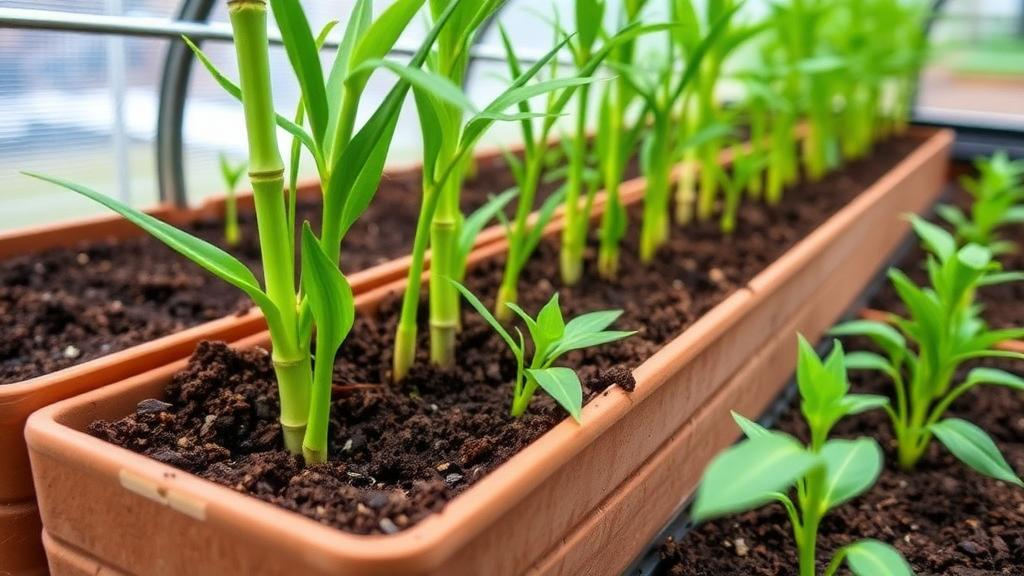
Japanese researchers have turned two of the country’s most abundant agricultural headaches—invasive moso bamboo and leftover rapeseed oilcake—into a low-cost vermicompost that reliably protects vegetable seedlings from one of horticulture’s most destructive diseases. The new study, published in Discover Soil by Ruka Kawasumi and Motoaki Tojo of Osaka Metropolitan University, shows that a simplified recipe using coarsely ground bamboo instead of finely milled material cuts production costs substantially while preserving, and even improving, the compost’s ability to suppress damping-off, a seedling-killing disease caused by water-mold pathogens.
The work builds on an earlier innovation from the same laboratory: a vermicompost made from finely ground bamboo and kudzu, a nitrogen-fixing but notoriously invasive vine. That original blend, known as VFBK, had already demonstrated an impressive capacity to suppress soilborne pathogens and plant-parasitic nematodes. Yet its path to commercial use was blocked by two stubborn problems. Grinding bamboo down to fine particles between 0.2 and 1.0 millimeters proved expensive, and harvesting enough wild kudzu added further labor costs. Worse, the finished compost carried relatively little nitrogen, and seedlings grown in it often developed visibly pale leaves—a sign that the plants were starved for this essential nutrient.
To overcome these limitations, the researchers reengineered the entire production system. They replaced kudzu with rapeseed oilcake, a widely available by-product of oil pressing that carries a much higher and more stable nitrogen content, with a carbon-to-nitrogen ratio of roughly 8 compared with about 16 for kudzu. More importantly, they abandoned fine grinding altogether, using bamboo particles between 0.3 and 6.5 millimeters with a mean of 1.6 millimeters—roughly two and a half times coarser than before. The resulting product, dubbed VCBR, was compared against both the original kudzu-based VFBK and a finely ground bamboo–rapeseed oilcake blend called VFBR, allowing the team to separate the effects of particle size from those of the nitrogen source.
The production process itself followed classic vermicomposting principles. Bamboo culms were ground, soaked in water for at least 24 hours to remove compounds repellent to earthworms, and mixed with either kudzu or rapeseed oilcake in plastic containers. After four weeks of precomposting at 25 degrees Celsius, roughly 70 grams of red wiggler earthworms (Eisenia fetida) were added to each container. Over three months, with moisture maintained at 70 to 80 percent, the worms and their associated microbes transformed the fibrous bamboo into a dark, biologically active amendment. Three replicate containers were prepared for each recipe, and equal amounts from each were pooled into composite samples for analysis.
The cost savings were dramatic. Estimated at a practical production scale of one metric ton per month, VCBR came in at 267,200 yen—about 1,670 US dollars—per ton. Simply switching back to finely ground bamboo added 32,960 yen, roughly 206 dollars, per ton. The original kudzu-based VFBK was the most expensive of all, at 349,600 yen, or about 2,185 dollars per ton, burdened by both fine grinding and the labor of harvesting and processing kudzu. For small- to medium-scale producers hoping to use locally available bamboo biomass, the coarser recipe removes a major economic barrier to adopting organic disease-suppressive amendments.
Chemical analysis revealed that particle size had surprisingly little effect on the raw bamboo itself: coarsely and finely ground material showed no significant differences in water-soluble nutrients or pH. The real differences emerged after vermicomposting. Both rapeseed-based blends outperformed the kudzu version on nitrogen: VFBK had much lower ammonium content and a markedly higher carbon-to-nitrogen ratio, confirming that swapping kudzu for oilcake improved nitrogen availability. Interestingly, although identical amounts of rapeseed oilcake were added to VCBR and VFBR, the finely ground version ended up with higher total nitrogen. The authors suggest that the coarser particles may have improved aeration during composting—larger particles create more free air space and better oxygen flow—and such conditions are known to influence nitrogen losses, though aeration was not directly measured.
The disease-suppression trials formed the heart of the study. The team tested two economically important pathosystems: shiso, a popular Japanese culinary herb, challenged with Pythium myriotylum under warm conditions, and cucumber challenged with Globisporangium ultimum at moderate temperatures. Each vermicompost was mixed into commercial nursery soil at 20 percent by volume, with unamended soil serving as the control. Disease was triggered by pouring inoculum grown on bentgrass-seed agar around the base of seedlings, and incidence was scored four days later across multiple independent experimental runs. Because statistical analysis revealed significant treatment-by-run interactions, the researchers compared each treatment against the control within every individual run using Dunnett’s test.
The results were striking. VCBR proved the most consistent performer of the three, significantly reducing damping-off in all three runs of the shiso–Pythium assay and in three of four runs of the cucumber–Globisporangium assay. VFBR suppressed disease in two runs of each assay, while the original VFBK managed only two runs against Pythium and a single run against Globisporangium. Notably, these differences could not be explained by the general microbial indicators the team measured—culturable fungal and bacterial counts, fungal-to-bacterial ratios, and total adenylate levels via bioluminescence assay all came back statistically indistinguishable among treatments. The authors point out that disease suppressiveness in organic amendments is generally tied to biological properties such as microbial community composition and specific antagonistic organisms, which their plate-count methods could not capture, leaving the precise mechanism an open question for future work.
There was, however, a significant catch. Seedlings grown in VCBR-amended media showed reduced SPAD values—a chlorophyll meter reading that serves as a proxy for leaf greenness and nitrogen status—in both shiso and cucumber compared with plants in unamended commercial soil. The finely ground VFBR was gentler: it lowered SPAD in shiso but not significantly in cucumber. This pattern suggests a genuine trade-off between production cost and seedling chlorophyll status, likely rooted in nitrogen dynamics. The authors emphasize that extractable ammonium and total carbon-to-nitrogen ratios do not fully predict nitrogen availability to seedlings; the balance between mineralization and immobilization after the compost enters the nursery substrate, along with the physical and microbial properties of the medium, all play a role. Encouragingly, they note that nitrogen status could potentially be improved simply by adjusting the amount of rapeseed oilcake added during production, since the oilcake carries more total nitrogen than kudzu—a hypothesis that now awaits experimental testing.
Beyond the greenhouse, the study carries a broader environmental message. Unmanaged moso bamboo forests now cover approximately 167,000 hectares of Japan, expanding relentlessly into farmland and native forests, reducing understory diversity, destabilizing soils, and worsening wildlife damage. Converting this troublesome biomass into a disease-suppressive nursery medium offers a rare win-win: a use for an invasive resource and a step toward pesticide-free seedling production. The authors caution that their cost estimates rest on specific assumptions and that the mechanisms underlying suppression remain unelucidated, but the direction is clear. With its combination of simple processing, accessible feedstocks, and consistent protection against two major seedling pathogens, the coarse bamboo–rapeseed oilcake vermicompost stands as a promising foundation—provided its nitrogen supply can be tuned to keep seedlings as green as they are healthy.
Subject of Research: Development of a low-cost, disease-suppressive bamboo-based vermicompost for seedling production
Article Title: Coarsely ground bamboo and rapeseed oilcake produce a lower-cost vermicompost with damping-off suppressiveness
Article References: Kawasumi, R., & Tojo, M. (2026). Coarsely ground bamboo and rapeseed oilcake produce a lower-cost vermicompost with damping-off suppressiveness. Discover Soil, 3(1), Article 172. https://doi.org/10.1007/s44378-026-00335-5
Image Credits: AI Generated
DOI: 10.1007/s44378-026-00335-5
Keywords: vermicompost, bamboo, rapeseed oilcake, damping-off, Pythium myriotylum, Globisporangium ultimum, Eisenia fetida, nursery medium, soilborne disease, organic amendment, invasive species, sustainable agriculture
Cite Scienmag News
Alan Morgan. (October 1, 2026). Cheaper Bamboo Vermicompost Fights Seedling Damping-Off in the Greenhouse. Scienmag. https://scienmag.com/cheaper-bamboo-vermicompost-fights-seedling-damping-off-in-the-greenhouse/
Alan Morgan. "Cheaper Bamboo Vermicompost Fights Seedling Damping-Off in the Greenhouse." Scienmag, 1 October 2026, https://scienmag.com/cheaper-bamboo-vermicompost-fights-seedling-damping-off-in-the-greenhouse/. Accessed 4 October 2026.
Alan Morgan. "Cheaper Bamboo Vermicompost Fights Seedling Damping-Off in the Greenhouse." Scienmag. October 1, 2026. https://scienmag.com/cheaper-bamboo-vermicompost-fights-seedling-damping-off-in-the-greenhouse/


