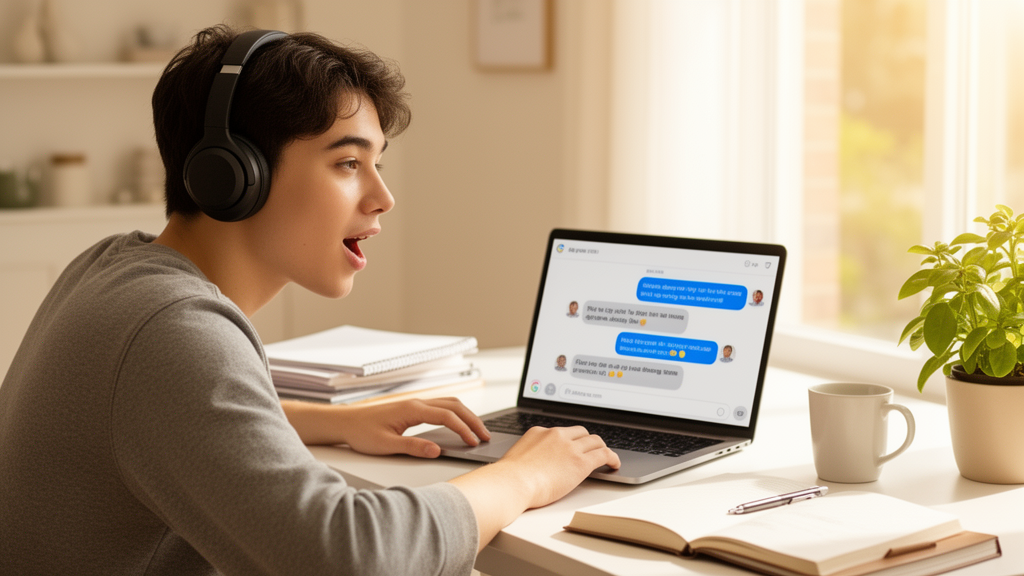
ChatGPT may be a surprisingly effective conversation partner for English learners, according to a new study from Iran that tracked how sixty-five intermediate students performed after ten weeks of structured speaking practice with the AI tool. The research, published in the Asian-Pacific Journal of Second and Foreign Language Education, measured learners’ spoken English using established complexity, accuracy, and fluency indicators and found that students who practiced with a customized ChatGPT produced noticeably longer, more elaborated sentences and spoke faster than peers who received conventional teacher-led instruction.
The study was conducted with adult learners enrolled in a private language institute in Tehran, all of them native speakers of Persian placed at the intermediate level, corresponding to B1 on the Common European Framework of Reference for Languages. The primary reason for enrollment was preparation for the IELTS examination, and the researchers deliberately embedded their intervention within that exam-oriented context. The learners were distributed across six pre-existing classes of eight to twelve students, and to preserve ecological validity and prevent contamination between groups, randomization was carried out at the class level rather than the individual level. Three classes, totaling thirty-three students, were assigned to the experimental condition, while three classes of thirty-two students followed traditional teacher-led speaking instruction.
Both groups received comparable amounts of instructional time and worked through similar speaking topics aligned with IELTS Part 1, the interview-style opening section of the exam that covers familiar subjects such as family, hobbies, and daily routines. The control group engaged in typical classroom activities, including structured dialogues, pair work, and role-plays guided by the instructor, with question-answer exchanges, peer interaction, and teacher feedback focused on fluency, vocabulary, and grammatical accuracy. The experimental group supplemented this classroom instruction with structured ChatGPT-assisted speaking practice using a dedicated GPT designed by the researchers specifically for IELTS Part 1 tasks.
That customization mattered. Rather than letting learners interact with general-purpose ChatGPT, the researchers configured the system to simulate the role of an IELTS examiner, generate topic-based questions, and provide follow-up prompts that encouraged extended responses. At the start of each session, learners received a menu of topic prompts generated by the GPT, selected a topic, and activated conversation mode, after which the system initiated an interactive dialogue mirroring the question-answer exchange of an actual IELTS interview. Learners were required to give extended answers while the GPT offered adaptive follow-up questions, elaboration prompts, and occasional feedback. All of this AI practice took place within the instructional setting under teacher supervision, ensuring that time-on-task was broadly equivalent across the two groups.
Performance was assessed at two points, a pre-test before the intervention and a post-test immediately after the ten instructional weeks. Speaking responses to standardized IELTS-aligned prompts were audio-recorded, transcribed, and coded using six widely employed measures from second language acquisition research. Complexity was operationalized as mean length of T-unit in words and clauses per T-unit, accuracy as the percentage of error-free clauses and the number of errors per 100 words, and fluency as speech rate in words per minute and pause frequency per minute. Statistical comparisons between groups used Welch’s one-way analyses of variance, chosen for their robustness to violations of homogeneity of variance and their ability to accommodate unequal sample sizes, with effect sizes reported as eta squared.
The complexity results were the most striking. At pre-test, the two groups were statistically indistinguishable, averaging around nine and a half words per T-unit and roughly 1.3 clauses per T-unit. By post-test, the ChatGPT group produced T-units averaging 12.82 words compared with 10.41 in the control group, a difference the statistical analysis confirmed as highly significant with a large effect size of eta squared equal to 0.36. The experimental group also showed a modest but significant increase in clauses per T-unit, rising to 1.41 while the control group remained nearly unchanged at 1.32, corresponding to a medium effect. In practical terms, learners who practiced with the AI were building longer, more syntactically elaborate utterances than their classroom-taught peers.
Fluency told a similar story, at least in part. Speech rate, which was nearly identical at baseline at roughly seventy words per minute in both groups, climbed to 79.33 words per minute in the experimental group while the control group remained essentially flat at 70.56. The between-group difference at post-test was statistically significant with a large effect. Pause frequency, however, showed only modest changes, with the experimental group reducing pauses to 8.42 per minute and the control group to 9.13, a difference that did not reach statistical significance. The researchers suggest that the faster speech delivery may reflect conditions commonly associated with reduced performance pressure in AI-mediated interaction, though the study did not directly measure anxiety or willingness to communicate.
Accuracy was the dimension where ChatGPT’s advantage disappeared. Both groups improved over the ten weeks: the experimental group increased its percentage of error-free clauses from 56.2 to 59.4 percent, while the control group actually edged slightly ahead at 62.3 percent, and both groups reduced their errors per 100 words to nearly identical levels of around ten and a half. None of the between-group differences on either accuracy measure approached statistical significance. The authors interpret this pattern as evidence that while increased practice opportunities and adaptive interaction can drive complexity and fluency gains, grammatical accuracy may require more sustained corrective input and scaffolding than ChatGPT-based practice typically delivers. Unlike teacher-led instruction, which often involves explicit corrective feedback and targeted form-focused teaching, the AI tended to provide indirect or implicit modeling that may be insufficient for learners to notice and internalize their error patterns.
These findings align with a growing international literature on AI-mediated speaking practice. Previous studies in Iranian contexts found that chatbot practice with platforms such as Replika and SmallTalk2Me produced gains in speech rate and reductions in speaking anxiety, while research with intelligent personal assistants showed fluency improvements comparable to those achieved by interacting with native English speakers. Studies of ChatGPT specifically have reported improvements in speaking self-efficacy, fluency, lexical range, and pronunciation, though researchers have also flagged persistent weaknesses, including inaccurate automated scoring, superficial feedback, inconsistent outputs, and the risk of learners becoming over-reliant on AI at the expense of peer collaboration. The new study adds fine-grained performance measures within a clearly defined instructional setting, an approach the authors argue has been relatively rare in a literature dominated by broad proficiency gains and short-term interventions.
The researchers are careful to frame their conclusions within the study’s limitations. The sample was relatively small and drawn from a single institute in Tehran, constraining generalizability, and the ten-week intervention may have been too short to capture long-term effects, particularly for accuracy. The study also relied exclusively on quantitative performance measures without examining affective or cognitive factors such as motivation, anxiety, or strategy use that might mediate learning outcomes. Moreover, the authors caution that interaction with AI systems differs from face-to-face communication in important ways, including reduced social pressure and the absence of real-time interpersonal dynamics, so the observed improvements reflect performance under these specific practice conditions rather than direct equivalents of real-world communicative competence. Their overall recommendation is a blended instructional model in which ChatGPT expands speaking opportunities and fosters learner autonomy while teachers continue to provide the explicit, form-focused feedback that generative AI, at least for now, does not reliably deliver.
Subject of Research: The effect of ChatGPT-assisted speaking practice on the complexity, accuracy, and fluency of Iranian EFL learners' oral English performance.
Article Title: Enhancing EFL learners’ speaking performance through ChatGPT-assisted practice: evidence from complexity, accuracy, and fluency measures
Article References: Karami, N., Feizarbabi, B., & Xodabande, I. (2026). Enhancing EFL learners’ speaking performance through ChatGPT-assisted practice: evidence from complexity, accuracy, and fluency measures. Asian-Pacific Journal of Second and Foreign Language Education, 11(1), Article 74. https://doi.org/10.1186/s40862-026-00452-2
Image Credits: AI Generated
DOI: 10.1186/s40862-026-00452-2
Keywords: ChatGPT, EFL learners, speaking performance, complexity accuracy fluency, IELTS preparation, language learning, artificial intelligence, quasi-experimental study, Iran, teacher-led instruction, large language models, oral proficiency
Cite Scienmag News
Courtney Benton. (October 30, 2026). ChatGPT speaking practice boosts fluency and complexity in EFL learners. Scienmag. https://scienmag.com/chatgpt-speaking-practice-boosts-fluency-and-complexity-in-efl-learners/
Courtney Benton. "ChatGPT speaking practice boosts fluency and complexity in EFL learners." Scienmag, 30 October 2026, https://scienmag.com/chatgpt-speaking-practice-boosts-fluency-and-complexity-in-efl-learners/. Accessed 31 October 2026.
Courtney Benton. "ChatGPT speaking practice boosts fluency and complexity in EFL learners." Scienmag. October 30, 2026. https://scienmag.com/chatgpt-speaking-practice-boosts-fluency-and-complexity-in-efl-learners/