


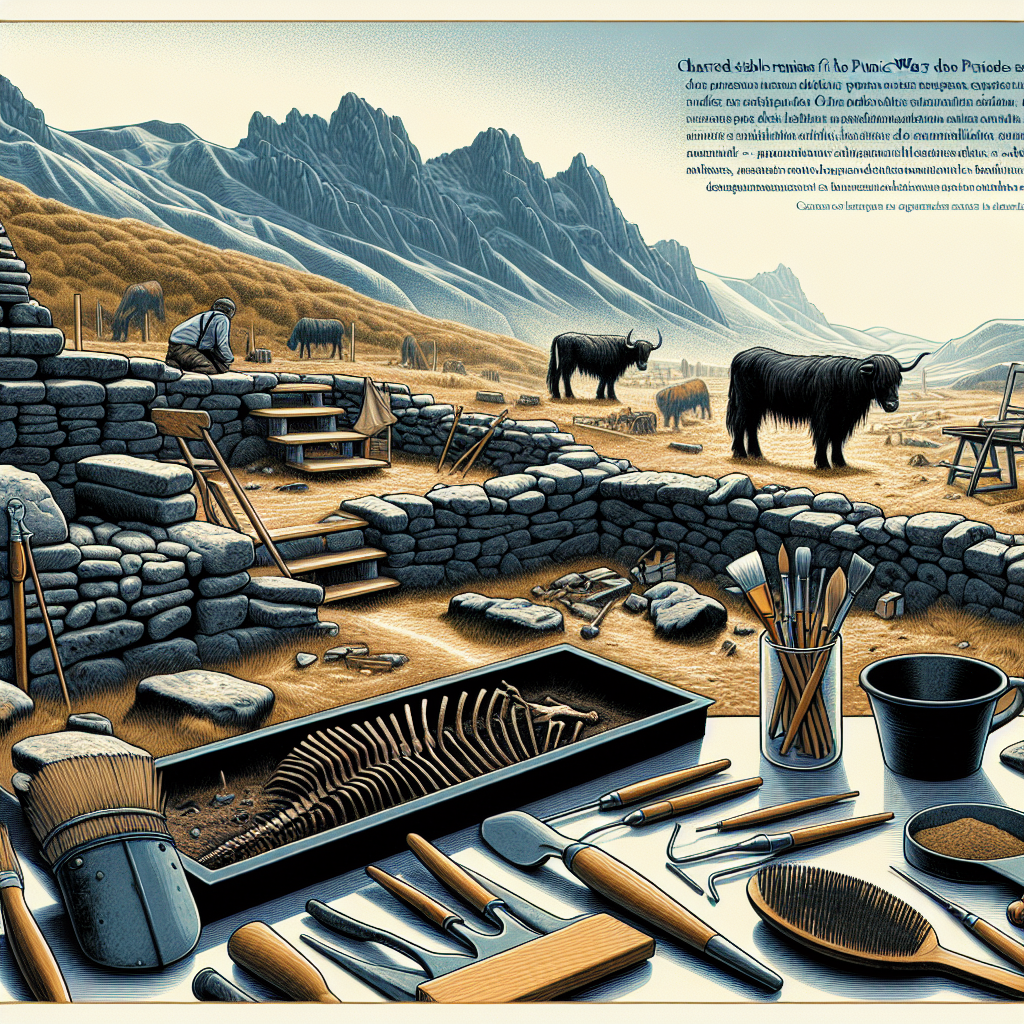
A research led by the UAB discovers the remains of six dead animals burned inside a stable in the Pyrenean village of Bellver de Cerdanya 2,200 years ago. Victims of a violent fire that may have been related to the passage of the Carthaginian army, the animals appeared along with some of the inhabitants’ valuables, such as a gold earring. The finding has made it possible to reconstruct the economic patterns of these inhabitants, with an important livestock breeding in which transhumance was practiced.
A research led by the UAB discovers the remains of six dead animals burned inside a stable in the Pyrenean village of Bellver de Cerdanya 2,200 years ago. Victims of a violent fire that may have been related to the passage of the Carthaginian army, the animals appeared along with some of the inhabitants’ valuables, such as a gold earring. The finding has made it possible to reconstruct the economic patterns of these inhabitants, with an important livestock breeding in which transhumance was practiced.
A research at the Tossal de Baltarga archaeological site, in Bellver de Cerdanya (Lleida Pyrenees), has brought to light the charred remains of a building, called Building G by archaeologists, burned by a fire 2,200 years ago, in the Iron Age. The building had two floors and the fire caused the roof, the support beams and the upper wooden floor to collapse.
The researchers, led by Oriol Olesti, lecturer of the Department of Antiquity and Middle Age Studies at the UAB, found the charred remains of a horse, four sheep and a goat, along with valuables such as an iron pickaxe and a gold earring concealed in a pot. From what researchers inferred, the upper floor appeared to have been divided into storage and textile production spaces. Numerous tools were found that could have been used for spinning and weaving the wool of the sheep and goats that lived on the lower floor, such as spindle whorls and loom weights. Archaeologists also found cereals such as oats and barley, and cooking vessels, with residues showing that the people using the building had been consuming milk and cheese and eating pork and lamb stews.
Findings show a complex economy
“The discovery has allowed us to reconstruct the economic patterns of these inhabitants, probably dedicated to transhumance”, explains Oriol Olesti. The isotope analysis indicates that some sheep had previously grazed in the lowland pastures, possibly by agreement with other communities.
“These mountain communities were not closed in the highlands, but connected with neighboring areas, exchanging products and, likely, cultural backgrounds,” said Olesti. The complex economy of these settlers, with farming, agriculture, forest management and mining activities, indicates “an Iron Age society adapted to their environment and taking advantage of their resources in the highlands. But it also shows their contact with other communities,” he adds.
The passing of Hannibal’s troops
The destruction of Tossal de Baltarga, which occupied a strategic position in the Pyrenees, could have been related to the passage of Hannibal’s army through this region to fight against the Romans during the Second Punic War. “The chronological precision in archaeology to speak of the Punic War is not enough to affirm this for sure,” says Oriol Olesti, “but we are very clear that it happened at that time in history.” He goes on to add that: “It is likely that the violent destruction of the site is related to this war. The general fire points to an anthropic destruction, intentional and very effective, since all the buildings on the site were destroyed. In an adjacent building we also found a burned dog.”
Tossal de Baltarga was a place of residence and lookout point for the Cerretani community with an important fortified settlement nearby, the Castellot de Bolvir. It seems to have lacked defensive walls, but had an excellent view over the river and the main travel routes. “These valleys were an important territory economically and strategically,” Olesti remarks. “We know that Hannibal crossed the Pyrenees fighting against local tribes, also probably against the Cerretani. Not many archaeological remains are preserved from this expedition, but Tossal de Baltarga is probably one of the best examples.”
A hidden gold earring
According to Olesti, “our reconstruction implies a sudden destruction, with no time to open the stall and save the animals”. “This could just be an unexpected local fire. But the presence of a hidden gold earring indicates the anticipation by the local people of some kind of threat, likely the arrival of an enemy. Also, the keeping of such a high number of animals in a little stall suggests the anticipation of a danger.”
Archaeologists do not know what became of the inhabitants of Tossal de Baltarga, but it was eventually reoccupied and used by the Romans. A part of the community likely survived the conflagration, and later lived alongside the Romans at the site. The most significant element of this new occupation is the impressive watchtower that remains at the site.
The research, published today in Frontiers in Environmental Archaeology, was led by Oriol Olesti, researcher of the UAB Department of Antiquity and Middle Age Studies, with the participation of Jordi Morera, Joan Oller and Jose M. Carrasco, researchers of the same department, as well as by researchers of the UAB Department of Prehistory Anna Berrocal, Oriol López Bultó, Laura Obea, Nadia Tarifa and Joaquim Sisa López de Pablo; Lídia Colominas, from the Catalan Institute of Classical Archaeology (ICAC-CERCA); Marta Portillo, from the Institució Milà i Fontanals of the CSIC; Paula Tàrrega, from the University of Heidelberg; and Chiara Messana, from the Catalan Institute of Human Palaeoecology and Social Evolution (IPHES-CERCA).
Journal
Frontiers in Environmental Archaeology
Method of Research
Observational study
Subject of Research
Not applicable
Article Title
The exploitation of mountain natural resources during the Iron Age in the Eastern Pyrenees: the case study of production unit G at Tossal de Baltarga (Bellver de Cerdanya, Lleida, Spain)
Article Publication Date
17-May-2024
Cite Scienmag News
Courtney Benton. (May 17, 2024). Charred stable remains from the Punic War period provide a glimpse into life in the Pyrenees in the Iron Age. Scienmag. https://scienmag.com/charred-stable-remains-from-the-punic-war-period-provide-a-glimpse-into-life-in-the-pyrenees-in-the-iron-age/
Courtney Benton. "Charred stable remains from the Punic War period provide a glimpse into life in the Pyrenees in the Iron Age." Scienmag, 17 May 2024, https://scienmag.com/charred-stable-remains-from-the-punic-war-period-provide-a-glimpse-into-life-in-the-pyrenees-in-the-iron-age/. Accessed 4 September 2026.
Courtney Benton. "Charred stable remains from the Punic War period provide a glimpse into life in the Pyrenees in the Iron Age." Scienmag. May 17, 2024. https://scienmag.com/charred-stable-remains-from-the-punic-war-period-provide-a-glimpse-into-life-in-the-pyrenees-in-the-iron-age/


