


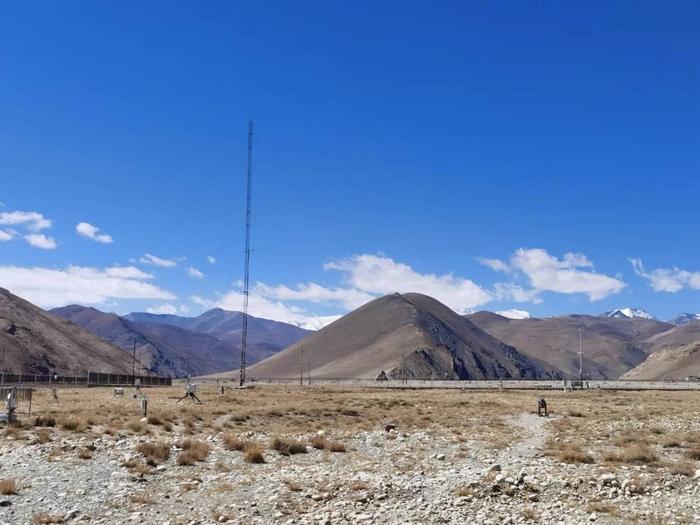
Under the background of global warming, the Mount Everest region has experienced evident climate changes. Glaciers and snow have been rapidly retreating in this region. These changes increase the rate of warming and water scarcity in downstream areas. The sensitivity and vulnerability of this region to climate variability make it an ideal long-term platform for monitoring the ongoing climate changes and the unique land–atmosphere interactions over high mountains.

Credit: Li Maoshan
Under the background of global warming, the Mount Everest region has experienced evident climate changes. Glaciers and snow have been rapidly retreating in this region. These changes increase the rate of warming and water scarcity in downstream areas. The sensitivity and vulnerability of this region to climate variability make it an ideal long-term platform for monitoring the ongoing climate changes and the unique land–atmosphere interactions over high mountains.
The distinct climate conditions present on the north and south slopes of Mount Everest, along with the complex underlying surface, result in notable variations in the two slopes’ surface energy flux patterns. Exploration of the differences and similarities in these surface energy flux variations on the north and south slopes of Mount Everest is of great significance for comprehending the process of land–atmosphere interaction on the Tibetan Plateau.
The research team of Professor Maoshan Li, has long been engaged in studying atmospheric boundary layer and land surface processes, cloud microphysical processes, and other related research directions. Within this context, the differences and similarities in the variations of atmospheric boundary layer processes between the north and south slopes of Mount Everest, and the underlying mechanisms involved, were studied recently by Professor Li’s team, the results of which have been published in Atmospheric and Oceanic Science Letters. Specifically, numerical modeling of the boundary layer was used for mechanistic analysis, and the results revealed some insightful understanding and interesting conclusions.
“To reflect the nature of the energy exchange between land and atmosphere over the area’s surface, a combination of satellite remote sensing or numerical modeling is required to extend the site observations in the region,” explains Professor Li.
The topographical Enhanced Surface Energy Balance System (TESEBS) model was employed to study the surface heat flux during monsoon and non-monsoon periods on the north and south slopes of Mount Everest using remote sensing and observational data.
In order to investigate the effect of albedo on surface heat flux, the simulation results of two satellite albedo products (MYD09GA and MCD43A3) were compared, and it was found that the MCD43A3 satellite data improved the surface albedo and made the simulation results more accurate.
Sensible heat fluxes increase with altitude on both the north and south slopes at high altitudes, while they increase with vegetation cover and canopy height at low altitudes. The latent heat flux of the south slope decreases with altitude, while the maximum latent heat flux of the north slope is at the southern margin. The maximum value of latent heat flux in the low-altitude region mainly appears on the south side of the central Himalayas, and the maximum value in the high-altitude region appears at the southwestern margin of Mount Everest. The seasonal changes in soil heat flux and net radiation are more obvious on the south than north slope.
“Changes in atmospheric circulation and hydrothermal conditions brought about by the monsoon’s onset will directly affect the distribution of surface heat fluxes on the north and south slopes”, concludes Professor Li.
With improvement in satellite sensor resolution and establishment of an observational network on Mount Everest, the plan is to further enhance comparative research on energy flux observations on the north and south slopes of the Himalayas, as doing so is of great significance for better understanding the similarities and their consequential impacts on weather and climate.
Journal
Atmospheric and Oceanic Science Letters
Cite Scienmag News
Sloane Callahan. (May 28, 2024). Changes in surface heat fluxes on Sensitive areas for global climate change – the north and south slopes of Mount Everest. Scienmag. https://scienmag.com/changes-in-surface-heat-fluxes-on-sensitive-areas-for-global-climate-change-the-north-and-south-slopes-of-mount-everest/
Sloane Callahan. "Changes in surface heat fluxes on Sensitive areas for global climate change – the north and south slopes of Mount Everest." Scienmag, 28 May 2024, https://scienmag.com/changes-in-surface-heat-fluxes-on-sensitive-areas-for-global-climate-change-the-north-and-south-slopes-of-mount-everest/. Accessed 4 September 2026.
Sloane Callahan. "Changes in surface heat fluxes on Sensitive areas for global climate change – the north and south slopes of Mount Everest." Scienmag. May 28, 2024. https://scienmag.com/changes-in-surface-heat-fluxes-on-sensitive-areas-for-global-climate-change-the-north-and-south-slopes-of-mount-everest/

