

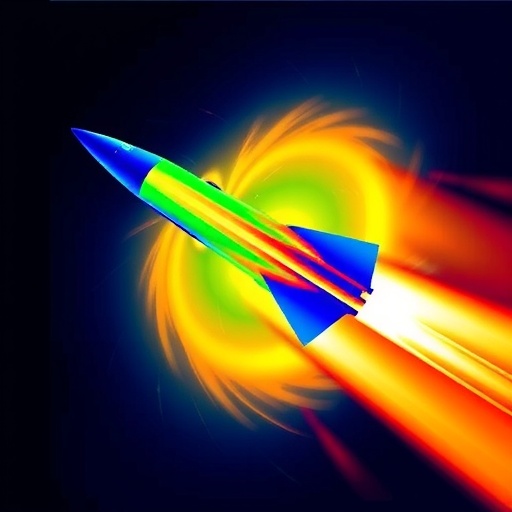
In an era where the exploration of space and atmospheric re-entry is rapidly advancing, understanding the complex flow characteristics over re-entry vehicles has become increasingly vital. A groundbreaking study conducted by researchers Arora, Srivastava, and Gairola sheds light on the hypersonic flow around spiked re-entry bodies equipped with counterflow jets—an investigation crucial for the development of future aerospace technologies. This analysis utilizes advanced computational fluid dynamics (CFD) techniques to decipher the intricate behaviors of airflow during high-speed re-entries, thus paving the way for innovations in vehicle design and safety.
As vehicles endeavor to return to Earth’s atmosphere at hypersonic speeds, they encounter extreme aerodynamic conditions. These conditions can result in significant challenges, including thermal stress and drag forces that could threaten the structural integrity of the vehicle. At hypersonic speeds, defined as speeds exceeding Mach 5, the dynamics of airflow differ drastically from subsonic or transonic regimes. This study focuses on these nuances, especially when spiked shapes are employed, which are known to affect shock wave formation and subsequent flow patterns.
The use of counterflow jets is another critical aspect examined in this research. Counterflow jets can enhance stability during the re-entry phase by mitigating the effects of high-temperature shockwaves and improving heat dissipation. The study highlights how these jets can influence the flow separation characteristics, ultimately aiding in reducing the thermal load on the vehicle surfaces. The synergy between the spiked geometries and the counterflow jets presents a formidable approach to enhancing re-entry vehicle performance.
Utilizing sophisticated CFD simulations, the researchers produced comprehensive data visualizations and flow field analyses. These simulations allow for detailed examination of pressure distributions and temperature gradients around the re-entry body. The findings indicate distinct variations in the flow characteristics when counterflow jets are introduced, leading to controlled thermal transfer rates and optimized aerodynamic profiles, which are essential for protecting sensitive components of the spacecraft during descent.
The significance of the research extends beyond theoretical models; it has profound implications for the design and engineering of future spacecraft. As aerospace missions become more ambitious, the need for re-entry vehicles that can withstand extreme conditions while maintaining functionality becomes paramount. This study provides a robust framework that engineers can leverage to innovate next-generation vehicles, making them safer and more efficient.
Moreover, the research underscores the importance of interdisciplinary collaboration in aerospace engineering. By integrating principles from fluid dynamics, thermodynamics, and material sciences, the authors have created a comprehensive perspective on hypersonic re-entry challenges. This holistic approach may inspire further studies and technological advancements that push the boundaries of current capabilities.
With the continual evolution of hypersonic technology, the outcomes from this research could influence a wide array of applications beyond mere spacecraft. The methodologies explored in this study may extend to ballistic missiles and high-speed aircraft, enhancing their operational efficiencies and safety margins. As nations race to develop advanced hypersonic capabilities, insights gained from this analysis will likely shape defense and aerospace strategies for years to come.
In addition to the immediate technical applications, the findings from this comparative analysis contribute to the growing body of literature on hypersonic flows. Academic institutions and research organizations can build upon these insights, engaging in experimental validations and further refinements that could lead to experimental breakthroughs in hypersonic aerodynamics. This cyclical relationship between research and application underscores the dynamic nature of scientific inquiry.
Furthermore, the timing of this research could not be more critical as space exploration initiatives accelerate worldwide. With multiple countries competing for leadership in space missions, understanding the complexities of atmospheric re-entry serves as a cornerstone for future endeavors. This study may very well influence policy decisions related to national aerospace programs, thereby impacting funding and developmental focus.
As one contemplates the future of hypersonic technology, it is essential to recognize that these advancements will not happen in isolation. Collaborative efforts across academia, industry, and governmental agencies will be necessary to harness the full potential of the insights gained through studies like that of Arora and colleagues. Integrating their findings into broader aerospace research initiatives will facilitate knowledge exchange and inspire innovative design practices.
The comprehensive nature of this research also sheds light on potential environmental implications. As aeronautical engineering evolves, so too must our awareness of sustainability practices. Understanding hypersonic flows could inform the development of greener technologies, minimizing the ecological footprint of future space and air travel. This consideration is increasingly vital in an age where climate change and environmental sustainability are paramount.
Lastly, as we move toward an era where air and space travel become more routine, the interaction of technological advancements with regulatory frameworks must also be considered. This study highlights the necessity for regulatory bodies to adapt and prepare for the implications of hypersonic travel, ensuring not only safety but also public assurance and environmental stewardship.
In conclusion, this comparative analysis by Arora, Srivastava, and Gairola represents a significant step forward in understanding hypersonic flow characteristics. Their work exemplifies the critical interplay between theoretical and applied research in aerospace engineering. Through continued advancements in CFD and aviation technologies, we may yet achieve a future where re-entry vehicles not only survive but excel in overcoming the challenges of hypersonic speeds. The implications of this research will resonate throughout various fields, marking a pivotal moment in the trajectory of aerospace exploration and technology.
Subject of Research: Hypersonic flow characteristics over spiked re-entry bodies with counterflow jets using CFD.
Article Title: Comparative analysis of hypersonic flow characteristics over spiked re-entry bodies with counterflow jets using CFD.
Article References:
Arora, D., Srivastava, S. & Gairola, S. Comparative analysis of hypersonic flow characteristics over spiked re-entry bodies with counterflow jets using CFD.
AS (2025). https://doi.org/10.1007/s42401-025-00405-6
Image Credits: AI Generated
DOI: 10.1007/s42401-025-00405-6
Keywords: Hypersonic flow, re-entry vehicles, counterflow jets, computational fluid dynamics, aerodynamic characteristics.


