


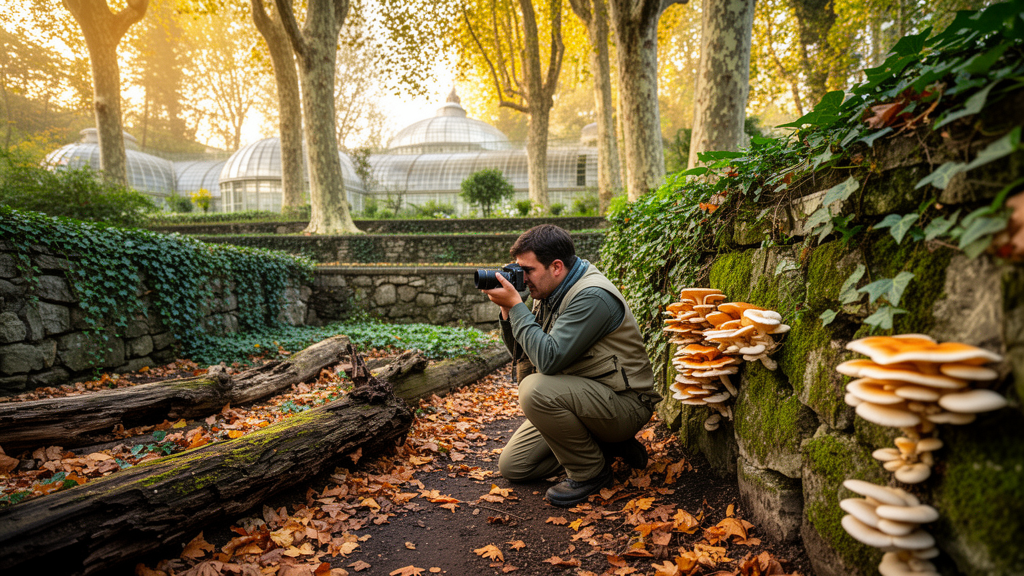
Beneath the cypress alleys and cedar plantations of the National Botanical Garden of Georgia, a quiet census has been underway. Mycologists compiling more than a century of records have produced the first complete list of large fungi ever assembled for the site, documenting 126 species of macromycetes from the beginning of the twentieth century to the present day. Among them are five species entirely new to the Georgian mycobiota, all collected during field surveys conducted between 2021 and 2024. The work, published in the journal Caucasiana, transforms scattered herbarium labels and obscure early publications into a single, coherent account of fungal life in one of Tbilisi’s oldest scientific institutions.
The National Botanical Garden of Georgia occupies a dramatic setting in the southeastern part of the capital, spilling across the lower reaches of the Tsavkisistskali Gorge, a right tributary of the Mtkvari River. The slopes of the Sololaki Ridge rise on the left bank and those of the Tabori Ridge on the right, both southeastern spurs of the Trialeti Range within the Lesser Caucasus mountain system. Elevations range from 435 to 662 meters above sea level, and the climate is dry continental, with hot summers, mild winters, an average annual temperature of 13 degrees Celsius and roughly 518 millimeters of precipitation. The terrain is rocky and thin-soiled, clothed in hemi-xerophyllous shrubs such as Spiraea hypericifolia, Atraphaxis caucasica and Paliurus spina-christi, with fragments of arid open woodland dominated by Celtis caucasica, steppe patches of Stipa capillata, and bare rocky outcrops.
Into this semi-arid landscape, generations of gardeners have planted a remarkable menagerie of foreign flora. The garden covers about 128 hectares and holds collection plots devoted to Himalayan, East Asian, North American, Mediterranean and West Georgian vegetation, alongside East Georgian trees and shrubs, pines, conifers, cedars, rare and endangered Caucasian plants, lilacs, herbaceous ornamentals and medicinal plants. There is an ethnobotanical display, a plant conservation plot, a historical arboretum, a Cypress Alley, a Bamboo Grove, a Rose Garden and a Garden of Cultivars. This mosaic of native shrubland and exotic plantations creates an unusually varied set of substrates and microhabitats for fungi, which helps explain the diversity the new inventory records.
The garden’s scientific credentials stretch back further than its plantings might suggest. In 1909, a mycological cabinet was established within the garden, dedicated to studying the fungal pathogens of agricultural plants. The earliest macromycete specimens collected on the grounds date to 1913 to 1915, gathered by pioneering botanists whose names still anchor the region’s literature. Yet despite this long history, no comprehensive mycological study of the garden had ever been conducted. Information on its macromycetes lay scattered across publications spanning from Voronov’s early twentieth-century reports through Soviet-era monographs to recent checklists, and across herbarium collections held in Tbilisi at the Institute of Botany of Ilia State University and the Georgian National Museum.
The new study set out to unify all of these sources. The researchers examined old literature records and herbarium specimens, then supplemented them with their own opportunistic field collections made during the non-winter seasons of 2021 through 2024. In the field, they recorded fruit bodies, habitats and substrates, photographing specimens with consumer digital cameras before moving to the laboratory. There, microscopic characters were examined with an Olympus CX31 light microscope and digital imaging equipment, using five percent potassium hydroxide as the mounting medium and potassium hydroxide and ammonia solutions for color reactions. Identification drew on classic regional works by Bondartsev and Melik-Khachatrian and colleagues, together with the modern illustrated guide by Læssøe and Petersen, while nomenclature follows Index Fungorum. Crucially, the authors did not attempt to re-validate the taxonomy of the older herbarium material, instead presenting historical records under their current names as a documented baseline.
The surveys proved remarkably productive. Fifty-five species were recorded during the 2021 to 2024 fieldwork alone, and five of these had never before been documented in Georgia: Lepiota pseudolilacea, Melanoleuca exscissa, Psilocybe coronilla, Entoloma politum and Gymnopus impudicus. Each represents a small but meaningful extension of the country’s known fungal diversity, and several were found in characteristic settings, such as Entoloma politum and Pluteus species fruiting on litter and soil in the riparian forest along the gorge, or Gymnopus impudicus emerging from soil and leaf litter in late spring. The five additions bring the garden’s total macromycete count to 126 species, a figure that includes everything from the earliest 1913 collections to the most recent finds.
The ecological profile of this community is strongly shaped by the garden’s dry, woody character. Of the 126 species, twelve percent belong to the phylum Ascomycota and eighty-eight percent to the Basidiomycota, the latter group including the familiar gilled mushrooms, boletes, puffballs and bracket fungi. Trophically, the assemblage is dominated by decomposers. Sixty-six percent of the species are saprotrophic, and within that group 47.6 percent live in soil, detritus or plant debris while 19 percent are associated with deadwood. A further 12.7 percent are wood decomposers, some of which may also act as parasites, while 16.7 percent form mycorrhizal partnerships with trees. True parasites account for only 0.8 percent, and the ecology of 2.4 percent of species remains undetermined, ambiguous between saprotrophic and mycorrhizal lifestyles.
Several entries in the compiled list stand out for their biology or rarity. Battarrea phalloides, the scaly stiltball, has appeared repeatedly over the years on soil near cedars, cypresses and pines, including along the garden’s avenue of Cupressus sempervirens, a striking desert-adapted fungus that raises its cap on a tall woody stalk. The earthstars Geastrum fornicatum, G. kotlabae and G. striatum, together with the rare many-mouthed Myriostoma coliforme, dot the soil beneath pines, yews and cedars. Wood-decay specialists tell their own story: Ganoderma australe on a log of Judas tree, Coriolopsis gallica on dead deciduous trees, Pyrofomes demidoffii on juniper, and the sulfur shelf Laetiporus sulphureus on wood. Historical records even include Serpula lacrymans, the dry rot fungus more often encountered in buildings than in the field, collected in 1938 and 1978.
The inventory also captures the garden’s role as a stage for introduced ecosystems. Species such as Marasmius wynneae were found in the Cedrus deodara plantation, Suillus granulatus was recorded in a plantation of the endemic Eldar pine, and Phallus hadriani, the dune stinkhorn, has been collected near cedars since 1913. Exotic trees like Ailanthus altissima and Fraxinus ornus, naturalized in the semi-arid habitats, host their own fungal associates, including Daldinia concentrica on Ailanthus stems. The interplay between native hemi-xerophytic vegetation and a century of ornamental plantings has thus produced a fungal community that is part Caucasus, part cosmopolitan, a living record of the garden’s horticultural history written in mycelium.
For the researchers, the value of the work lies as much in consolidation as in discovery. By linking every species to its habitat, substrate, collection date, herbarium of storage and literature source, the checklist turns a fragmented archive into a usable scientific resource, one that can be compared with future surveys as the climate warms and the garden’s plantings evolve. The five new national records demonstrate that even a well-trodden urban garden in the Caucasus biodiversity hotspot can still yield species never before documented in a country, provided someone looks closely at the soil, the litter and the rotting wood. A garden that began cataloging fungi in 1909 has, more than a century later, finally been given a complete account of its own mushrooms, and the list is almost certain to keep growing.
Subject of Research: Macromycete diversity of the National Botanical Garden of Georgia
Article Title: Macromycetes of the National Botanical Garden of Georgia: Revised data
Article References: Svanidze, E., Kvelashvili, A., Jorjadze, A., & Peikrishvili, K. (2025). Macromycetes of the National Botanical Garden of Georgia: Revised data. Caucasiana, 4, 125-136. https://doi.org/10.3897/caucasiana.4.e164636
Image Credits: AI Generated
DOI: 10.3897/caucasiana.4.e164636
Keywords: macromycetes, fungi, Georgia, Tbilisi, National Botanical Garden of Georgia, biodiversity inventory, mycobiota, new records, Basidiomycota, Ascomycota, Caucasus, herbarium
Cite Scienmag News
Roger Howard. (October 16, 2026). Century of Fungal Records Reveals 126 Species in Tbilisi’s Historic Botanical Garden. Scienmag. https://scienmag.com/century-of-fungal-records-reveals-126-species-in-tbilisis-historic-botanical-garden/
Roger Howard. "Century of Fungal Records Reveals 126 Species in Tbilisi’s Historic Botanical Garden." Scienmag, 16 October 2026, https://scienmag.com/century-of-fungal-records-reveals-126-species-in-tbilisis-historic-botanical-garden/. Accessed 16 October 2026.
Roger Howard. "Century of Fungal Records Reveals 126 Species in Tbilisi’s Historic Botanical Garden." Scienmag. October 16, 2026. https://scienmag.com/century-of-fungal-records-reveals-126-species-in-tbilisis-historic-botanical-garden/


