

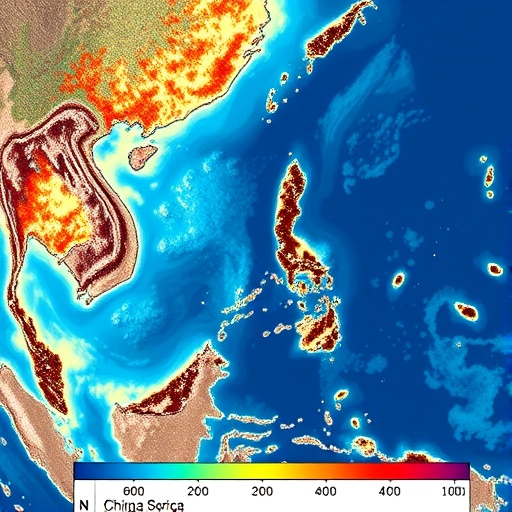
The South China Sea Throughflow (SCSTF) is a crucial component of the global oceanic system, acting as a key conduit for heat and freshwater exchange between the South China Sea (SCS) and the adjoining Pacific and Indian Oceans. This dynamic flow not only regulates the regional oceanographic properties, including heat and salt budgets, eddy activities, and marine biogeochemical cycles, but also significantly influences the Indonesian Throughflow (ITF) and broader climatic variability throughout the Indo-Pacific realm. Despite its importance, the long-term behavior of the SCSTF has remained elusive due to the scarcity of direct observational data, complicating efforts to fully understand how climate change might be reshaping this vital ocean current.
Recognizing this knowledge gap, a dedicated research team from the Institute of Oceanology of the Chinese Academy of Sciences (IOCAS) undertook an ambitious reconstruction of the SCSTF’s volume transport spanning nearly 130 years, from 1894 through 2022. This groundbreaking study provides the first continuous century-plus record of the SCSTF’s dynamic evolution, offering unprecedented insights into its historical variability and long-term trends. Published in the prestigious journal Science Advances on February 25, the findings shed new light on this ocean pathway’s critical role in climate regulation and regional marine ecosystems.
To achieve this reconstruction, researchers deployed an innovative multi-proxy approach centering on oxygen isotope ratios (δ¹⁸O) extracted from a Porites lobata coral core obtained off Palaui Island in the northeastern Philippines. This site sits within the direct influence of the Kuroshio Current, which serves as the primary inflow governing the SCSTF’s volume transport. To complement these paleoclimate signatures, satellite altimeter data spanning the modern observational era from 1993 to 2022 were incorporated, enabling a refined and continuous monthly record of Luzon Strait Transport (LST)—the metric quantifying water flow through the Luzon Strait, the principal gateway linking the Pacific Ocean and the South China Sea.
Analysis of the reconstructed dataset revealed a complex tapestry of variability within the SCSTF. Expected interannual fluctuations aligned closely with the El Niño–Southern Oscillation (ENSO), while decadal patterns echoed the well-known Pacific Decadal Oscillation (PDO). Beyond these established modes, however, the study uncovered a striking long-term decreasing trend in the transport volume, characterized by an average decline of approximately −0.14 ± 0.02 Sverdrups (Sv) per decade. Given that the mean volume transport over the entire period was 5.15 Sv, this trend culminates in a total reduction exceeding one-third of the flow—specifically, a withdrawal of 1.81 ± 0.26 Sv over the 129-year timeframe.
Crucially, the team applied the Time-Dependent Island Rule (TDIR) theoretical framework to identify the physical drivers underlying this pronounced slowdown. Their results implicate the century-scale intensification of trade winds in the tropical western Pacific as the predominant mechanism. In the context of global warming, the tropical Pacific has increasingly adopted a Cold Tongue Mode (CTM) configuration, which manifests as anomalous warming in the western Pacific and cooling in the eastern equatorial Pacific. Such a thermal gradient strengthens the western Pacific trade winds, generating negative wind stress curl anomalies in off-equatorial zones. These wind forcing anomalies excite downwelling Rossby waves, elevating sea levels to the east of the Philippines. The resultant anticyclonic circulation anomaly effectively curtails the intrusion of the Kuroshio Current into the South China Sea, thereby suppressing the SCSTF’s intensity.
The observed decline in SCSTF transport carries profound implications for oceanographic and ecological dynamics within the South China Sea basin. The researchers highlight that this reduction has lengthened the water renewal cycle in the South China Sea from approximately 2.6 decades to 3.5 decades, a shift that may alter the thermocline and halocline structures foundational to vertical ocean stratification. Consequently, the altered stratification is expected to reshape air–sea interactions critical to the East Asian monsoon’s behavior, potentially modifying regional climate patterns. Moreover, the attenuation of Kuroshio intrusion correlates with observed decreases in chlorophyll-a concentrations and phytoplankton growth rates, signaling threats to marine productivity and the health of fisheries that depend on these foundational trophic levels.
Importantly, the slowdown of the SCSTF might not only be an isolated regional phenomenon but part of a broader reconfiguration of Indo-Pacific basin-wide ocean circulation. By acting as a compensatory adjustment to the strengthening Indonesian Throughflow, the weakening SCSTF could influence large-scale inter-basin exchanges, with possible cascading effects on global ocean heat transport and carbon cycling. These findings underscore the necessity for integrated approaches that consider multiple throughflow pathways when projecting future climate and ocean ecosystem scenarios.
Beyond illuminating the past century’s trends, the study also opens fertile ground for future investigation into the feedbacks between ocean circulation changes and regional climate systems. The South China Sea’s enhanced retention time raises questions about how nutrient recycling, sediment transport, and biogeochemical fluxes might evolve, with cascading impacts on fisheries and coastal communities. Investigating the interplay between these physical changes and biological responses remains a vital area for multidisciplinary research, particularly as climate warming continues to accelerate.
In summarizing the significance of this work, lead author Nan Feng emphasized that their reconstruction offers an essential baseline for understanding the SCSTF’s historical dynamics and provides a critical foundation for anticipating its future behavior under ongoing climatic shifts. With the advent of increasingly sophisticated observational platforms and modeling tools, continued monitoring and analysis of the SCSTF will be indispensable for robust climate risk assessments and sustainable marine resource management in one of the world’s most ecologically and economically important maritime regions.
This landmark investigation represents a critical advance in oceanographic science by bridging the observational void spanning more than a century, revealing how climate-induced wind changes have systematically reshaped a major ocean current integral to the Indo-Pacific climate system. As future research builds on these findings, the evolving narrative of SCSTF variability will undoubtedly contribute to a clearer understanding of the complex ocean–atmosphere coupling processes that regulate Earth’s climate and marine ecosystems.
Subject of Research: Ocean circulation changes and climate variability related to the South China Sea Throughflow (SCSTF)
Article Title: Centennial-Scale Slowdown of the South China Sea Throughflow Driven by Strengthening Western Pacific Trade Winds
News Publication Date: February 25
Web References: http://dx.doi.org/10.1126/sciadv.aea9091
References: Published study in Science Advances, DOI 10.1126/sciadv.aea9091
Image Credits: Institute of Oceanology of the Chinese Academy of Sciences
Keywords: South China Sea Throughflow, SCSTF, Kuroshio Current, Luzon Strait Transport, Time-Dependent Island Rule, trade winds, Pacific Cold Tongue Mode, Rossby waves, ocean circulation, climate change, Indo-Pacific Oceanography, marine biogeochemistry


