

Monday, October 26, 2026
Science
No Result
View All Result
  • Login
  • HOME
  • SCIENCE NEWS
  • CONTACT US
  • HOME
  • SCIENCE NEWS
  • CONTACT US
No Result
View All Result
Scienmag
No Result
View All Result
Home Science News Psychology & Psychiatry

Central emotional faces speed automatic processing in EEG study

October 26, 2026
in Psychology & Psychiatry
Glenn Wilkins
By Glenn Wilkins Scienmag Editorial Profile - Clinical Psychology
Reading Time: 3 mins read
0
Central emotional faces speed automatic processing in EEG study

Central emotional faces speed automatic processing in EEG study

65
SHARES
587
VIEWS
Share on FacebookShare on Twitter
ADVERTISEMENT

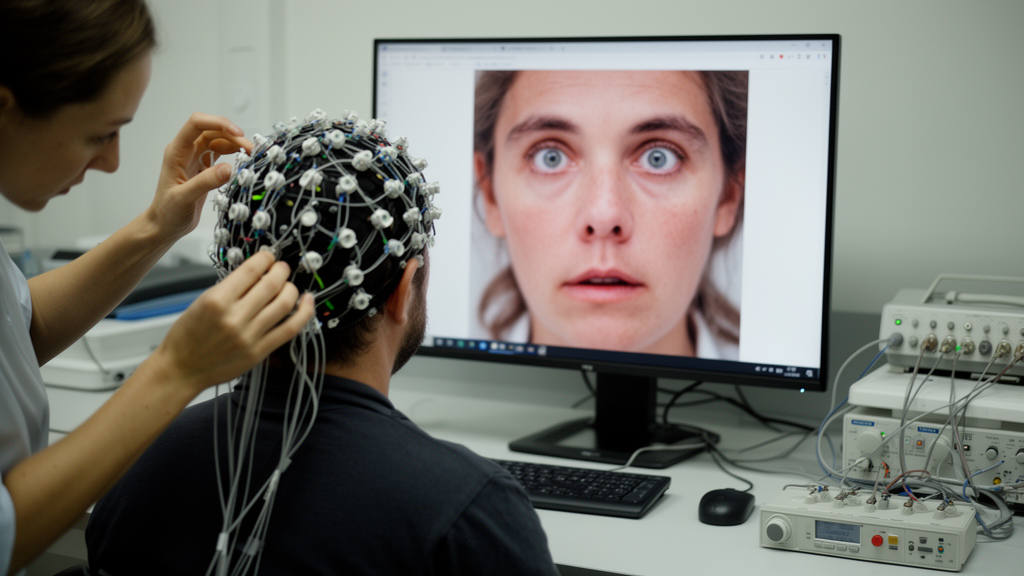
In three EEG experiments involving 48 college students, emotional faces placed at the center of a visual display appeared to accelerate the brain’s automatic response to surrounding expressions rather than simply amplify it. The study measured the visual mismatch negativity, or vMMN, a neural marker used to detect automatic changes in visual stimuli. Central emotional faces produced significantly earlier vMMN responses than central neutral faces, with no significant difference in response strength, according to the research published in BMC Psychology.

The experiments focused on how people process multiple facial expressions, a routine task that can help viewers identify emotional cues in complex social environments. Earlier behavioral work has found that faces in the central visual field contribute more strongly than peripheral faces when people explicitly judge an overall emotion, but it remained unclear whether central emotion has a special effect during faster, more automatic processing. The researchers addressed that question by arranging one central face with four surrounding faces and asking participants to perform tasks unrelated to judging their emotions. Across three experiments, the central emotion was associated with a shift in processing speed rather than a larger neural response.

Experiment 1 used a forward–reverse oddball design, which the researchers employed to control for physical differences among the stimuli. Twenty-four participants viewed displays containing one central face and four peripheral faces while making a central gender-detection judgment. The central face was either emotionally expressive—happy or surprised and congruent with the surrounding expressions—or neutral. Compared with the neutral condition, central emotional faces elicited an earlier vMMN latency, indicating that the change unfolded sooner. There was no significant difference in vMMN amplitude, the measure of response strength. This pattern led the team to describe the result as an acceleration effect of central emotion rather than an enhancement of the overall neural response.

The second experiment provided a single-face benchmark. Another 24 participants viewed isolated happy or surprised faces at fixation, without the surrounding ensemble of expressions. In this comparison, the multiple-facial-expression condition produced shorter vMMN latency than the single-emotional-face condition. The authors interpret this finding as evidence that the central face can influence the automatic processing of a broader expression ensemble. The result does not mean that viewers consciously recognized or judged the emotions more rapidly; instead, it concerns the timing of an automatic electrophysiological response measured while participants performed another visual task.

Experiment 3 tested whether the effect depended on the participants’ explicit gender judgment. The researchers replaced the central neutral face with a scrambled face and changed the task to detecting irrelevant colors, reducing demands associated with directly examining the central face. Twenty-four participants took part. The experiment replicated the earlier finding: displays with central emotional faces generated significantly earlier vMMN responses than displays with central scrambled faces. A consistent negativity bias also emerged across the experiments, with surprised faces producing earlier vMMN responses than happy faces. The authors characterized surprise as threat-related, but the supplied findings do not establish why the two emotional categories differed in timing. The study’s conclusions are also limited to the stimuli, college-student sample and experimental tasks used, so further work would be needed to determine how broadly the effect applies across people and emotional displays.

Subject of Research: EEG evidence that central emotional faces accelerate automatic processing of facial-expression ensembles

Article Title: Central facial emotion accelerates automatic processing of multiple facial expressions: An EEG study

Article References: Xiong, M., Ding, X., Hu, L., Liang, J., & Huang, Y. (2026). Central facial emotion accelerates automatic processing of multiple facial expressions: An EEG study. BMC Psychology. https://doi.org/10.1186/s40359-026-05505-2

Image Credits: AI Generated

DOI: 10.1186/s40359-026-05505-2

Keywords: EEG, facial expressions, automatic processing, visual mismatch negativity, central vision, emotion, neural timing, social perception, Central, facial, accelerates, automatic

Cite Scienmag News

Glenn Wilkins. (October 26, 2026). Central emotional faces speed automatic processing in EEG study. Scienmag. https://scienmag.com/central-emotional-faces-speed-automatic-processing-in-eeg-study/

Glenn Wilkins. "Central emotional faces speed automatic processing in EEG study." Scienmag, 26 October 2026, https://scienmag.com/central-emotional-faces-speed-automatic-processing-in-eeg-study/. Accessed 26 October 2026.

Glenn Wilkins. "Central emotional faces speed automatic processing in EEG study." Scienmag. October 26, 2026. https://scienmag.com/central-emotional-faces-speed-automatic-processing-in-eeg-study/


Tags: acceleratesautomaticautomatic brain responses to facial expressionsautomatic processingCentralcentral emotional face processingcentral visionEEGEEG neural markers of emotion recognitionEEG studies on facial emotion processingEmotionexperimental methods in emotion perception researchfacialfacial expressionsimpact of central emotional stimuli on visual cognitioninfluence of central versus peripheral faces on emotion detectionneural mechanisms of automatic emotion detectionneural timingneural timing differences in emotional face recognitionrapid neural processing of emotional cuessocial context effects on automatic visual processingsocial perceptionvisual mismatch negativityvisual mismatch negativity in social perception
Share26Tweet16
Previous Post

Gamified Nursing Assessment Linked to Higher Scores and More Stress

Next Post

CHARLS comparison finds persistent physician-recognition gap for probable depression in China

Related Posts

CHARLS comparison finds persistent physician-recognition gap for probable depression in China
Psychology & Psychiatry

CHARLS comparison finds persistent physician-recognition gap for probable depression in China

October 26, 2026
Scoping review separates meaning and purpose across retirement
Psychology & Psychiatry

Scoping review separates meaning and purpose across retirement

October 26, 2026
Randomized test: brief mindfulness alters state, not overall cognition
Psychology & Psychiatry

Randomized test: brief mindfulness alters state, not overall cognition

October 26, 2026
Cross-sectional study links metacognitive beliefs to emotional eating in adult obesity
Psychology & Psychiatry

Cross-sectional study links metacognitive beliefs to emotional eating in adult obesity

October 26, 2026
Performance-linked rewards shape cognitive effort in 30-person study
Psychology & Psychiatry

Performance-linked rewards shape cognitive effort in 30-person study

October 26, 2026
Survey links AI dependence to a peak in employee innovation
Psychology & Psychiatry

Survey links AI dependence to a peak in employee innovation

October 26, 2026
Next Post
CHARLS comparison finds persistent physician-recognition gap for probable depression in China

CHARLS comparison finds persistent physician-recognition gap for probable depression in China

  • Mothers who receive childcare support from maternal grandparents show more optimized

    Mothers who receive childcare support from maternal grandparents show more parental warmth, finds NTU Singapore study

    27656 shares
    Share 11059 Tweet 6912
  • University of Seville Breaks 120-Year-Old Mystery, Revises a Key Einstein Concept

    1061 shares
    Share 424 Tweet 265
  • Bee body mass, pathogens and local climate influence heat tolerance

    682 shares
    Share 273 Tweet 171
  • Researchers record first-ever images and data of a shark experiencing a boat strike

    546 shares
    Share 218 Tweet 137
  • Groundbreaking Clinical Trial Reveals Lubiprostone Enhances Kidney Function

    531 shares
    Share 212 Tweet 133
Science

Embark on a thrilling journey of discovery with Scienmag.com—your ultimate source for cutting-edge breakthroughs. Immerse yourself in a world where curiosity knows no limits and tomorrow’s possibilities become today’s reality!

RECENT NEWS

  • CHARLS comparison finds persistent physician-recognition gap for probable depression in China
  • Central emotional faces speed automatic processing in EEG study
  • Gamified Nursing Assessment Linked to Higher Scores and More Stress
  • Study finds parallel links between safety management and construction performance

Categories

  • Agriculture
  • Anthropology
  • Archaeology
  • Athmospheric
  • Biology
  • Biotechnology
  • Blog
  • Bussines
  • Cancer
  • Chemistry
  • Climate
  • Earth Science
  • Editorial Policy
  • Marine
  • Mathematics
  • Medicine
  • Pediatry
  • Policy
  • Psychology & Psychiatry
  • Science Education
  • Science News
  • Social Science
  • Space
  • Technology and Engineering

Subscribe to Blog via Email

Enter your email address to subscribe to this blog and receive notifications of new posts by email.

Join 5,151 other subscribers

© 2025 Scienmag - Science Magazine

Welcome Back!

Login to your account below

Forgotten Password?

Retrieve your password

Please enter your username or email address to reset your password.

Log In
No Result
View All Result
  • HOME
  • SCIENCE NEWS
  • CONTACT US

© 2025 Scienmag - Science Magazine

Discover more from Science

Subscribe now to keep reading and get access to the full archive.

Continue reading