Cement production is responsible for seven to eight percent of global carbon dioxide emissions, and roughly sixty percent of that total comes from a single unavoidable chemical step: the decomposition of limestone during clinker formation. That reaction releases carbon dioxide no matter how efficient the kiln or how clean the fuel, because calcium carbonate must break down at temperatures approaching 1450 degrees Celsius to supply the calcium oxide from which the clinker minerals alite and belite crystallise. Process optimisation and fuel switching can address perhaps forty percent of the sector’s emissions, but the remainder can only be tackled by rethinking the binder itself. A new review published in the journal Discover Concrete and Cement examines one of the most promising alternatives, limestone calcined clay cement, known as LC3, and argues that its success depends far less on the recipe than on the specific clay used to make it.
LC3 works through a chemical synergy rather than simple dilution. Calcined clay supplies reactive silica and, critically, reactive alumina; fine limestone supplies carbonate ions; and the clinker fraction supplies calcium hydroxide, or portlandite, along with the alkaline pore solution that makes secondary reactions possible. Together these react to form carboaluminate hydrates, hemicarboaluminate and monocarboaluminate, which are more thermodynamically stable under typical LC3 pore solution conditions than monosulphate. This pre-emptively locks aluminium into stable phases, refines the pore network, and consumes portlandite, producing a denser matrix with smaller, less connected pores than ordinary Portland cement at the same water-to-binder ratio.
The environmental arithmetic is substantial. A typical single-clinker Portland cement has a clinker ratio of about 0.95, and the global average had already fallen to roughly 0.65 to 0.67 by the mid-2010s through blended cements. LC3-50, the most widely studied composition, pushes the clinker ratio down to about 0.50, and independent reviews consistently report an associated 30 to 40 percent reduction in carbon dioxide emissions and a 25 to 30 percent reduction in production energy demand relative to ordinary Portland cement. Much of that saving comes from temperature: clay calcines at 500 to 800 degrees Celsius, far below the roughly 1450 degrees Celsius needed for clinker. One documented case study estimated that building a 768-metre bridge in Colombia with LC3 instead of ordinary Portland cement would avoid approximately 9,240 tonnes of carbon dioxide.
What complicates generalisation is that performance is clay-specific. The reactive alumina available after calcination depends on the original mineralogy, and kaolinite, illite, smectite and gibbsite respond differently to heat. Because reactivity is governed by how oxides are distributed across reactive and inert mineral phases and by the degree of calcination, two clays from adjacent deposits with near-identical bulk oxide analyses can differ markedly in behaviour, and two LC3 systems with the same nominal composition can set, strengthen and degrade differently. Kaolinite, with its weakly bonded 1:1 layer structure, disrupts readily between 500 and 700 degrees Celsius to form highly disordered metakaolin, the most reactive calcined product. Illite’s potassium-stabilised 2:1 structure dehydroxylates more slowly and incompletely, yielding moderate and variable reactivity, while smectites require very high temperatures for full amorphisation and risk sintering that permanently reduces reactivity.
Every clay has a calcination window, a range of conditions over which structural disorder is maximised without triggering recrystallisation. For kaolinite-rich clays this window spans roughly 550 to 750 degrees Celsius under typical residence times; outside it, incomplete dehydroxylation leaves residual crystallinity, or overheating drives the formation of spinel-type phases and eventually incipient mullite, both of which sharply reduce pozzolanic activity. Mixed clays are harder to optimise because different minerals respond to different temperature ranges, so tuning the process for one may over- or under-process another. Grinding fineness interacts with calcination as well: finer grinding increases reactive surface area and can partially compensate for moderate under-calcination, but it also raises water demand, a trade-off that must be resolved experimentally for each deposit.
The mechanical evidence is encouraging but conditional. All LC3 systems show lower three-day compressive strength than ordinary Portland cement controls at equivalent water-to-binder ratios, because pozzolanic reactions depend on portlandite that accumulates at a finite rate. The deficit narrows as secondary hydration proceeds, and at 28 days well-formulated LC3 systems using adequately activated clays at 50 to 60 percent clinker replacement achieve strengths comparable to ordinary Portland cement. A calcined clay-to-limestone ratio of about 2:1 has repeatedly performed well, and the review reports that a kaolinite content of about 40 percent is sufficient for LC3-50 to match plain Portland cement from about seven days onward. Below that threshold, strength falls progressively with replacement level: with a low-grade clay containing 17 percent kaolinite, LC3 mortars at 20, 30, 40 and 50 percent replacement trailed the control by 1.2, 4, 9.8 and 18 percent at 28 days. Above roughly 65 percent calcined kaolinite, pore refinement reaches a limit that inhibits further clinker reaction.
Durability results show a distinctive asymmetry. Published studies report chloride resistance improvements of 2 to 8 percentage points in strength retention after accelerated sodium chloride exposure, with the advantage scaling with the alumina content of the calcined clay, since carboaluminate phases chemically bind chloride ions into their interlayer structure. Under sulphate exposure the advantage is larger, at 5 to 10 percentage points, because LC3 chemistry does more than slow penetration. During normal hydration, reactive alumina is preferentially incorporated into stable carboaluminate phases rather than monosulphate, depleting the pool available for sulphate-induced ettringite formation, while reduced portlandite limits gypsum formation. The thermodynamic driving force for the expansive reactions that damage ordinary concrete is thereby chemically limited, a protection mechanism with no equivalent in conventional systems.
Carbonation is the critical trade-off. Atmospheric carbon dioxide reacts with calcium-bearing phases, primarily portlandite, lowering pore solution pH from above 13 to below 9 and destabilising the passive oxide film that protects reinforcing steel. Because the same pozzolanic reactions that improve chloride and sulphate resistance consume portlandite, LC3 has a smaller chemical buffer against pH reduction. Published studies document measurably higher carbonation depths in LC3 concretes than in ordinary Portland cement controls under equivalent exposure, particularly at higher replacement levels, and the effect is more pronounced in naturally exposed specimens than in accelerated tests. Notably, a modest 30 percent clinker replacement can outperform a reference cement under both exposure regimes, and a five-year natural exposure programme across 34 concretes in a tropical climate has produced a correlation model between accelerated and natural carbonation coefficients, offering a route to estimate 50-year carbonation depth from shorter tests. Multi-year sulphate and freeze-thaw data, by contrast, remain scarce.
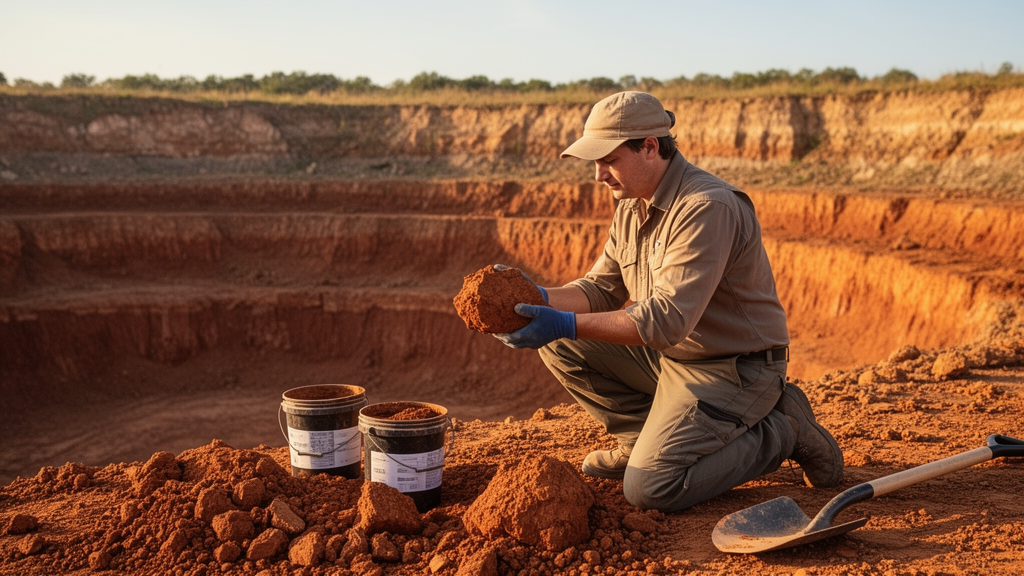
The review devotes particular attention to Ghana, a country with no domestic supply of fly ash or slag that imports clinker for most of its cement production. Its clay resources include tropical kaolinitic deposits and lithomargic clays underlying the bauxite ore at Awaso in the Western North Region, currently treated as mining waste. The Awaso clay forms a horizon more than eight metres thick, is dominated by kaolinite and gibbsite with little or no quartz, and has reported alumina contents of roughly 31 to 46 percent by weight, a compositional advantage for carboaluminate formation, though its elevated water demand pushes single-clay paste formulations outside acceptable consistency limits without admixtures. Because the clay underlies the ore rather than being consumed by mining, its physical supply does not deplete with the bauxite, though excavating it after mine closure would raise costs, and potential competing uses in aluminium sulphate and refractory production could constrain availability.
The authors identify four research gaps standing between demonstrated viability and reliable engineering design: quantitative processing–structure–property maps for mixed and low-grade clays, phase-level durability modelling under combined chemical attack, carbonation quantification over realistic service-life timescales, and composition-informed mix design frameworks that treat clay mineralogy, calcination state, limestone reactivity, gypsum content and water-to-binder ratio as first-order design variables. Their central message is that LC3 should be treated as an engineered composite rather than a prescriptive replacement level. Compositions that perform well with one clay deposit cannot be assumed to transfer to another, even within the same geological formation, so site-specific characterisation and performance testing must be the starting point for any regional LC3 programme.
Subject of Research: Processing, structure and property relationships in limestone calcined clay cement systems
Article Title: A review of processing structure and property relationships in limestone calcined clay cement systems with implications for locally sourced clays
Article References: Antwi, E. B., Andrews, A., & Adom-Asamoah, M. (2026). A review of processing structure and property relationships in limestone calcined clay cement systems with implications for locally sourced clays. Discover Concrete and Cement, 2(1), Article 87. https://doi.org/10.1007/s44416-026-00130-z
Image Credits: AI Generated
DOI: 10.1007/s44416-026-00130-z
Keywords: LC3, limestone calcined clay cement, calcined clay, clay mineralogy, carboaluminate, clinker substitution, carbonation, chloride resistance, sulphate resistance, Ghanaian clays, low-carbon cement, supplementary cementitious materials
Cite Scienmag News
Denise Maddox. (October 28, 2026). Cement’s next low-carbon fix may lie in locally dug clays. Scienmag. https://scienmag.com/cements-next-low-carbon-fix-may-lie-in-locally-dug-clays/
Denise Maddox. "Cement’s next low-carbon fix may lie in locally dug clays." Scienmag, 28 October 2026, https://scienmag.com/cements-next-low-carbon-fix-may-lie-in-locally-dug-clays/. Accessed 28 October 2026.
Denise Maddox. "Cement’s next low-carbon fix may lie in locally dug clays." Scienmag. October 28, 2026. https://scienmag.com/cements-next-low-carbon-fix-may-lie-in-locally-dug-clays/