


Concrete is the most-used human-made material on Earth, and the glue that holds most of it together, Portland cement, carries a heavy carbon footprint and a well-known list of chemical weaknesses. Now a team of European researchers has put a radical alternative through one of the most demanding durability trials yet attempted: a 100 percent cement-free ultra-high performance geopolymer concrete, tested head-to-head against a Portland cement-based ultra-high performance concrete (UHPC) in the laboratory and then left to fend for itself for twelve months in the Atlantic Ocean. The results, published in Case Studies in Construction Materials as part of the European NaturSea-PV project, show that the geopolymer can match its conventional rival in the sea while beating it in some of the harshest chemical environments a marine structure will ever face.
The geopolymer mix, designated GEO, is built from ground granulated blast-furnace slag and silica fume, activated by a sodium silicate and potassium hydroxide solution rather than by any Portland cement. It achieves a compressive strength of 152 megapascals, comfortably above the 120 megapascal threshold that defines the UHPC class, and incorporates 1.5 percent by volume of steel fibers. Its Portland cement reference, designated REF, reaches 165 megapascals. The two binders differ at the molecular level in a way that matters enormously for durability. Portland cement hardens into calcium silicate hydrate gel accompanied by portlandite, a calcium hydroxide phase that is notoriously vulnerable to acid dissolution and to the sulfate reactions that produce expansive ettringite crystals. The geopolymer instead forms a potassium-containing calcium aluminosilicate hydrate gel, C-(K)-A-S-H, in which portlandite is entirely absent. Quantitative X-ray diffraction of the hardened GEO binder confirmed the point: nearly 40 percent amorphous aluminosilicate gel, quartz and calcite as the main crystalline phases, and ettringite present only as a trace of about one percent by weight.
The laboratory program subjected prisms of both mixes to a year of immersion in five solutions: distilled water, five percent sodium sulfate, five percent magnesium sulfate, nitric acid held at pH 3, and a combined magnesium and sodium sulfate bath designed to mimic the cation pairing of real seawater, albeit at accelerated concentrations. The sodium sulfate results were striking. The Portland cement reference expanded by up to 0.16 percent, the classic signature of ettringite-driven sulfate attack, while the geopolymer actually contracted slightly, ending near minus 0.05 percent. With its aluminum locked into the gel structure and no monosulfoaluminate to react, the geopolymer simply lacks the raw material for the expansive reaction. Under nitric acid the story repeated itself: the geopolymer showed negligible dimensional change, whereas the reference swelled by more than 0.2 percent at its peak, consistent with acid attack on portlandite and the formation of secondary products.
But the trial also exposed a genuine vulnerability. In both magnesium-bearing solutions the geopolymer expanded beyond the 0.10 percent criterion that ASTM C1012 uses to flag sulfate-susceptible behavior, peaking at 0.29 percent in the combined bath, the condition most representative of seawater chemistry, where the reference actually contracted. The researchers attribute this to magnesium ions exchanging with calcium within the calcium-rich gel, destabilizing the binding phase, and to brucite precipitation at specimen surfaces. The lesson is precise: for this class of binder, magnesium rather than sulfate as such is the principal chemical enemy, a finding that gives future formulators a clear target, namely lowering the calcium content of the gel through partial substitution of the slag with fly ash or metakaolin.
Chloride resistance, the parameter that governs reinforcement corrosion in marine structures, told a more nuanced story. In the rapid chloride penetration test the geopolymer passed an average of 254 Coulombs, classified as very low penetrability, while the reference recorded 43 Coulombs, classified as negligible. Both sit far below the 1000 Coulomb boundary for low penetrability, and both are orders of magnitude better than the 2000 to 4000 Coulombs typical of ordinary structural concrete. The derived diffusion coefficients, around 6.9 times ten to the minus thirteen square meters per second for the geopolymer and 1.2 times ten to the minus thirteen for the reference, both fall in the characteristic UHPC range. The authors caution, however, that the test measures total ionic current, and the potassium-rich pore solution of the geopolymer conducts far more readily than a Portland cement pore solution, so the raw charge figures likely overstate the true gap in chloride transport between the two binders.
Electrical impedance spectroscopy provided a continuous, non-destructive window into the microstructure throughout the year. Monitoring the impedance of instrumented specimens across all exposure solutions, the team found that both materials showed steadily increasing bulk resistance over 365 days, a sign of continued pore refinement rather than degradation. The geopolymer’s impedance was essentially unaffected by sulfate solutions compared with the water control, while the reference showed reduced impedance in sodium sulfate, an early indicator of sulfate ingress into its pore network. Most intriguingly, in nitric acid the geopolymer’s impedance rose to the highest value of any specimen, suggesting that the acid selectively dissolves the most soluble surface phases and leaves behind a densified, protective aluminosilicate layer that impedes further attack.
Elevated temperature was the one arena where the geopolymer clearly lost ground. After heating to 600 degrees Celsius, the reference retained 90 percent of its ambient compressive strength, while the geopolymer dropped to 36 percent, a result the authors link to the calcium-rich gel behaving more like conventional hydrates than like the thermally robust, low-calcium gels of fly ash geopolymers, combined with a coarser pore network that permits steeper thermal gradients and microcracking. Yet the comparison carries an important caveat: at 600 and 900 degrees Celsius only a single reference specimen survived heating in testable condition, whereas every geopolymer specimen remained intact, with no explosive spalling even at 900 degrees, where the reference spalled severely. Since sustained exposure to 600 degrees is not a realistic offshore service condition, the finding defines a known limit of the formulation rather than a barrier to its intended use, and points to remedies such as pore refinement and hybrid fiber systems.
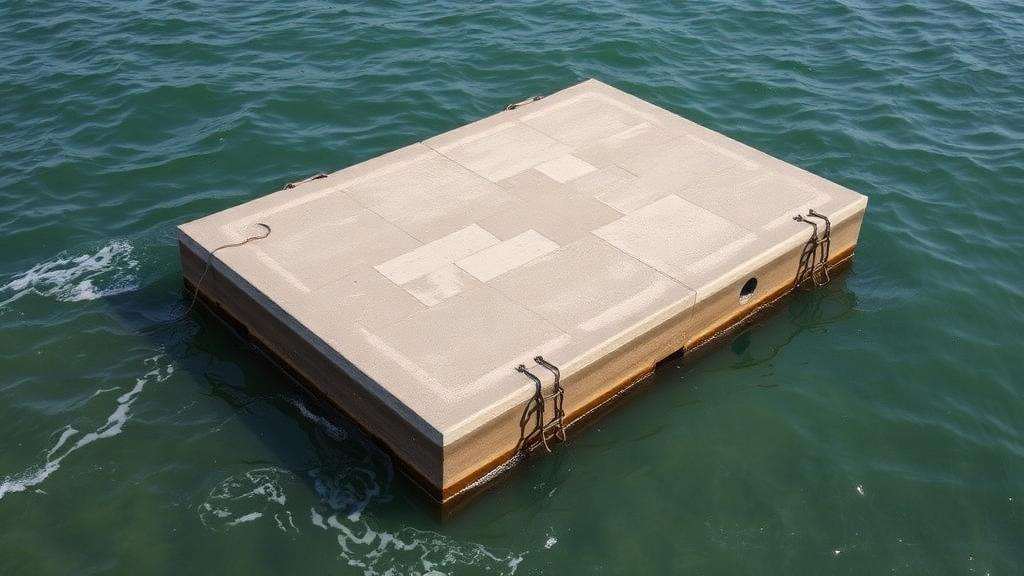
The decisive test came at HarshLab, a floating laboratory in the Cantabrian Sea operated by Tecnalia in Bilbao, Spain. Geopolymer prisms were deployed for twelve months across three exposure zones, atmospheric, splash, and fully immersed, some uncoated and some carrying bio-based coatings developed within the project for antifouling purposes. On retrieval, the material had lost nothing that matters. Flexural strength ranged from 14 to 17 megapascals across all groups, essentially unchanged from the 28-day reference value, and compressive strength remained between 150 and 167 megapascals, in several cases exceeding the original laboratory figure, apparently because continued geopolymerization in the moist marine environment offset any chemical degradation. Phenolphthalein spraying showed no carbonation anywhere, and silver nitrate colorimetry revealed no chloride penetration front even in permanently submerged specimens. Electrical resistivity after exposure, between 560 and 1610 ohm-meters, remained an order of magnitude above the threshold for negligible corrosion risk.
The convergence of independent indicators, mechanical retention, colorimetric evidence, and electrical resistivity, is what makes this study persuasive. Accelerated laboratory tests can exaggerate or misrepresent durability mechanisms, but here the field campaign confirmed the laboratory picture: the geopolymer sustained its full UHPC mechanical class through a year of real Atlantic service with no measurable transport-related degradation. The authors are candid about limitations, including the single production batch, the small number of specimens in some groups, the absence of pore-solution normalization in the impedance data, and the fact that the field campaign covered only the geopolymer, since the reference mix was assessed separately by a project partner. Twelve months is also short against the decades-long service life of an offshore structure, and the magnesium sensitivity observed in the laboratory remains microstructurally unverified.
Even so, the implications reach well beyond floating solar platforms, the immediate target of the NaturSea-PV project. Offshore photovoltaics need substructures that avoid land-use conflicts and benefit from water cooling of panels, but they demand concrete that can endure seawater, waves, and decades of chemical assault with a fraction of the embodied carbon of Portland cement. This study demonstrates that a geopolymer binder can deliver UHPC-class strength, proven marine durability, and clear advantages under sodium sulfate and acid exposure, while identifying magnesium sensitivity and high-temperature strength retention as the principal remaining weaknesses. With a patent application covering the exact formulation and follow-up work already mapped out, from lowering the gel’s calcium ratio to refining the pore structure, the cement-free concrete that spent a year in the Bay of Biscay and came back stronger may be one of the most credible routes yet toward genuinely sustainable marine infrastructure.
Subject of Research: Durability of a cement-free ultra-high performance geopolymer concrete compared with Portland cement UHPC under laboratory chemical exposure and real marine conditions
Article Title: Durability of a cement-free ultra-high performance geopolymer concrete: A laboratory comparison with Portland-cement UHPC validated by real marine exposure
Article References: Sleiman, Y., El Oifi, B., Martin, C., Saiyouri, N., & Sbartaï, Z. M. (2026). Durability of a cement-free ultra-high performance geopolymer concrete: A laboratory comparison with Portland-cement UHPC validated by real marine exposure. Case Studies in Construction Materials, 25, Article e06583. https://doi.org/10.1016/j.cscm.2026.e06583
Image Credits: AI Generated
DOI: 10.1016/j.cscm.2026.e06583
Keywords: geopolymer concrete, ultra-high performance concrete, marine durability, sulfate attack, chloride ingress, Portland cement, floating photovoltaics, alkali-activated materials, HarshLab, NaturSea-PV, electrical impedance spectroscopy, sustainable construction
Cite Scienmag News
Denise Maddox. (October 3, 2026). Cement-Free Geopolymer Concrete Survives a Year in the Sea, Challenging Portland Cement. Scienmag. https://scienmag.com/cement-free-geopolymer-concrete-survives-a-year-in-the-sea-challenging-portland-cement/
Denise Maddox. "Cement-Free Geopolymer Concrete Survives a Year in the Sea, Challenging Portland Cement." Scienmag, 3 October 2026, https://scienmag.com/cement-free-geopolymer-concrete-survives-a-year-in-the-sea-challenging-portland-cement/. Accessed 4 October 2026.
Denise Maddox. "Cement-Free Geopolymer Concrete Survives a Year in the Sea, Challenging Portland Cement." Scienmag. October 3, 2026. https://scienmag.com/cement-free-geopolymer-concrete-survives-a-year-in-the-sea-challenging-portland-cement/


